


Introduction
I used to spend hours on keyword research and still felt unsure about what to target. I would build long keyword lists, check volumes, and compare difficulty scores, but something was always missing.
As SERPs became more crowded and search intent less clear, keyword research started to feel slow and frustrating instead of strategic.
Traditional keyword tools still have their place, but I found they struggled when I needed to work at scale. Expanding keywords manually, grouping them into topics, and determining what truly mattered took far more time than it should have.
That was when I started looking at AI as a way to improve the process, not replace it.
What stood out to me was how AI could support the entire keyword research workflow. It helped me uncover new keyword ideas, expand related terms, cluster keywords by topic and intent, analyze search results, and prioritize opportunities more clearly.
Instead of doing everything by hand, I could focus more on making better decisions.
AI search traffic has surged dramatically, with LLM-driven sessions increasing by over 527% year-over-year, showing how quickly discovery patterns are emerging.
At Revv Growth, we see the same pattern with the teams we work with. When AI is used alongside a clear SEO strategy, keyword research becomes faster, cleaner, and easier to scale. It removes a lot of the manual work while keeping strategy and judgment where they belong.
Before diving into the step-by-step process, let’s take a moment to understand what AI keyword research is.
What Is AI Keyword Research?
AI keyword research is the process of using artificial intelligence and machine learning to discover, analyze, and organize the search terms people use in search engines.
Instead of relying only on manual brainstorming and basic keyword tools, AI evaluates massive datasets, including search behavior, language patterns, and SERP features, to identify keyword opportunities more intelligently and at scale.
AI keyword research understands semantic relationships between words, detects user intent, and uncovers long-tail and conversational queries that reflect how people actually search. It can also automatically cluster related keywords, predict performance potential, and prioritize terms based on relevance and business impact.
This shift is becoming increasingly important as search behavior evolves. Semrush projections suggest that AI-driven search traffic may surpass traditional search traffic by 2028, signaling a major change in how users discover information online.
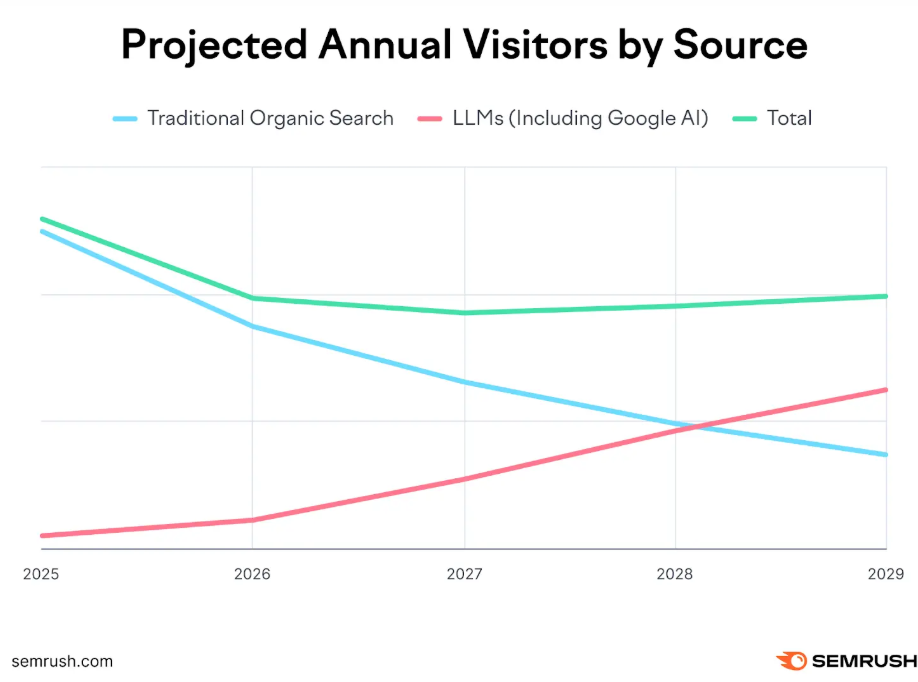
In that context, relying solely on traditional keyword research methods risks missing emerging query patterns shaped by AI assistants and conversational search experiences.
In short, AI keyword research turns what was once a slow, manual, and fragmented process into a faster, more strategic, and data-driven approach to building SEO and content strategies, one that’s better aligned with the future of search.
With that foundation in place, let’s explore the top benefits of using AI for keyword research.
Top Benefits of Using AI for Keyword Research
AI keyword research is not just about speed. The real value comes from how it improves clarity, structure, and decision-making. Here are some key benefits of using AI keyword research for better workflow:
- Faster keyword discovery with fewer inputs
Traditional keyword research often requires multiple tools, exports, and manual expansion. Even then, it is easy to miss opportunities.
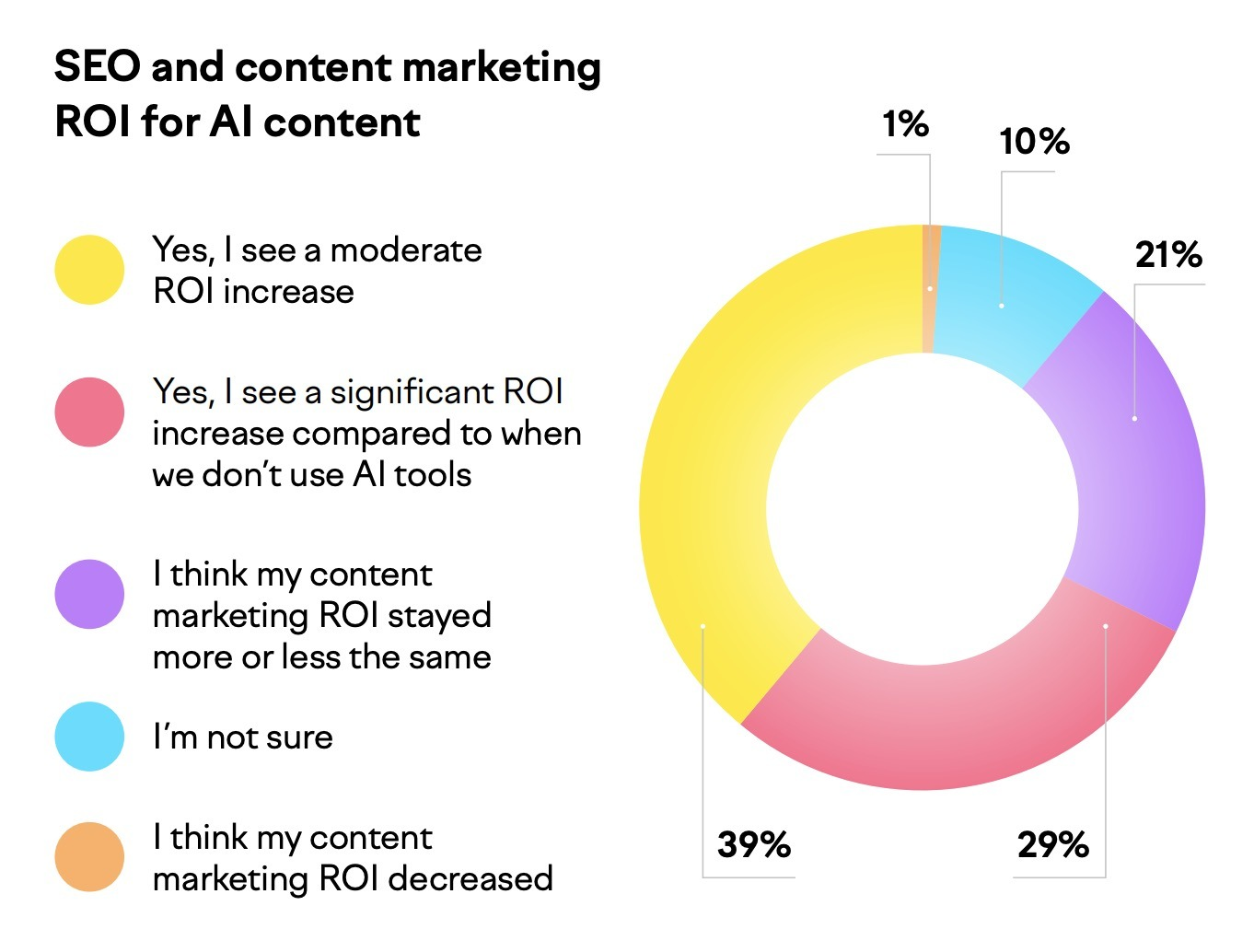
Almost 70% of businesses report higher ROI from using AI in SEO due to the increased speed and scale. AI eases the workflow by automating processes, leaving more time for the teams to concentrate on other important tasks.
2. Broader long tail and semantic keyword coverage
Finding long tail keywords manually is slow and inconsistent. Traditional tools often surface obvious variations but miss semantically related queries.
AI analyzes language patterns to uncover related phrases, questions, and variations that reflect how people actually search. This leads to deeper keyword coverage and stronger topical relevance.
3. Automatic keyword clustering by topic and intent
Manually grouping keywords is one of the most error-prone steps in keyword research. Guesswork often leads to weak clusters and overlapping content.
AI automatically groups keywords based on meaning and intent. This creates clear topic clusters and makes it easier to plan content without keyword cannibalization.
4. More accurate search intent classification
Search intent is not always obvious from a keyword alone. Traditional methods rely heavily on assumptions or basic labels.
AI evaluates patterns across keywords and SERPs to classify intent more accurately. Informational, commercial, and transactional queries are easier to identify, which helps align content with what users expect.
5. Better keyword prioritization
Many teams prioritize keywords based only on volume or difficulty, which can lead to wasted effort.
AI helps prioritize keywords by combining relevance, intent, and business value. This makes it easier to focus on opportunities that are more likely to drive meaningful results.
These benefits exist because AI goes beyond processing keywords. It helps teams understand demand, intent, and opportunity at a much deeper level.
Now let’s break this into a step-by-step process you can follow.
How to do Keyword Research Using AI: Step-by-Step Process
AI keyword research works best when it follows a clear process. Without structure, AI just produces more data. With structure, it helps you move from a rough idea to a clear, actionable content plan much faster than traditional methods.
This step-by-step approach shows how to use AI to find keywords, organize them, and decide what to work on first, without turning keyword research into a guessing game.
- Set Up Your AI Keyword Research Tool
Before generating keywords, define how your AI tool should think about your topic. AI works best when it’s given clear context. Without this, it may produce broad or low-intent ideas that don’t support real goals.
Start by clarifying:
- Main topic
- Target audience
- Goal (traffic, leads, authority, conversions)
- Content format (guide, comparison, landing page, etc.)
This setup determines the quality of everything that follows.

Example: How I Used This Step
Before writing this article, I defined my setup like this:
- Topic: AI keyword research
- Audience: SEO professionals and content marketers
- Goal: Create an MOFU educational guide
- Format: Long-form blog post
I also excluded basic “what is AI” queries to keep the output focused on an actionable keyword strategy.
How you can use it
Before running keyword expansion:
- Write one sentence defining your goal
- List your audience, funnel stage, and content type
- Add this context to your AI prompt
This simple step prevents noise, reduces irrelevant output, and makes every next step more effective.
2. Generate Seed Keywords and Variations
A seed keyword is a core topic or starting term you give to an AI tool to guide keyword expansion.
Instead of choosing seeds based only on volume, keep them:
- Specific
- Relevant
- Tied to business or content goals
Once seeds are defined, use AI to generate:
- Long-tail variations
- Related phrases and synonyms
- Common questions
- Alternative phrasings
- Adjacent subtopics
The goal here is coverage, not filtering.
How you can use it
- Choose 1–3 seed topics
- Generate broad keyword variations
- Save all relevant ideas
- Look for repeated themes rather than individual terms
By the end of this step, you should have a wide but relevant keyword list that reflects how people actually search, setting the foundation for intent analysis and clustering in the next steps.
3. Analyze Search Intent with AI
Not all keywords serve the same purpose. This step is about understanding why someone is searching for a term.
Use AI to classify keywords into:
- Informational
- Commercial
- Transactional
- Navigational
Correct intent alignment matters because rankings and conversions depend on how well your content matches what users expect.
For example, a keyword like “AI keyword research tools” signals commercial intent, while “how to do AI keyword research” is informational and better suited for a guide.
How to Use AI for Intent Analysis
Once you have your expanded keyword list, use AI to:
- Tag each keyword with an intent type
- Identify the funnel stage (TOFU, MOFU, BOFU)
- Highlight mixed-intent or ambiguous keywords
- Surface clusters dominated by the same intent
This quickly reveals which keywords align with your current content goal and which ones should be set aside.
How you can use it
- Ask AI to classify your keyword list by intent
- Remove keywords that don’t match your current goal or funnel stage
- Group keywords with the same dominant intent
- Flag ambiguous keywords for later review
By the end of this step, your keyword list should be cleaner, more focused, and clearly mapped to user intent, making clustering and prioritization much easier in the next steps.
4. Cluster Keywords into Topic Groups
Once your keyword list is cleaned and intent is defined, the next step is clustering. This is where keyword research shifts from individual terms to structured topics that can be turned into content.
Clustering means grouping keywords that belong on the same page because they support the same user goal. Each cluster should represent one clear topic that can realistically be covered in a single piece of content.
At this stage, keywords are no longer treated as standalone items. They are treated as signals that point to a shared intent and topic.
How to Cluster Keywords with AI
Use AI to group keywords based on:
- Semantic meaning
- Shared user intent
- Similar SERP behavior
- Overlapping subtopics
The objective is clarity. Each cluster should:
- Center around one clear topic
- Support a single, consistent intent
- Avoid overlap with other clusters
- Map cleanly to one content format
If a keyword feels like it belongs in multiple clusters, the boundaries between topics aren’t clear enough.
How I Used This Step
While planning content around emerging search trends, I used AI to cluster keywords into three main topical groups:
- AEO (Answer Engine Optimization)
- AI SEO
- GEO (Generative Engine Optimization)
Instead of treating everything as one broad “future of search” topic, AI grouped keywords based on semantic meaning and intent within each theme.
For example:
- The AEO cluster included subtopics like AEO tracking tools and best practices for answer engine optimization.
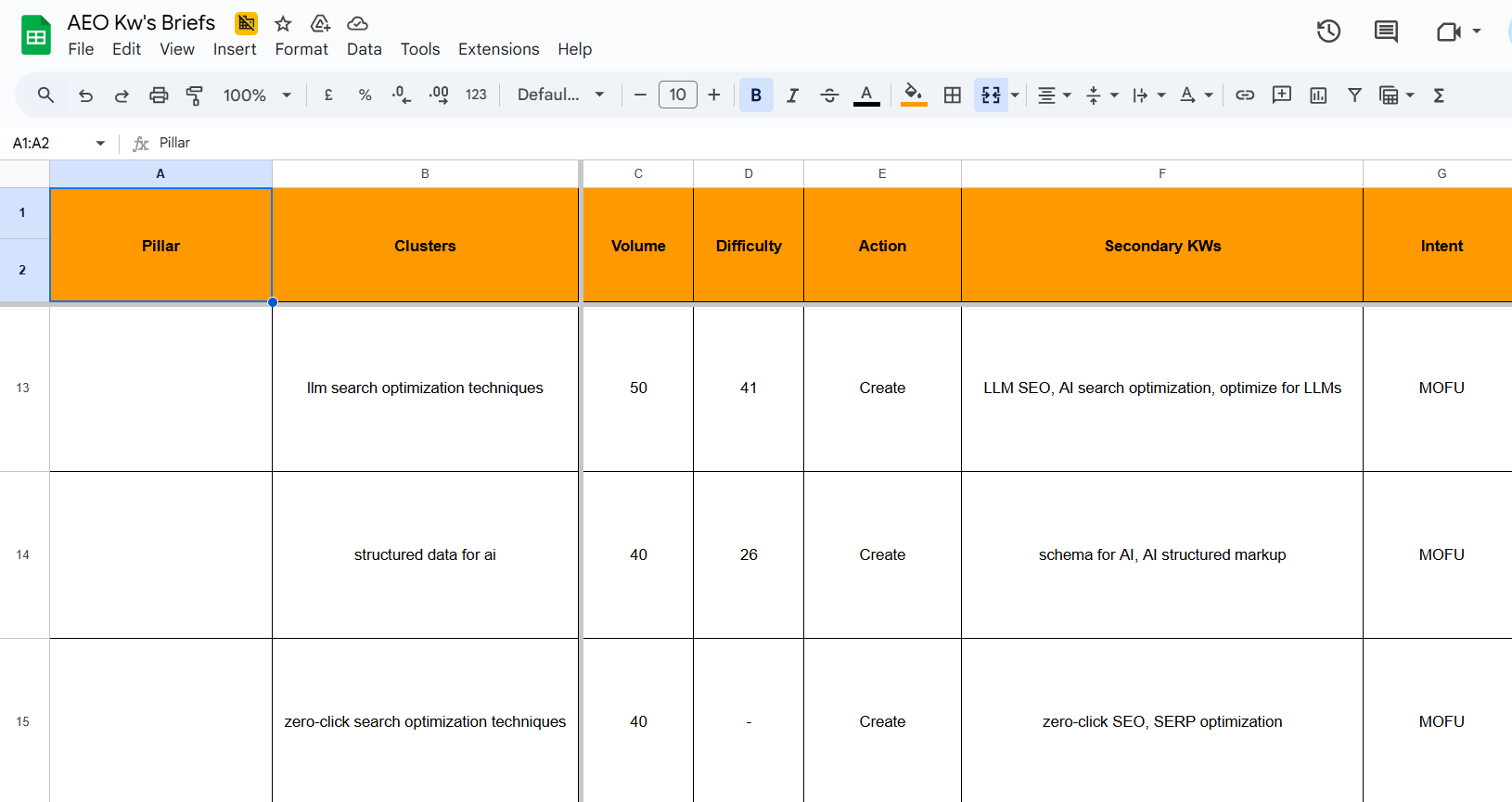
- The AI SEO cluster covered AI keyword research, SEO automation tools, and AI content optimization.
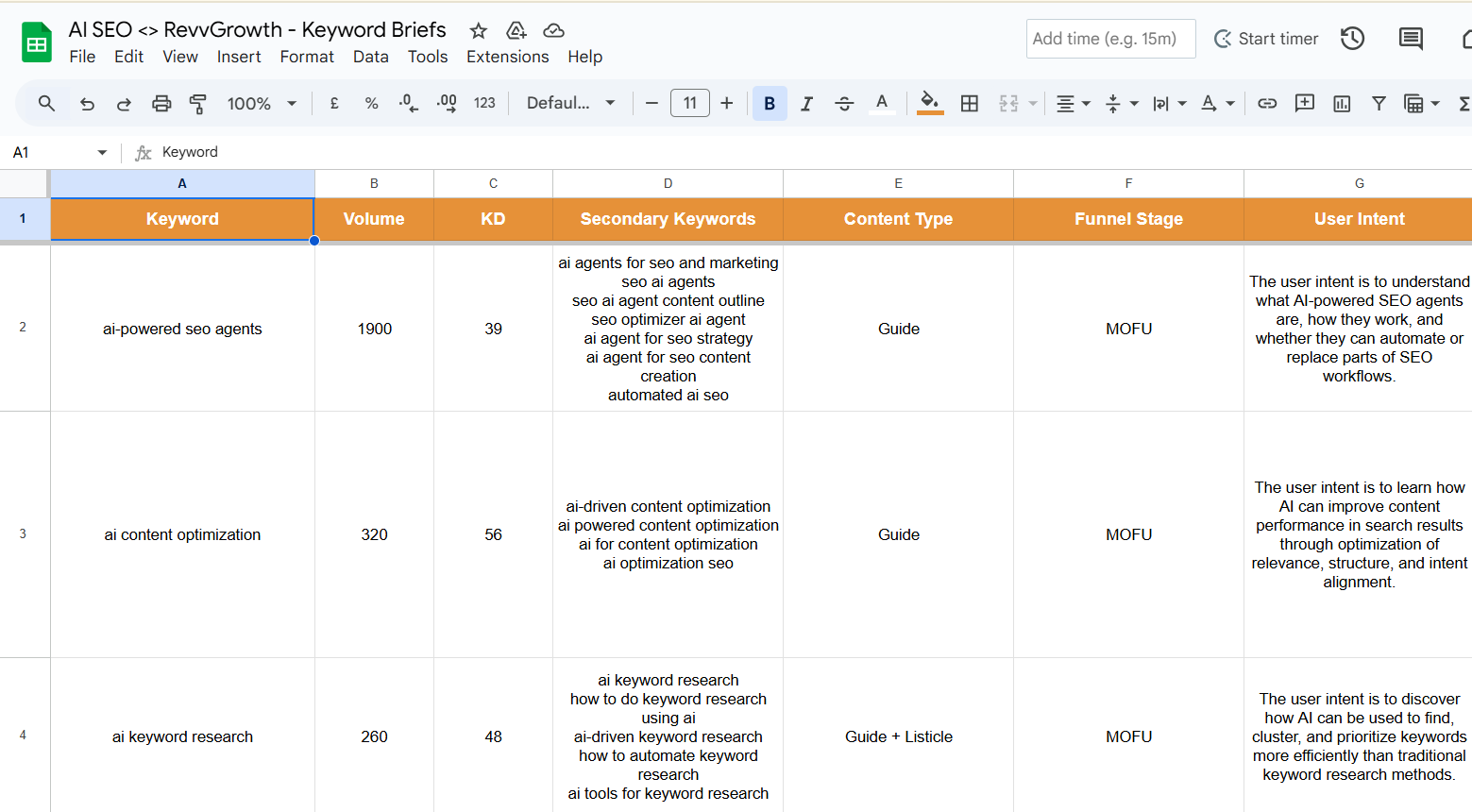
Each cluster represented a different content pillar with its own audience intent and funnel stage. This made it easy to build a structured content roadmap instead of writing scattered articles across overlapping topics.
How you can use it
- Ask AI to cluster your keyword list by topic and intent
- Review each cluster and remove keywords that don’t clearly belong
- Name each cluster in plain language (not as a list of keywords)
- Split any cluster that feels too broad into subtopics
By the end of this step, your keyword research should look like a structured content outline rather than a raw data dump.
5. Identify Low-Competition Opportunities
Not every keyword or cluster is worth targeting right away. This step is about finding opportunities where demand exists, but competition is still manageable, so your content has a realistic chance of ranking.
AI helps speed this up by analyzing competition patterns, SERP strength, and content gaps across large keyword sets instead of evaluating keywords one by one.
At this stage, evaluate your clusters and keywords using three core factors:
- Relevance
- Competition level
- Opportunity signals
For example, if the top results are thin blog posts from low-authority sites, that cluster is often a better opportunity than a high-volume keyword dominated by enterprise brands.
How to Use AI for This Step
Use AI and SEO tools to:
- Score keywords or clusters by difficulty and SERP strength
- Flag keywords with weak top-ranking pages
- Highlight clusters with high relevance and low competition
- Detect patterns across multiple keywords instead of judging them individually
The goal is not to find “easy” keywords in isolation, but to identify entire clusters that represent realistic, high-impact opportunities.
How you can use it
- Filter your clusters by relevance first
- Remove clusters that don’t support your current goal
- Prioritize clusters with low to medium competition
- Flag keywords with weak or outdated SERPs
- Create a short list of high-probability opportunities
By the end of this step, you should have a focused set of keyword clusters that are both valuable and achievable, setting the stage for final validation and prioritization in the next step.
Step 6: Validate and Prioritize Your Keywords
Before turning your keywords into content, it’s important to confirm that your top clusters match what search engines are actually ranking. Metrics alone can be misleading. Live SERPs show real intent, real competition, and real content expectations.
This step ensures your final keyword choices are not just data-driven, but search-reality aligned.
For each priority cluster or main keyword, check three things:
- Search intent
- Content format
- Competition strength
How to Use AI for This Step
Use AI to:
- Summarize SERP patterns across your top keywords
- Compare your planned content angle with ranking pages
- Flag intent mismatches or unrealistic targets
- Score clusters based on effort vs impact
This helps you prioritize intelligently instead of guessing.
How You Can Use It
- Search your main keyword from each priority cluster
- Review the top 5–10 ranking results
- Note the dominant intent and content format
- Identify repeated subtopics and angles
- Adjust your target keyword or page outline if needed
- Rank clusters by relevance, competition, and business value
By the end of this step, you should have a clear execution order so you know exactly what to work on first and why.
Once keyword clusters are validated and translated into clear content plans, the next question is not what to do, but what tools actually help you do it well.
Also read → LLM Search Optimization: 8 Techniques to Improve AI Rankings
Top AI Tools for Keyword Research
Most keyword research tools fail not because they are inaccurate, but because they are evaluated emotionally. Teams choose tools based on popularity, branding, or feature lists instead of understanding what problem each tool actually solves.
The right way to evaluate AI keyword tools is by category.
1. Keyword Generation and Expansion Tools
These tools take seed inputs and expand them using semantic similarity, language models, autocomplete data, and historical search behavior.
Examples of tools
- Ahrefs Keyword Generator
- Semrush Keyword Magic Tool
- Keyword Insights
- ChatGPT, when used with structured prompts
Strengths
- Rapid expansion from a single idea into hundreds or thousands of keyword variations
- Discovery of long-tail and question-based searches
- Useful for uncovering language users actually type, not just industry jargon
Limitations
- Large portions of output are repetitive or low intent
- Volume metrics can exaggerate opportunity
- Tools cannot determine which keywords are worth pursuing strategically
Best used when
You are defining topic boundaries, brainstorming angles, or exploring unfamiliar markets.
2. Clustering and Topical Mapping Tools
Instead of treating keywords as individual targets, these tools organize them into semantic clusters that reflect how search engines interpret topical relationships.
Examples of tools
Strengths
- Helps design content hubs and pillar pages
- Reduces keyword cannibalization
- Clarifies internal linking and content hierarchy
Limitations
- Clusters can be mathematically correct but strategically wrong
- Over-clustering can blur intent differences
- Output still requires human review and adjustment
Best used when
You are planning site architecture, scaling content, or reorganizing existing pages.
3. SERP and Intent Analysis Tools
These tools analyze live search results to infer intent from ranking pages, formats, and SERP features.
Examples of tools
- Ahrefs SERP Overview
- Semrush SERP Analysis
- SEO Minion
- Manual SERP review combined with AI summarization
Strengths
- Reveals dominant content formats such as guides, tools, or product pages
- Identifies intent mismatches before content creation
- Highlights SERP volatility and competitive saturation
Limitations
- Intent labels are often oversimplified
- Tools cannot explain why a page ranks
- Requires manual interpretation to avoid false conclusions
Best used when
Validating keywords before writing or diagnosing why existing content underperforms.
At this point, the difference between average and high-performing content is no longer the keywords, but how they are executed.
Final Thoughts
AI has changed how fast we can do keyword research, but it has not changed what actually drives results. We still win or lose based on relevance, intent alignment, and execution, not on how many tools we stack or how advanced the outputs look.
What I see consistently is this. Teams that use AI well treat it as a thinking partner. They use it to surface patterns, challenge assumptions, and move through analysis faster, while keeping humans firmly in charge of decisions. Teams that struggle hand over judgment too early and end up scaling the wrong work.
When AI supports strategy instead of replacing it, keyword research becomes clearer, more focused, and far easier to defend internally. You stop chasing numbers and start making decisions you can explain and stand behind.
If you want help building a keyword research system that truly connects content, intent, and growth, book a demo with us to see how we work with teams to turn AI-assisted research into strategies that drive real business outcomes.
.svg)


.webp)
.avif)