


.jpg)
Introduction
When I first started using AI for on-page SEO, I thought speed was the biggest win.
Pages were getting optimized faster. Titles, headings, and content updates took minutes instead of hours. On paper, it looked like progress. But after a few weeks, the results didn’t fully add up. Some pages improved slightly, some stayed flat, and a few even slipped in rankings.
That’s when I realized something important: using AI for on-page SEO isn’t the same as using it correctly.
Using AI might sound like a shortcut: feed it a keyword, optimize a few elements, and rankings will follow.
In reality, on-page SEO today is far more nuanced.
At Revv Growth, we use AI effectively to optimize on-page SEO by combining SERP analysis, intent matching, and structured workflows instead of relying on shortcuts or generic automation.
This guide breaks down that approach. You’ll learn what AI actually improves on a page, a practical framework for how to use AI for on-page SEO, how SEO teams apply it in real workflows, and the situations where AI can quietly damage your SEO if you’re not careful.
What Is On-Page SEO and How AI Fits into It
On-page SEO is the practice of optimizing elements on a webpage, such as content, headings, metadata, internal links, and structure, so search engines can understand it and users find it useful.
In modern SEO, on-page optimization works as a system, not a checklist. A strong page should:
- Match search intent
- Cover the topic with sufficient depth
- Use a clear, logical heading structure
- Link naturally to related pages
- Use compelling, accurate metadata
- Stay fresh and useful for readers
Where AI fits in:
AI doesn’t replace on-page SEO. It helps evaluate and improve it faster. By analyzing top-ranking pages, AI surfaces patterns in topics, headings, formats, and gaps that are hard to spot manually.
This is why adoption has grown quickly. Over 85% of SEO professionals now use AI in their workflows, mainly to speed up analysis and uncover optimization opportunities.
AI is especially effective at scaling, analysis, and handling repetitive optimization tasks. However, it can’t guarantee rankings, replace brand voice, verify facts, or build authority on its own. That’s why AI works best as a decision-support system, not an SEO autopilot.
Next, we’ll look at what AI actually improves on a page, so you can see where its impact is strongest and where it should be used more carefully.
What AI Actually Improves on a Page
One of the biggest misconceptions about AI in SEO is that it only helps with writing content. In reality, its real value shows up in how it improves specific on-page elements, the parts that directly influence rankings, readability, and click-through rates.
1. Titles and Meta Descriptions
AI tools make it easy to generate multiple titles and meta variations instead of settling for the first idea. They can also adjust tone based on your requirement, whether you want something formal, conversational, technical, or conversion-focused. This flexibility makes metadata optimization faster and more intentional rather than trial-and-error.
This matters because the #1 organic result captures roughly 27% of all clicks, making strong titles and descriptions critical even before ranking changes occur.
Example
When we used GPT to generate meta titles and descriptions for a CPQ Order blog for our client Everstage, we used a custom prompt with tone guidelines, character limits, and keyword rules. GPT produced multiple variations instantly, making it easy to pick the right direction and refine it.

2. Headings and Content Structure
AI is particularly helpful for improving how a page is organized. Instead of guessing which sections to add, AI tools analyze top-ranking pages and highlight missing subtopics, weak hierarchies, or unnecessary sections. This makes it easier to turn scattered headings into a clear, logical flow that both users and search engines can follow.
Example
At Revv Growth, while preparing a blog for our client OvalEdge, we first structured the headings manually based on their target audience and content goals. We then used a customized GPT prompt to validate the structure against top-ranking SERP pages.
This surfaced two missing sections and a few overly detailed H3s. We refined the hierarchy accordingly, keeping the client’s messaging intact while improving clarity, flow, and SERP alignment without rewriting the entire article.

3. Content Body Optimization
AI is especially effective at improving the main content of a page, particularly when sections feel thin, repetitive, or unclear. Instead of simply increasing word count, AI tools help identify missing supporting points, related entities, and semantic keywords that make the content more complete and aligned with user intent.
Example
In one of our client projects with Atlan, we used a customized AI prompt framework while updating an existing blog. Instead of manually reworking each section, the prompts helped us surface missing entities, refine weak paragraphs, and standardize structure in minutes.
This made the optimization process significantly faster and more efficient without compromising clarity.
4. Internal Linking
Internal links are often overlooked manually, but are easy for AI to analyze. AI tools can detect orphan pages, suggest contextual internal links, and recommend stronger anchor text. These adjustments strengthen crawl paths and distribute link equity more effectively across a site.
5. Image Alt Text and Accessibility
Beyond text content, AI can meaningfully improve accessibility by generating accurate, descriptive image alt text at scale.
Instead of writing alt text manually for every image, AI tools can analyze visuals and suggest descriptions that are both user-friendly and SEO-relevant. This helps screen-reader users understand images while also giving search engines clearer context about your visuals.
For example, tools like Cloudinary and ImageKit can automatically generate alt descriptions, categorize images, and even flag images that lack meaningful text. Many CMS platforms and DAM tools now also include built-in AI alt text suggestions.
6. Schema and Structured Data
AI can also assist with technical enhancements such as generating FAQ, HowTo, or Article schema. Structured data increases the chances of qualifying for rich results in search engines, which can improve visibility and click-through rates without changing the main content itself.
Example
For several of our blogs, we created a custom GPT prompt to automatically generate SEO-friendly FAQs from the main content. The prompt extracted key user questions, converted them into clear question–answer pairs, and formatted them in a way that could be easily mapped to the FAQ schema.
We then reviewed and refined the questions before implementing the markup, ensuring accuracy while significantly reducing manual effort.
Over time, we’ve built similar prompt systems to automate repetitive optimization tasks, things like metadata variations, semantic gap checks, and internal linking suggestions, while keeping the final review entirely human.
That balance is why many clients trust Revv Growth for content optimization and automation: the efficiency of AI, with the judgment and nuance that only manual editing can provide.
Knowing where AI adds value is only half the equation. The bigger difference comes from how you apply it.
The AIO Framework: A Smarter Way to Use AI for On-Page SEO
AI can make on-page SEO faster, but speed alone doesn’t guarantee better rankings. Many pages are rewritten or expanded without a clear process, which leads to inconsistent results.
Nearly 70% of businesses report better ROI from AI in SEO, but the gains are strongest when it’s used within a clear framework.
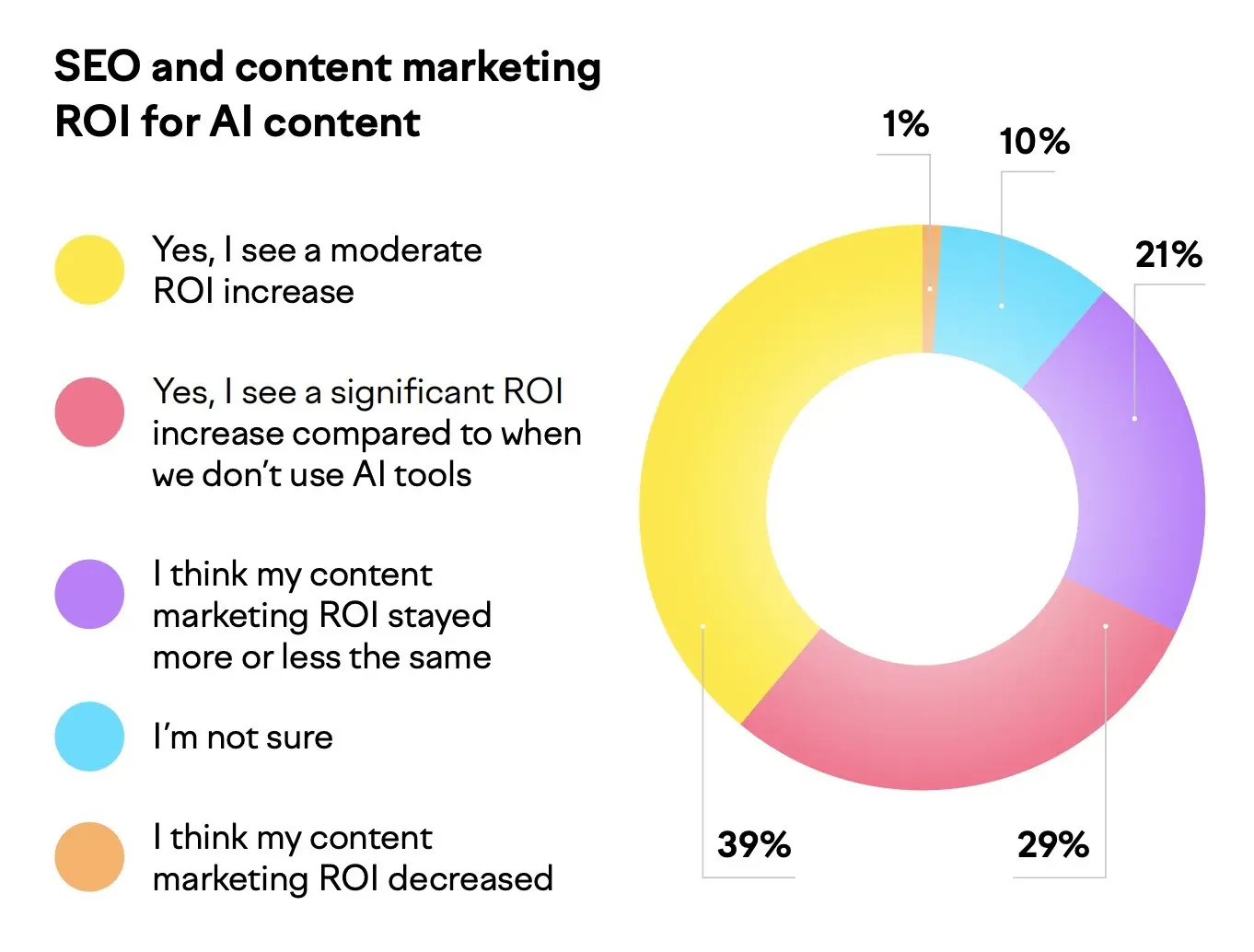
Source: Semrush
This is the idea behind the AIO Framework we use internally. AIO stands for: Analyze, Intent-Match, Optimize.
Instead of asking, “What can AI change on this page?” the framework focuses on “What does this page actually need?” keeping optimizations purposeful and intent-aligned rather than reactive.
The strength of AIO is its repeatability: the same three steps work for new content and refreshes alike, while human oversight remains critical for accuracy, brand voice, and E-E-A-T. To see how this works in practice, let’s start with Analyze.
1. Analyze
The first stage of the AIO Framework focuses on understanding the search patterns before making any changes. Instead of jumping straight into rewriting content, this step replaces guesswork with data.
In this phase, AI-powered SEO tools such as Surfer, Clearscope, or Frase are used to scan the search engine results page (SERP) for a target keyword.
They analyze top-ranking pages to reveal patterns that are hard to spot manually, common headings, average content depth, content formats, and frequently covered subtopics.
They also highlight keyword and topical gaps, showing what your page may be missing compared to competitors.
In practical terms, the Analyze phase helps answer questions such as:
- What content format is Google currently rewarding?
- Which subtopics appear consistently across top pages?
- Is the page too shallow or unnecessarily long?
- Are important entities or related terms missing?
A simple yet effective practice is to compare only the top 3–5 ranking pages rather than analyzing dozens. This keeps insights focused and prevents over-optimization.
By the end of this stage, you gain a clear picture of what actually needs improvement and what should remain unchanged. This prevents unnecessary edits and ensures the next steps are driven by real search data rather than intuition.
Once this is clear, the next step is aligning the page with what users actually expect, which is where Intent-Match comes in.
2. Intent-Match
After analyzing the SERP, the next step is asking a simple but often ignored question:
“If I searched this keyword myself, would this page actually satisfy me?”
Intent-Match is about aligning the page with the reason behind the search, not just the keyword.
At this stage:
- AI helps read SERP patterns, not write content
- It shows whether Google favors:
- step-by-step guides
- listicles
- comparisons
- tutorials
- product pages
- step-by-step guides
- The goal is not to copy competitors, but to understand the shape of content users expect
A useful rule of thumb here is: format before expansion.
Before adding more content, check whether:
- The structure matches intent
- A small change (e.g., a comparison table, FAQ, or step-by-step flow) would be more useful than more paragraphs
Often, subtle structural shifts (better headings, clearer flow, the right content format) improve relevance more than increasing word count.
By the end of this stage, the page isn’t just “optimized”. It’s contextually right for the searcher.
3. Optimize
With analysis done and intent aligned, the final step is targeted execution and not a full rewrite.
At this stage, AI acts as an execution assistant to:
- Refine titles and meta descriptions for clarity and CTR
- Strengthen thin sections with relevant examples or details
- Add contextual internal links to improve crawl paths
- Refresh outdated content so the page stays current
- Generate schema and image alt text quickly without manual coding
Key principles of AI-powered optimisation
- Precision over volume: Make a few high-impact improvements rather than many small edits to avoid over-optimization.
- AI suggests, humans validate: AI provides recommendations; humans ensure accuracy, tone, and brand fit.
- Trust over mechanics: Search engines favor content that feels natural and credible, not automated.
When done right, optimisation delivers:
- Better readability
- Stronger structure
- Fresher content
- Higher click potential
And because this follows Analyze → Intent-Match → Optimize, the process becomes repeatable, whether you’re updating one page or scaling across an entire site.
So how does this framework look in real life? The answer depends on who’s using it.
Also Read → AI-Powered SEO Agents for Automating Workflows
How the SEO Team Uses AI for On-Page SEO
When AI is used effectively, it doesn’t replace the SEO team. It extends their capacity. Instead of handling every task manually, teams use AI as a structured assistant across research, planning, optimization, and quality control. The difference lies in where and how it is applied, not just which tool is used.
- Research and SERP Analysis
The SEO workflow usually begins with understanding what already ranks. AI tools help teams scan the top search results for a target keyword and quickly extract patterns such as common headings, average content length, related entities, and frequently covered subtopics.
Without AI, this process can take hours of manual comparison. With AI, it becomes a focused review that highlights only the insights that matter. Strategists then decide which gaps are worth addressing and which competitor patterns should be ignored. This stage ensures the team starts with evidence rather than assumptions.
- Content Structuring and Outlines
Once research is complete, AI assists in shaping the content structure. Instead of starting with a blank page, writers receive an outline informed by SERP patterns and user intent signals.
Importantly, the outline is not copied directly from competitors. It acts as a directional guide that writers refine based on brand voice, audience needs, and internal linking opportunities. This approach reduces major rewrites later because the structure is aligned with expectations from the beginning.
- Optimization and Content Refresh
During publishing or update cycles, AI becomes a consistency tool. SEO teams commonly use it to:
- Generate multiple titles and meta descriptions
- Identify thin or repetitive sections
- Suggest contextual internal links
- Highlight outdated statistics or references
- Recommend semantic keywords and related entities
Rather than rewriting entire pages, teams focus on targeted improvements. This saves time while preventing over-optimization, which can occur when every section is expanded unnecessarily.
- Quality Checks and Technical Audits
Before publishing or reindexing, AI is often used as a final checkpoint. Automated audits can quickly detect issues such as duplicate metadata, missing image alt text, weak heading hierarchies, broken internal links, or low topical coverage.
These checks act as a safety net that complements manual reviews. Instead of relying solely on human memory or long checklists, the team uses AI to surface technical gaps in seconds.
- Human Oversight and Editorial Control
Despite automation, human input remains central. Editors review AI outputs for factual accuracy, tone consistency, and clarity. Strategists validate whether recommendations actually align with business goals and search intent. Brand or content leads ensure the page still sounds authentic rather than templated.
This balance prevents the two most common AI SEO mistakes: blind publishing and over-editing. AI accelerates execution, but people guide direction and final decisions.
- Repeatability and Scale
One of the biggest advantages of integrating AI into the SEO workflow is repeatability. The same process can be applied to a single blog post, a product page, or an entire content library without reinventing the system each time.
Over time, this creates a rhythm where research, structuring, optimization, and quality checks happen faster and more consistently. The team isn’t just producing more content. They are producing better-aligned, better-structured pages at scale, which leads to steadier ranking improvements rather than short-term spikes.
As powerful as AI is, it isn’t risk-free. Used incorrectly, it can actually hurt your SEO.
When AI Hurts SEO and How to Avoid It
AI can significantly improve on-page SEO, but it can also create problems when used without checks and balances. Understanding these risks doesn’t weaken your strategy; it actually strengthens it. The goal isn’t to avoid AI, but to use it with awareness so small mistakes don’t scale into larger ranking issues.
1. Over-Optimization Risks
One of the most common pitfalls is over-optimization. AI tools often try to “fully optimize” a page by adding more keywords, expanding every section, or rewriting headings repeatedly. The result can be unnatural keyword stuffing, bloated paragraphs, or awkward heading structures that feel mechanical rather than helpful.
Search engines increasingly reward clarity and usefulness, not density. When every paragraph tries to rank, the page usually becomes harder to read and less trustworthy for users.
2. Duplicate or Templated Content
AI outputs can sometimes sound repetitive, especially when similar prompts are used across multiple pages. This leads to templated introductions, identical phrasing, or predictable sentence patterns that reduce originality.
While this may not always trigger direct penalties, it weakens differentiation. Pages start to look interchangeable, which lowers perceived value for both users and search engines.
3. Hallucinated or Inaccurate Facts
AI can occasionally generate confident-sounding but incorrect information. These inaccuracies damage credibility and can directly impact E-E-A-T signals (Experience, Expertise, Authoritativeness, Trustworthiness).
Even a small factual error can reduce user trust. Over time, this affects engagement metrics and, indirectly, rankings.
4. Brand Voice Erosion
When AI is overused without editorial control, content can begin to sound generic. Unique tone, phrasing, and personality gradually disappear, replaced by safe but bland language. This doesn’t just affect branding; it also reduces memorability and audience connection.
5. YMYL and Sensitive Content Risks
For topics related to health, finance, or legal advice, often called “Your Money or Your Life” (YMYL) content, the margin for error is extremely small. AI-generated inaccuracies in these areas can have real-world consequences. Search engines apply stricter quality expectations to these pages, making human expertise and verification essential.
Guardrails and Prevention Strategies
The safest way to use AI in SEO is to treat it as an assistant, not an autopilot. A few consistent practices can prevent most issues:
- Always human-edit AI outputs: Ensures clarity, accuracy, and natural flow before anything goes live.
- Lock brand voice guidelines: Keeps tone, terminology, and messaging consistent across all pages.
- Fact-check statistics and claims: Prevents misinformation that can damage trust and E-E-A-T.
- Limit keyword density: Avoids unnatural phrasing and over-optimization signals.
- Use plagiarism or originality tools: Helps maintain uniqueness and avoid templated content issues.
- Monitor performance after updates: Quickly detects ranking or engagement drops caused by changes.
When these guardrails are in place, AI becomes a multiplier for quality instead of a source of risk. The difference isn’t the tool, it’s the level of oversight and intention behind how it’s used.
Conclusion: Is AI On-Page SEO Worth It?
AI doesn’t replace an on-page SEO strategy. It simply makes execution faster and more consistent. Its real strength isn’t automation for the sake of speed; it’s helping with analysis, intent alignment, and optimization while humans still control direction, accuracy, and brand voice.
If there’s one idea to remember, it’s this: analyze first, match intent next, optimize last. When AI is used within a structure like the AIO Framework, improvements become repeatable instead of random. Without a system, AI often just ends up scaling the same mistakes faster.
AI is especially useful if you’re handling multiple pages, whether you’re an agency running audits, a SaaS team updating feature pages, an ecommerce store refining product listings, or a blogger trying to keep content fresh. But it’s not risk-free. A little human oversight is what turns speed into real advantage.
So, a simple, low-risk way to start?
Pick one existing page, run it through the AIO Framework, and watch what changes. Check rankings, clicks, and engagement before scaling anything.
And if you decide you’d like expert input along the way, Revv Growth offers support ranging from quick audits to structured on-page optimization.
.svg)


.webp)
.avif)