


Introduction
Last month, I reviewed a client’s content performance report that looked impressive at first glance; multiple page-one rankings, strong keyword visibility, and steady impressions.
But when we dug deeper, the picture changed. Readers were leaving quickly, clicks were inconsistent, and very few visitors were converting. Their content was easy for Google to find, but hard for people to trust.
That experience reflects a broader shift in SEO. The game is no longer about keyword checklists or chasing rankings. It’s about creating content that genuinely serves search intent, feels clear to read, and answers real questions.
Research from McKinsey's 2023 State of AI report shows that organizations that scale AI effectively are three times more likely to report significant value from it, a signal that smarter use of AI is now a competitive advantage in marketing and content.
AI content optimization now sits at the center of this shift, helping brands refine relevance, improve structure, and align with how users actually search.
If you want to apply this approach systematically, Revv Growth can help you build an AI-first content strategy that improves real performance, not just rankings.
To understand how this works, let’s first clarify what AI content optimisation actually means.
What is AI Content Optimization?
AI content optimization refers to the use of artificial intelligence to improve content relevance, structure, and intent alignment by analyzing SERPs, user behavior, and semantic patterns, rather than relying only on keywords.
In simple terms, traditional SEO asked, “Did we use the right keywords?”
AI content optimization asks, “Did we answer the right question in the right way?”
That shift changes how content is created, measured, and improved.
At a practical level, AI helps you get three things right before you publish:
- What to say
- How to structure it
- Who it is for
Instead of guessing, AI studies top-ranking pages, identifies patterns in how users engage with them, and highlights gaps competitors leave open. The result is content that is easier for readers to understand and easier for search engines to interpret.
How AI-driven content optimization is different from traditional SEO
Traditional SEO was largely checklist-driven: keyword placement, word count, backlinks, and meta tags. These still matter, but they don’t guarantee results if the content misses what users actually want.
AI-driven optimization starts with meaning, not mechanics. It looks at how Google interprets queries and how top pages organize their answers. As a result, content becomes better structured, more complete, and more aligned with real user needs.
This shift from keywords to meaning naturally brings us to the most important factor in modern SEO: intent.
Why intent matters more than keywords
The same search: “AI content optimisation” can signal very different needs:
- Learning the concept (informational)
- Comparing tools (commercial)
- Evaluating agencies (transactional)
If your content answers the wrong intent, it may still rank, but readers will leave quickly, engagement drops, and conversions suffer.
AI reduces this risk by reading intent patterns directly from SERPs and suggesting the best format (guide, comparison, or framework) before you write. The goal is tight alignment between the query, your content, and user expectations.
At Revv Growth, we treat intent as the starting point for every piece of content optimisation, not an afterthought.
Why AI is Changing Content Optimization for SEO
Every search query carries a deeper story about what users want. AI is helping SEO teams read that story more clearly, turning raw data into actionable insights that shape smarter content optimization.
From keywords to semantics
Matching a string of words used to be the focus, but modern search engines reward how well content addresses real user questions and intent. Content designed around topic depth and semantic relevance earns better visibility because it aligns with how people actually think and search.
Pages optimized for context and user needs also benefit from how result pages are structured today. The first organic position alone captures roughly 39.8% of clicks, making thorough, relevant content even more valuable for earning attention.
From static to continuously optimized content
Content performance isn’t fixed once published. As search behavior shifts, particularly with AI-generated answers and features, pages must evolve to maintain or improve visibility.
Search features such as AI overviews, snippets, and zero-click results now appear so often that around 58-60% of Google searches end without an external click, meaning users find what they want directly on the result page itself.
This trend means teams need to refine and expand content continuously, not just when traffic drops.
From rankings to real performance
Ranking high is valuable, but what happens after discovery matters more for real business impact. High rankings that don’t lead to engagement or conversions don’t move the needle.
Engagement, measured through metrics like time on page, scroll depth, and repeat visits, signals that content meets user expectations. Outcomes like lead generation or sales show that content is doing more than just attracting clicks.
With organic search still dominating traffic opportunities, creating content that keeps users engaged and drives action is essential.
This performance-first mindset is what shapes how Revv Growth applies AI in its content optimisation process, which we’ll look at next.
How AI Content Optimization Works: Revv Growth’s Approach
When I talk about AI in content, I’m not talking about a tool that writes your blog and walks away. At Revv Growth, AI is more like a smart co-pilot. It surfaces insights, tests assumptions, and helps us move faster, while humans still make the final calls on tone, accuracy, and brand voice.
Think of this process as a loop, not a straight line: we research, optimize, publish, learn from the results, and then refine again. That’s what makes the work consistently better over time.
Here’s how that plays out in practice.
Step 1: AI-Based SERP & Intent Analysis
We begin by understanding the competitive space before creating anything new.
Instead of manually comparing dozens of ranking pages, we use AI to analyze the outlines of top-performing blogs. It helps us quickly see patterns in what competitors cover and, more importantly, what they don’t. This surfaces content gaps, weak sections, and opportunities to add real value.
For example, while working on our “Generative AI in Marketing” blog at Revv Growth, we began by analyzing the pages that ranked at the top of Google.
We then used custom GPT prompts to summarize how leading pages were structured and to identify areas where their coverage was shallow or incomplete.


AI-powered SWOT analysis helped us pinpoint content gaps and prioritize what to address in our BOFU blog. It also surfaced strategic recommendations that guided our narrative and structure from the outset.

These insights shaped our content direction early on, allowing us to move beyond simply replicating what already ranks and instead create something more useful, differentiated, and actionable for our audience.
Once intent is clear, the next step is organizing that knowledge into a strong content plan.
Step 2: Semantic Mapping and Content Planning
Once we understand intent, we move from individual keywords to meaningful themes.
Instead of treating each keyword separately, we use AI to group related ideas into topic clusters. This helps us see how concepts connect, where competitors have gaps, and where we might accidentally overlap with our own content.
For example, rather than treating ideas in isolation, we often group topics under core clusters like AI SEO, AEO, ABM, and many more. This helps us look at optimisation not just from a ranking perspective, but also from how content appears in AI answers and across generative search experiences.
AI then helps us build a smarter outline, one that mirrors how Google understands the topic, not just how we think it should be structured. The result is content that feels complete, logical, and easier for both readers and search engines to follow.
With a clear plan in place, we move to structuring the content so it’s easy to read and understand.
Step 3: AI-Assisted Content Structuring
We begin by creating a baseline structure manually, mapping key sections, logical flow, and how ideas should connect for the reader. This gives the content a human-first backbone and ensures the narrative makes sense before any AI refinement.
Once that foundation is ready, we use custom GPT prompts to fine-tune the structure so it aligns more closely with what performs well in the SERP. AI helps us refine heading hierarchy, tighten transitions, and adjust section placement based on patterns seen in top-ranking content.
This hybrid approach keeps the content:
- easy to read for users,
- logically organized, and
- aligned with how search engines interpret strong pages.
AI provides the scaffolding; we retain control over clarity, tone, and brand voice.
With the structure in place, the next step is to fine-tune the content for both traditional search results and AI-powered answers.
Step 4: Optimization for SERP + AI Overviews
Once the structure is locked, we refine the content so it performs well in both traditional search results and AI-powered answers.
This isn’t about rewriting everything. It’s about precision edits in the right places. We focus on how information is presented, how questions are framed, and how easily search engines (and AI systems) can extract key points.
The goal is not just to rank but to be present wherever users are getting answers today: featured snippets, People Also Ask boxes, and AI-generated responses.
For example, while structuring a blog on the benefits of data lineage for our client, Atlan, we used AI to identify high-potential featured snippet opportunities and built dedicated sections around them, which improved its visibility in both traditional SERPs and AI Overviews.
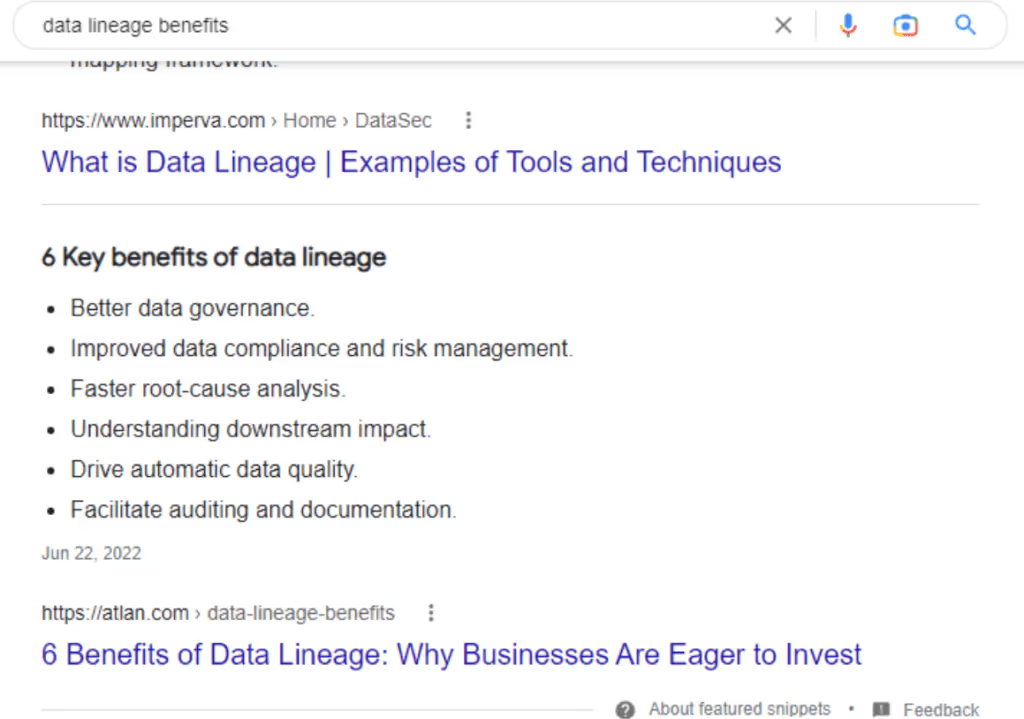
This step ensures content is both reader-friendly and machine-friendly for modern search systems.
With the content optimised, we move into measuring performance and refining it over time.
Step 5: Measurement and Continuous Improvement
Once the content is live, our work doesn’t stop. It actually gets more data-driven.
We track how the page performs in the real world. Using tools like Google Search Console, Google Analytics 4 (GA4), Ahrefs, and Semrush, we monitor:
- Click-through rate (CTR)
- Dwell time and engagement
- Organic traffic trends
- Conversions or goal completions
- Changes in SERP features or intent
AI then helps us interpret this data faster and more effectively. Instead of guessing what needs fixing, it surfaces:
- Sections that need clearer explanations
- New questions users are asking
- Missing subtopics that should be added
- Opportunities to strengthen featured snippets
- Structural tweaks that could improve readability
For fast-moving topics like AI or generative search, we revisit content regularly rather than treating it as “finished.” Small, precise updates often deliver better results than massive rewrites.
Optimisation is an ongoing process that evolves with real user behavior and changing search results.
AI Optimization SEO Framework
Instead of treating optimisation as a checklist, we follow a simple, repeatable cycle that keeps content relevant, useful, and high-performing over time:
Research → Optimize → Publish → Measure → Improve.
This framework keeps strategy grounded in data while still allowing room for human judgment and creativity.
1. Research
We start by understanding the landscape before creating anything new. This includes:
- Analyzing SERPs to see what already ranks
- Mapping user intent behind key queries
- Benchmarking competitors to identify content gaps
AI helps speed up this phase by summarizing patterns across top pages and surfacing opportunities we might otherwise miss.
2. Optimize
Once we know what to build, we refine how we build it. This stage focuses on:
- Clear content structure and logical flow
- Semantic relevance and topic depth
- Readability and scannability
- Strong on-page SEO fundamentals
Here, AI acts as a second layer of intelligence, suggesting improvements while humans validate tone, accuracy, and brand alignment.
3. Publish
When the content is ready, we ensure it is positioned for maximum impact on the site. This includes:
- Strategic internal linking to related pages
- Placement within relevant topic hubs or pillar pages
- Ensuring metadata aligns with user intent and SERP expectations
The goal is not just to publish, but to integrate the piece meaningfully into the broader content ecosystem.
4. Measure
After launch, we shift into performance mode. Using tools like Google Search Console, GA4, Ahrefs, and SEMrush, we track:
- Rankings and visibility
- Click-through rate (CTR)
- Engagement signals
- Conversion outcomes
This step tells us whether our assumptions were correct and where we need to adjust.
5. Improve
Finally, we close the loop by refining content based on real results. AI helps us:
- Identify weak sections
- Spot new questions users are asking
- Add missing subtopics
- Strengthen snippet opportunities
Instead of rewriting everything, we focus on high-impact improvements that move the needle.
This framework works best because it rests on five core components of AI-driven optimisation, which we’ll break down next.
Core Components of AI-Driven Content Optimization
The framework works because it is built on five foundational elements. These are the qualities that separate content that merely ranks from content that truly performs.
1. Intent Alignment
Every strong piece of content starts with a clear understanding of what the user wants.
Intent alignment means your content matches the reason behind the search, not just the words typed into Google. If someone is looking for a guide, you shouldn’t give them a sales page. If they want a comparison, you shouldn’t give them a definition.
AI helps here by analyzing SERP patterns and predicting the format and depth users expect. When intent is aligned, engagement naturally improves.
2. Semantic Relevance
Modern search is about meaning, not just keywords.
Semantic relevance ensures your content covers related concepts that users and search engines expect. Instead of repeating one phrase, you build a rich, connected narrative around the topic.
AI supports this by identifying related themes, missing subtopics, and common patterns across top-ranking pages, helping you create more comprehensive and coherent content.
3. Content Depth
Depth doesn’t mean length. It means completeness.
High-performing content answers real questions thoroughly rather than skimming the surface. It anticipates follow-up questions and provides clear explanations.
AI helps highlight where content feels shallow and suggests areas that need more detail, examples, or clarification. The result is content that feels genuinely helpful, not generic.
4. Readability
Even the best ideas fail if they are hard to read.
Readability focuses on:
- Short paragraphs
- Clear headings
- Logical flow
- Strategic use of bullet points
AI can refine structure, simplify sentences, and improve scannability, but humans ensure the tone stays natural and engaging.
When content is easy to read, users stay longer, and engagement signals improve.
5. On-Page SEO Basics
AI content optimization doesn’t replace traditional SEO; it enhances it.
This includes:
- Clear, intent-aligned meta titles
- Well-structured headers (H1, H2, H3)
- Strategic internal linking to related pages
- Clean formatting for featured snippets
AI helps refine these elements at scale, while humans ensure accuracy and brand consistency.
Know More → How to Use AI for On-Page SEO to Improve Rankings, CTR, and Content Quality
When these five components come together, AI content optimisation moves beyond rankings and starts delivering real business impact.
Conclusion
AI content optimisation marks a shift from reactive SEO to intentional, continuously learning content strategy. The biggest advantage isn’t just speed, it’s consistency: teams can apply the same standards of relevance, structure, and intent across every asset instead of treating each blog as a one-off experiment.
What separates high performers from the rest is how they combine automation with governance. AI provides scale, but clear editorial guardrails, brand principles, and quality checks ensure content remains trustworthy and distinct. Over time, this builds compounding benefits: stronger topical authority, clearer audience trust, and more predictable search performance.
Another emerging advantage is experimentation. AI allows teams to test variations in structure, framing, and snippet-friendly answers quickly.
If you want to move beyond rankings and build a repeatable system for better engagement, Revv Growth can help you design an AI-first content approach that blends smart tooling, human judgment, and measurable outcomes so your content consistently performs, not just occasionally wins. Book a call with our AI SEO experts today.
.svg)


.webp)
.avif)