

Introduction
Think about the last time you ran an SEO audit or keyword research project. How many tools did you open? How many spreadsheets did you download? And how long did it take before you could actually decide what to do next? For many teams, SEO still feels more like data management than a growth marketing strategy.
Today’s SERPs are filled with featured snippets, People Also Ask boxes, and AI-generated answers that often provide users with what they need without requiring a single click. In fact, over 50% Google Searches now end without a click. So even when you rank, how do you make sure people still choose your content?
Keyword research still involves juggling multiple tools and spreadsheets. Technical audits are often reactive, uncovering issues only after rankings drop.
Content optimization remains repetitive and time-consuming, while SEO data is scattered across platforms, slowing down execution and decision-making.
Meanwhile, AI is rapidly transforming digital marketing from ad optimization to content creation and analytics. It’s no surprise that SEO is next.
This shift has led to the rise of AI-powered SEO agents, a new category of intelligent systems that analyze data, prioritize actions, and automate SEO workflows. Instead of just showing what’s happening, they help determine what should happen next.
At Revv Growth, we’re already helping teams use AI-powered SEO agents to drive smarter, faster organic growth.
Now that we’ve seen why traditional SEO is struggling to keep up, let’s understand what AI-powered SEO agents actually are.
What Are AI-Powered SEO Agents?
If you’ve ever stared at an SEO dashboard and thought, “Okay… now what?”, you already understand the problem AI-powered SEO agents are trying to solve.
In simple terms, AI-powered SEO agents are intelligent systems that don’t just show SEO data; they help act on it.
Instead of handing you another report full of numbers, they analyze what’s happening on your site, figure out what matters most, and suggest or even carry out the next best steps to improve your rankings.
Traditional SEO tools collect data: keywords, rankings, backlinks, crawl errors, and stop there. You still have to interpret everything and take action yourself. SEO agents go further. They analyze data, prioritize high-impact tasks, and trigger actions such as content updates or technical fixes. In short, tools give you data; agents give you direction.
What makes these agents different isn’t just automation, it’s how they work. They run on their own, learn from results, adapt to SERP and algorithm changes, and understand context, such as user intent and brand voice.
In practice, they handle the busy work that marketers hate, such as keyword research, content suggestions, technical audits, performance tracking, and competitor monitoring.
Put simply, AI-powered SEO agents are like having a junior SEO specialist working 24/7, helping you focus on what actually moves the needle.
How AI-Powered SEO Agents Work
At a high level, AI-powered SEO agents follow a simple cycle: collect data, analyze it, prioritize actions, execute changes, and learn from results. This allows them to automate SEO decisions without overwhelming users with technical complexity.
1. Data Ingestion
SEO agents begin by pulling data from multiple sources to build a complete picture of your site’s performance and opportunities.
This includes website crawls (HTML, metadata, internal links, schema), Google Search Console (queries, impressions, CTR), analytics platforms (traffic and conversions), live SERP data (rankings, snippets, People Also Ask), and competitor data (content and backlinks).
2. Data Processing & Analysis
Once the data is collected, the agent cleans and normalizes it to remove noise and inconsistencies. It then uses AI to recognize entities, extract topics, cluster related keywords, detect keyword cannibalization, and classify search intent.
This step helps the agent understand what your content is really about and how well it matches user needs.
3. Decision-Making Logic
Instead of surfacing everything at once, the agent prioritizes actions using impact-vs-effort scoring. It identifies ranking opportunities, flags declining pages, and may predict which changes could drive the biggest gains.
Some decisions are rule-based (for example, fixing broken pages first), while others are AI-driven (such as refreshing content that’s losing relevance or potential).
4. Action Execution
After priorities are set, the agent turns insights into action. It generates SEO recommendations, creates tasks for teams, sends alerts, and, when integrated, applies changes directly through your CMS. This step bridges the gap between insight and execution.
5. Feedback & Learning
This is where SEO agents get smarter over time. After changes are made, the agent tracks performance, compares results before and after updates, and retrains its models. It learns which recommendations worked, which didn’t, and adjusts future prioritization and suggestions accordingly.
How SEO Agents Automate Real Workflows
AI-powered SEO agents automate repetitive work, so your team can focus on strategy and creativity.
At Revv Growth, we’ve built real-world SEO automation workflows that turn hours of manual effort into minutes of action. Here’s how we approach it and what it looks like in practice.
1. Automating Content Audits
Traditionally, content audits meant manually reading each article, checking structure, SEO elements, and quality. It was time-consuming and inconsistent. At Revv Growth, we automated this entire process:
- The process begins by entering a single URL into our audit interface.
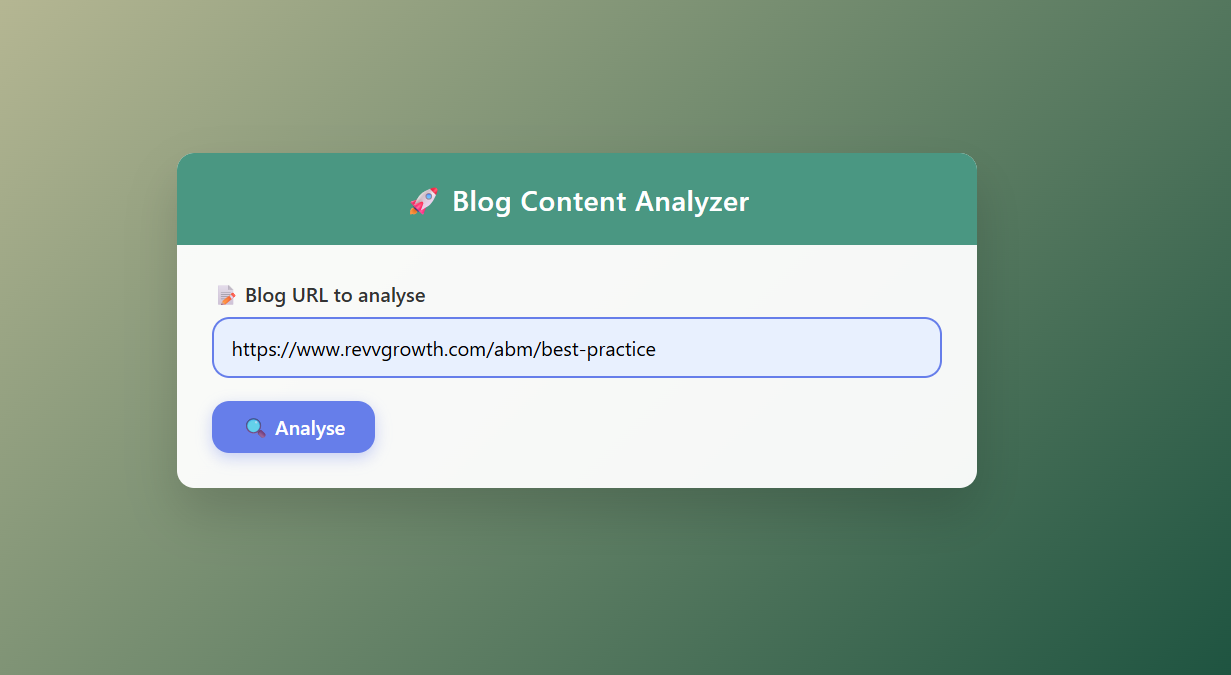
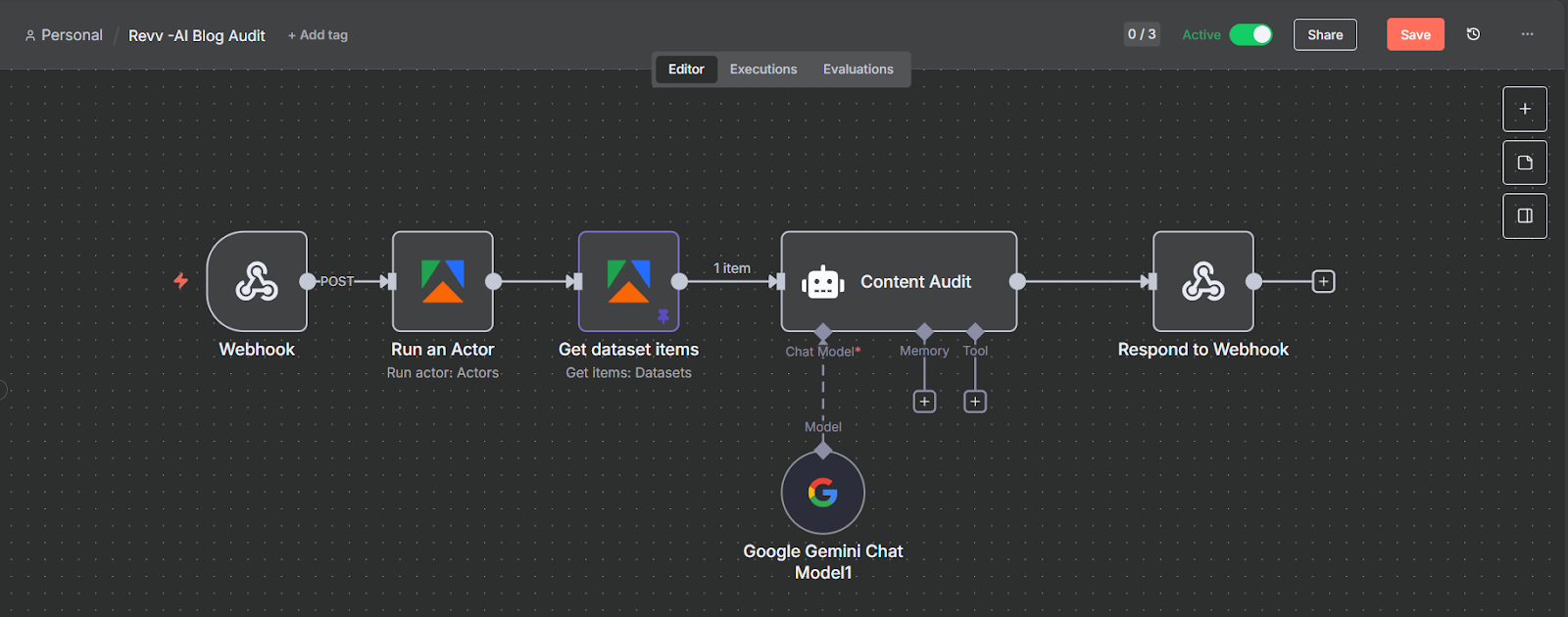
- Once the link is submitted, Apify automatically pulls the full content of the page, including text, headings, meta descriptions, images, and author details. Everything runs in the background with no manual extraction needed. This replaces hours of slow copying and formatting with a fast, automated scraping step.
- Once scraping is complete, the data is sent to an AI evaluation agent trained to review blog quality. It assesses relevance, clarity, completeness, structure, and overall content strength to identify what can be improved.
- Within minutes, a full audit report is generated with actionable suggestions.
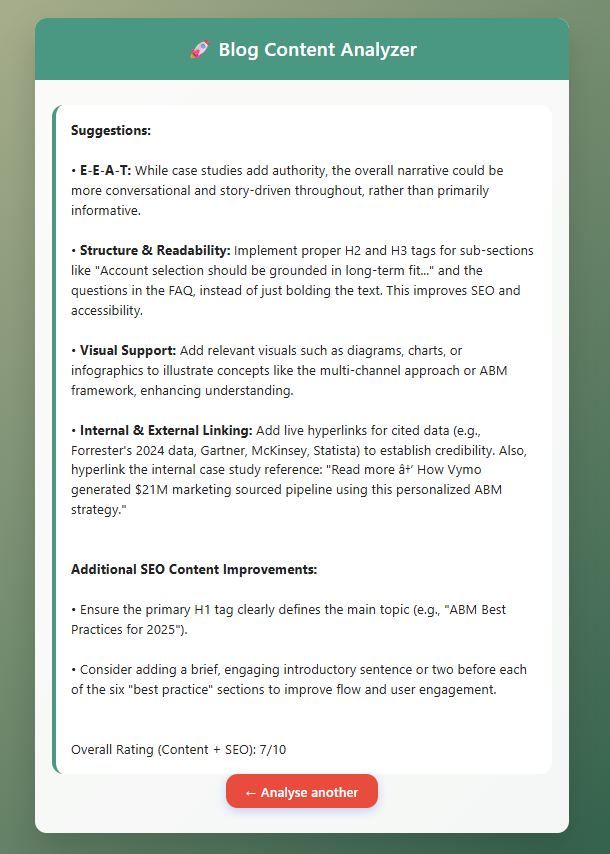
- Over time, feedback from the team improves the audit accuracy and insights
This turns a task that once took nearly an hour per article into a 2-minute review that’s consistent and strategic.
2. Competitor Keyword Research Automation
Manual competitor research used to require multiple tools, CSV exports, and hours of formatting. Our automated workflow works like this:
- The workflow begins by entering a competitor’s domain URL.
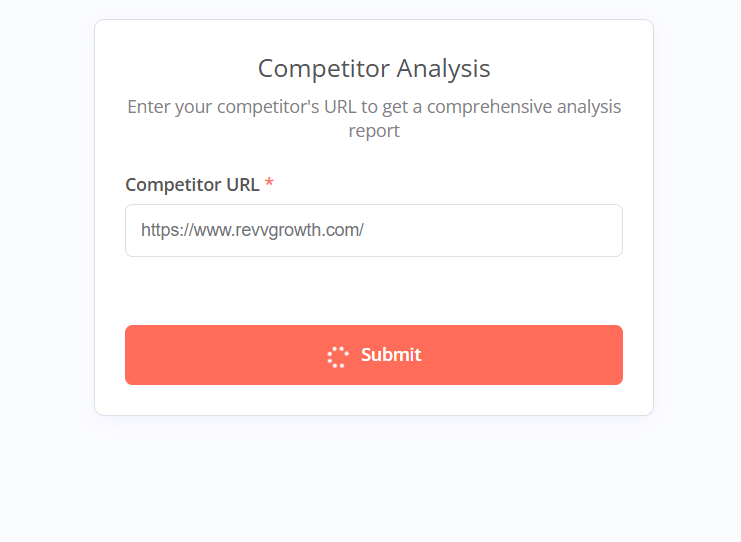
- As soon as a domain is submitted, the system creates a new tab in a shared Google Sheet. Each competitor gets its own neatly named sheet, so nothing has to be built or labeled by hand.
- The system sends the domain to DataForSEO and pulls all key keyword data in one go, including volume, difficulty, intent, ranking URLs, and total keywords. What used to take multiple manual searches now happens automatically in a single step.
- Once the keyword data is pulled, an AI agent organizes it into a structured, easy-to-use format. Instead of a raw list, we get clean keyword rows ready for comparison, filtering, and opportunity mapping.
- The keywords are added straight into the sheet automatically. What once took hours per competitor now takes just minutes.

Instead of spending 2–4 hours per competitor, the SEO team gets a clean, ready-to-use dataset that prioritizes opportunities.
3. Keyword Brief Generation
Creating keyword briefs used to involve prompting AI tools, checking SERPs, and formatting tables manually. We simplified it:
- The process starts in a dedicated Claude project where the full brief logic is already defined. This includes the table format, SERP validation rules, and safeguards against fabricated data. Everything is set up to ensure consistent, reliable output every time.

- To generate a brief, only three values are entered. This replaces long prompts, manual SERP checks, and formatting work, with the system preparing the brief automatically.
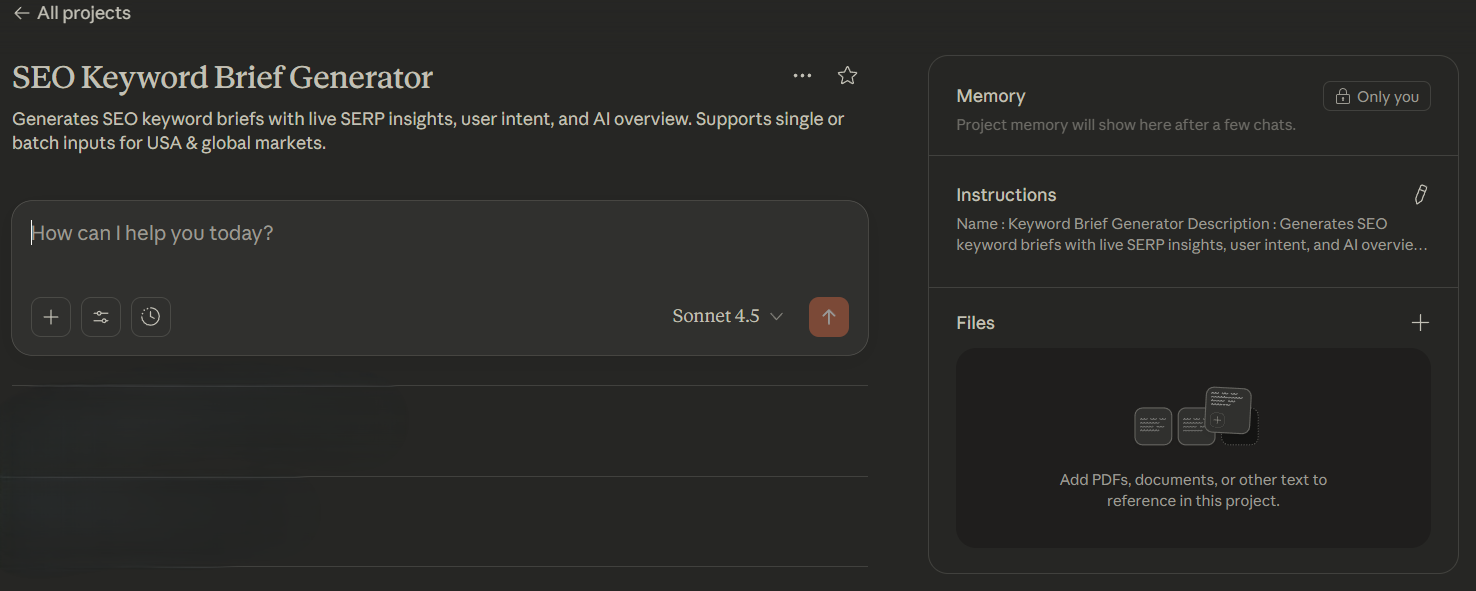
- Claude runs real-time SERP analysis for each keyword instead of using outdated data. It reviews current results, understands context, and pulls relevant terms so the brief reflects today’s search behavior and competition.
- The brief is generated as a neatly formatted table with LSI and secondary keywords, NLP terms, intent, content type, slug, and a reference link. It gives you everything needed to build a content outline without extra research.
- The workflow supports continuous use, letting you generate briefs back-to-back with consistent quality. What once required repeated prompting, SERP checks, and formatting now happens in seconds.
This automation replaces repetitive manual steps with fast, consistent outputs you can act on immediately.
What Changes After Automation?
After automation, our SEO team shifted from doing to thinking, with far less time spent on manual work and more on strategy. Output is scaled without adding headcount, and repetitive tasks no longer slow execution. It became easy to see why more businesses are rapidly adopting SEO agents.
Key Benefits of Using SEO AI Agents
AI-powered SEO agents quietly remove much of the manual effort from day-to-day SEO work. They help teams work more efficiently without changing how they operate overnight.
Here are some of the key benefits businesses typically see after adopting SEO AI agents.
1. Time-Saving and Faster Execution
AI-powered SEO agents significantly reduce the time spent on repetitive tasks like audits, keyword research, and reporting. Instead of manually pulling data from multiple tools and spreadsheets, teams get instant insights and prioritized actions in one place.
In fact, according to McKinsey, existing technologies could automate up to 57% of work hours across tasks similar to routine SEO activities. This allows SEO teams to respond to ranking drops, technical issues, and content opportunities much faster, often in minutes instead of days.
2. Smarter Prioritization and Better Decision-Making
AI-powered SEO agents help teams cut through noise and focus on what matters most by turning raw data into prioritized action plans rather than reactive alerts.
According to Gartner, 68% of organizations are either using AI or planning to use AI within key business functions, showing how widespread AI adoption has become in decision workflows across teams.
3. Scalability Without Adding Headcount
AI-powered SEO agents make it possible to manage large websites, growing content libraries, and expanding keyword portfolios without increasing team size. By automating audits, research, monitoring, and reporting, teams can scale their SEO output while keeping operational overhead low.
According to a PwC AI productivity report, AI-driven automation can boost employee productivity by up to 40%, allowing teams to handle significantly more work without additional hires.
4. Lower Costs and Reduced Human Error
AI-powered SEO agents help reduce operational costs by handling routine SEO tasks (like keyword organization, reporting, and data checks) with far less manual effort, which also reduces mistakes that come from manual data handling.
According to HubSpot data, 75% of marketers believe AI-enabled search engines will positively impact their content performance and traffic, highlighting how AI tools can boost efficiency and outcomes without adding manual workload.
5. Always-On Optimization & Competitive Advantage
AI-powered SEO agents help teams monitor SEO performance continuously, detect issues early, and adapt faster than manual workflows.
According to BrightEdge research, organic search (the main channel SEO agents optimize for) accounts for over 50% of all website traffic, reinforcing why maintaining and improving organic visibility is critical for staying ahead of competitors.
Top Performing AI SEO Agents in 2026
To bring these automations to life, here are some of the top-performing SEO tools that streamline the workflow.
1. Semrush
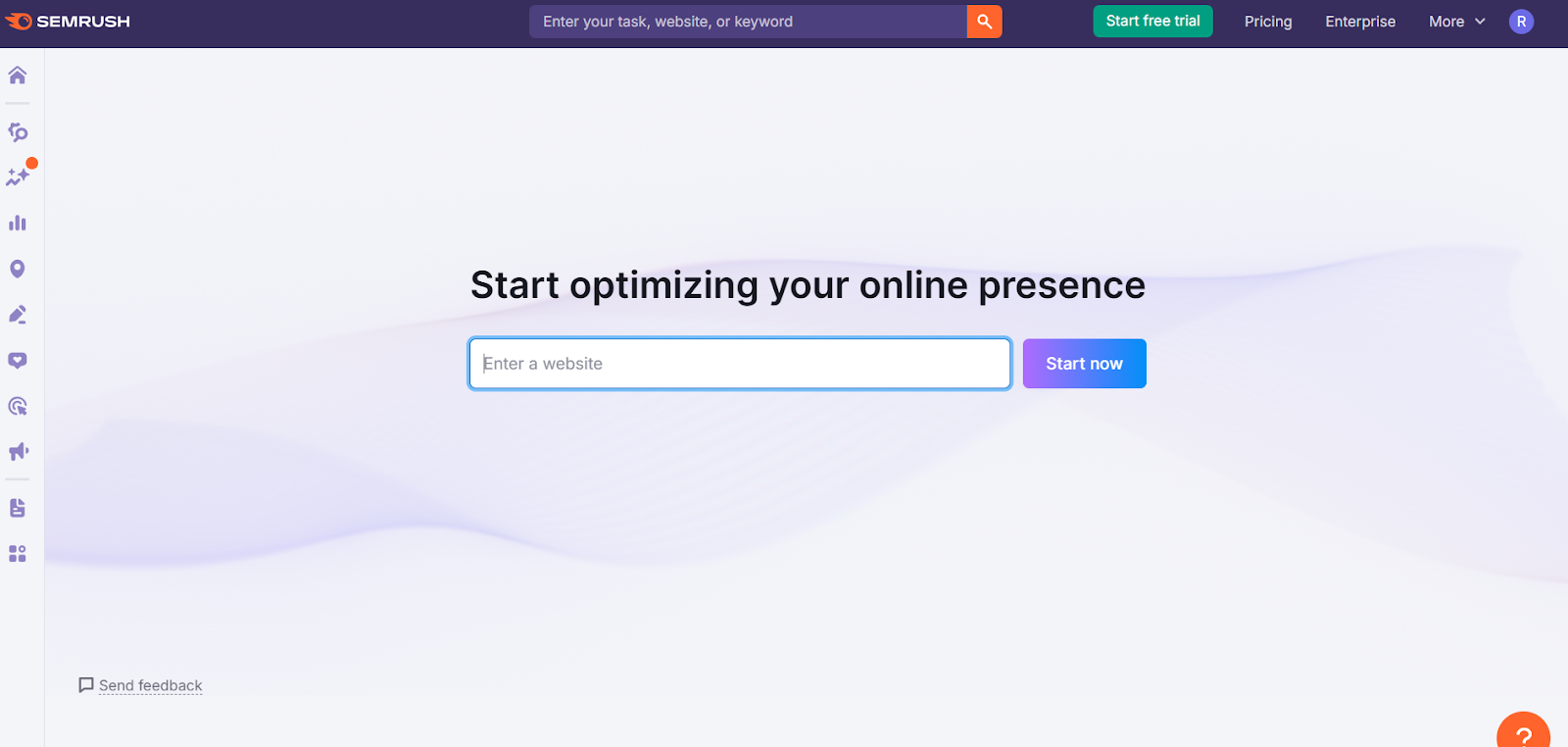
Semrush is one of the most widely used SEO platforms in the world, and in recent years, it has evolved into an AI-enhanced SEO agent that goes far beyond basic keyword research. It combines large-scale SEO data with machine learning and AI-driven insights to help teams automate audits, prioritize opportunities, and optimize content at scale.
Key Services
- AI-Powered Keyword Research – Discovers keyword opportunities, clusters topics, and maps search intent.
- Site Audit Automation – Runs continuous technical SEO audits and prioritizes issues by severity.
- SEO Writing Assistant – Provides real-time guidance on readability, tone, and SE
- Content Gap & Topic Research – Identifies opportunities for missing content based on competitor data.
- Rank Tracking & SERP Monitoring – Tracks keyword performance and visibility changes at scale.
- Competitive Intelligence – Analyzes competitor keywords, backlinks, ads, and content strategies.
- SEO Forecasting & Trend Analysis – Uses predictive data to guide strategy and planning.
The Semrush Experience
Semrush is known for its depth and reliability rather than simplicity. It gives teams a complete view of keywords, competitors, technical issues, and content performance in one platform. Users consistently rate Semrush as a leading SEO tool, often highlighting its data accuracy, feature richness, and ability to scale for large websites and agencies.
2. Birdeye

Birdeye is an AI-powered customer experience and local SEO platform designed to help businesses improve their online visibility, reviews, and local search rankings. Birdeye acts as an AI SEO agent for local discovery and trust-building, combining review management, listings optimization, and AI-driven insights in one system.
Key Services
- Review Generation & Management – Automates review requests, monitors feedback, and helps respond to reviews using AI.
- Local Listings Management – Syncs business information across Google, Yelp, Facebook, and hundreds of directories.
- AI Review Response Generator – Creates personalized, on-brand responses to customer reviews at scale.
- Local SEO Insights – Tracks local rankings, visibility, and performance across locations.
- Social Media Monitoring & Publishing – Manages social content and engagement from one dashboard.
- Customer Feedback & Surveys – Collects and analyzes customer feedback to identify experience gaps and opportunities.
The Birdeye Experience
Birdeye is built for businesses that care as much about reputation as rankings. Users frequently highlight how much time it saves and how easy it makes it to keep business listings accurate at scale. Many also mention that it helps turn customer feedback into a practical growth lever, rather than just another inbox to manage.
3. NightOwl–AI SEO Agent by Nightwatch
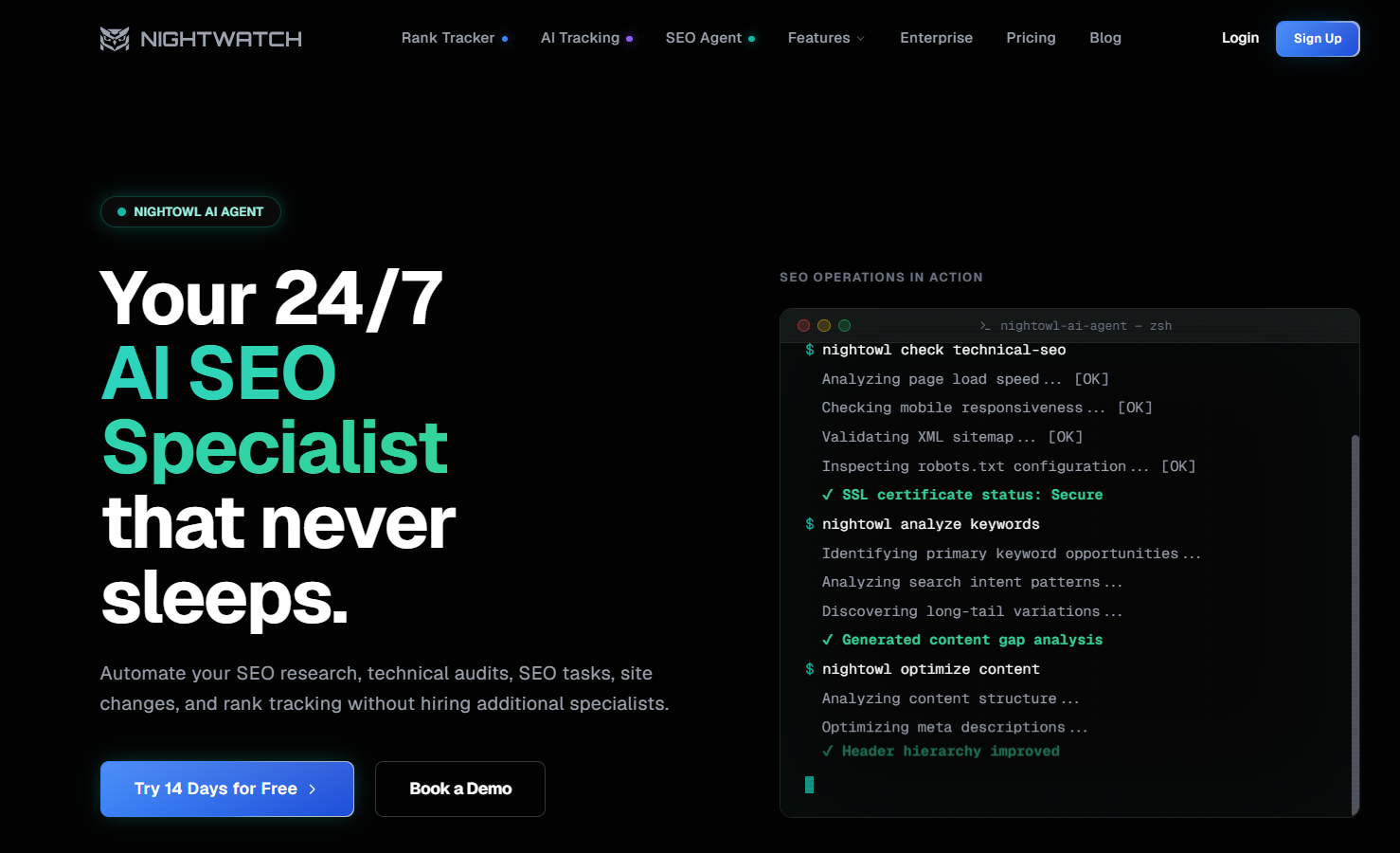
NightOwl is an AI-powered SEO agent built into the Nightwatch platform that works like a 24/7 SEO assistant. Instead of just showing data, it actively monitors your site, surfaces issues, and prioritizes what to fix next. It brings rank tracking, audits, and optimization insights into one automated workflow.
Key Services:
- Automated SEO Audits – Continuous scanning of site health, crawl issues, metadata problems, and technical SEO errors.
- AI-Driven Keyword Insights – Intelligent keyword discovery, intent grouping, and opportunity prioritization.
- Content Optimization Suggestions – On-page improvement recommendations based on top-ranking pages and semantic context.
- Rank & Performance Monitoring – Live tracking of keyword rankings and visibility changes with alerts.
- Competitor Analysis – Identification of competitor keyword gaps and benchmarking performance.
- 24/7 Alerts & Recommendations – Round-the-clock monitoring with actionable insights delivered automatically.
The NightOwl Experience
Using NightOwl feels like having an always-on SEO assistant quietly working in the background. Many Nightwatch users describe the platform as reliable and easy to use, highlighting how it simplifies rank tracking, reporting, and ongoing monitoring without constant manual effort.
One verified reviewer even called it a reliable, comprehensive, and user-friendly tool that makes day-to-day SEO work feel much more manageable.
4. Writesonic
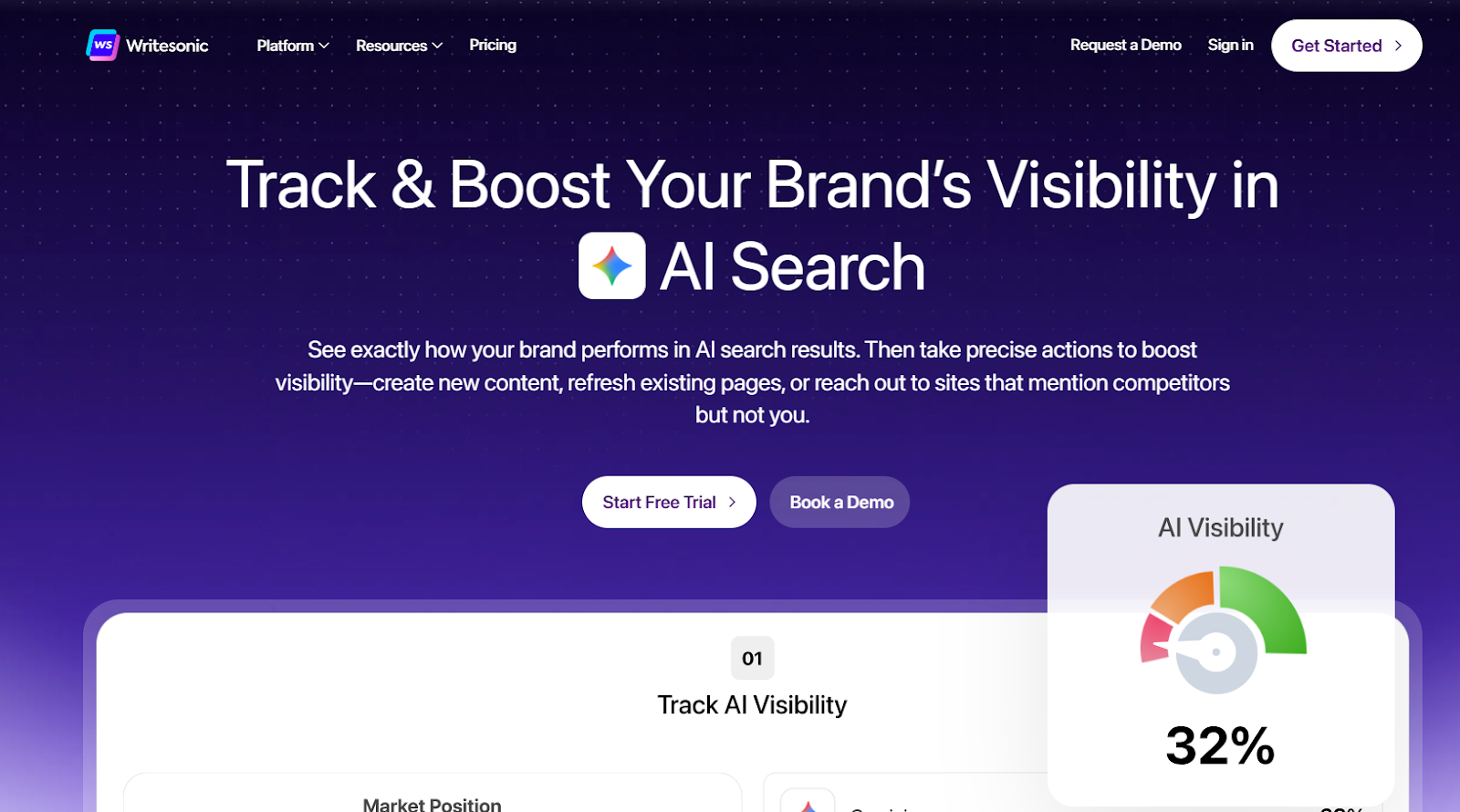
Writesonic is an AI-powered SEO and content platform designed to bring content creation and SEO optimization into a single workflow. While it started as an AI writing tool, it has evolved into a full AI SEO agent that helps teams plan, create, optimize, and track content performance.
Key Services
- AI SEO Agent & Optimization – Analyzes content and SEO signals, then suggests improvements based on ranking potential.
- Content Generation & Enhancement – Creates SEO-friendly drafts, outlines, and rewrites aligned with search intent.
- SEO Checker & Optimizer – Scores content and provides actionable recommendations for structure, keywords, and metadata.
- Technical SEO Audits – Flags issues like missing tags, schema errors, and content gaps.
- Internal Linking Suggestions – Identifies internal link opportunities to improve crawlability and topical authority.
- Performance Tracking – Monitors rankings, traffic, and content performance with dashboards and alerts.
The Writesonic Experience
Writesonic stands out for how quickly it turns ideas into usable, SEO-ready content. Users frequently mention its ease of use, speed, and flexibility, especially for blogs, landing pages, and marketing copy. Many also highlight how it helps maintain consistent quality when producing content at scale.
5. Surfer SEO
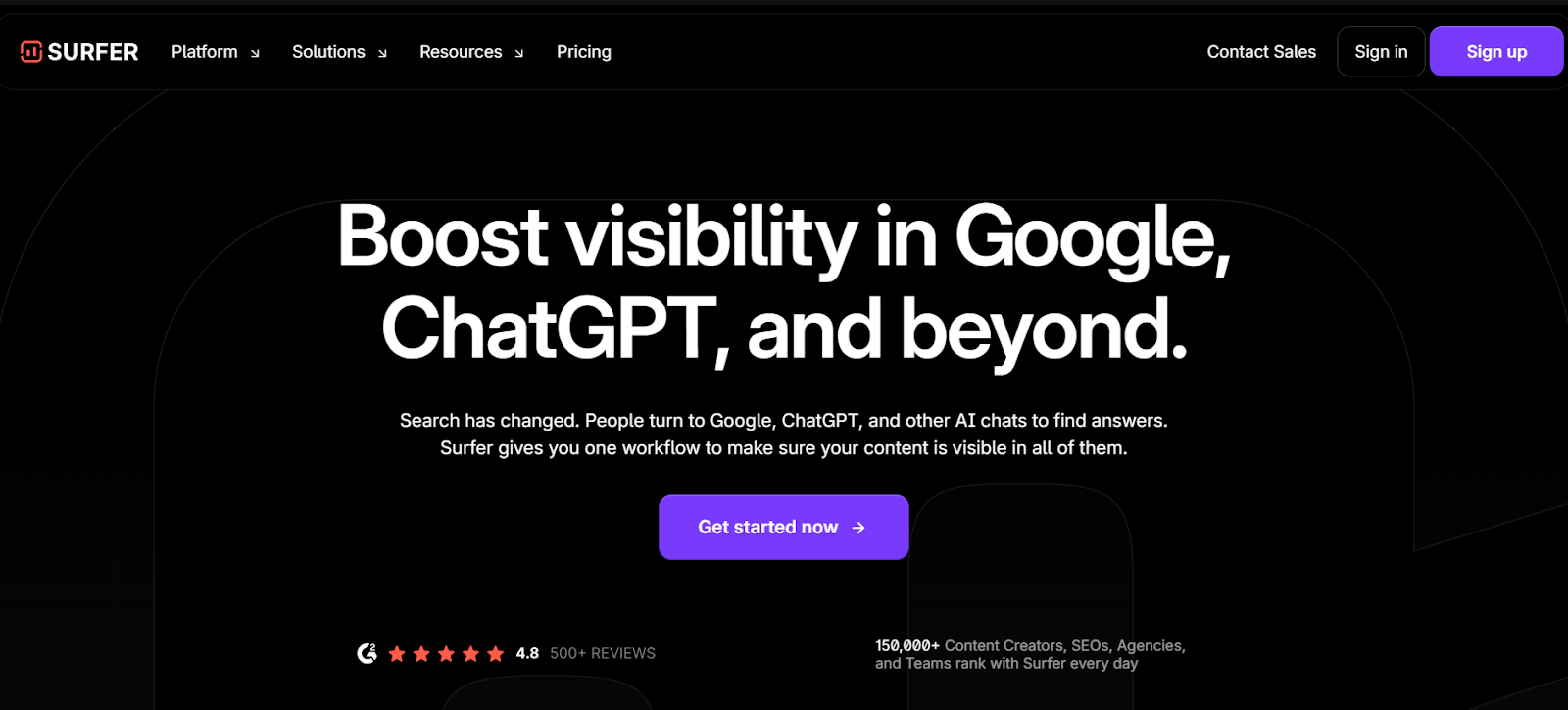
Surfer SEO is an AI-powered SEO platform built specifically for on-page content optimization. Rather than focusing on monitoring or automation, Surfer acts as a data-driven SEO agent that analyzes top-ranking pages and tells you exactly how to structure and optimize your content to compete.
Key Services
- Content Editor – Analyzes top-ranking pages and provides real-time recommendations for word count, headings, and keyword usage.
- SERP Analyzer – Breaks down ranking factors from the top results to show what’s working in your niche.
- AI Content Generator – Creates SEO-optimized drafts based on SERP data and keyword requirements.
- Keyword Research & Clustering – Groups keywords by topic and intent for better content planning.
- Content Audit Tool – Scores existing pages and flags under-optimized or declining content.
- Internal Linking Suggestions – Recommends internal links to improve topical authority and crawlability.
The Surfer SEO Experience
Surfer SEO is built for people who want clear rules instead of SEO guesswork. Users often point out how helpful it is for aligning writers and SEOs around the same benchmarks, so content stops being subjective and starts being performance-driven.
As useful as these applications are, many teams still rely on traditional SEO tools, so how do they really compare?
AI-Powered SEO Agents vs Traditional SEO Tools
Traditional SEO tools have helped teams track rankings, run audits, and research keywords for years. But as search becomes more complex and workflows more time-intensive, simply collecting data is no longer enough. AI-powered SEO agents take things a step further by analyzing that data, prioritizing actions, and automating parts of execution.
Here’s a side-by-side look at how they compare.
Traditional SEO tools tell you what’s happening. AI-powered SEO agents help you decide what to do, and increasingly, they help you do it. For teams struggling with manual workflows, scaling challenges, and slow execution, SEO agents offer a more efficient, future-ready way to manage organic growth.
Final Thoughts
SEO isn’t getting simpler; it’s getting faster, noisier, and more competitive. What used to work with spreadsheets, weekly audits, and a stack of disconnected tools now feels slow and reactive.
AI-powered SEO agents aren’t just another trend; they’re a practical response to how search has evolved. They help teams move from chasing issues to staying ahead of them, and from manual busywork to strategy-driven execution.
That doesn’t mean humans are being replaced.
It means SEO finally has a smarter operating system. One that handles monitoring, prioritization, and optimization in the background while people focus on creativity, growth, and business decisions.
For teams that care about scaling SEO without burning out their people or their budgets, agents aren’t a “nice to have” anymore; they’re becoming essential.
At Revv Growth, we’ve seen firsthand how SEO automation changes the pace of results. By blending AI-powered workflows with real-world SEO strategy, we help teams stop reacting and start building momentum.
Ready to make SEO feel lighter, faster, and more predictable? Book a quick strategy call to see how automation can fit into your growth plan.
.svg)
.webp)