



Introduction
The job boards tell one story. AI content marketer roles keep rising, and companies want people who can work fast, scale output, and use AI like a second brain.
According to a 2024 Forrester Survey, “experience with generative AI” is now included in 20% of new CMO job descriptions, which means AI proficiency is moving from “optional skill” to leadership-level expectation. If CMOs are expected to understand and leverage generative AI, content teams certainly aren’t exempt.
Many brands still insist on hiring writers who “don’t touch AI,” as if using it somehow weakens the work.
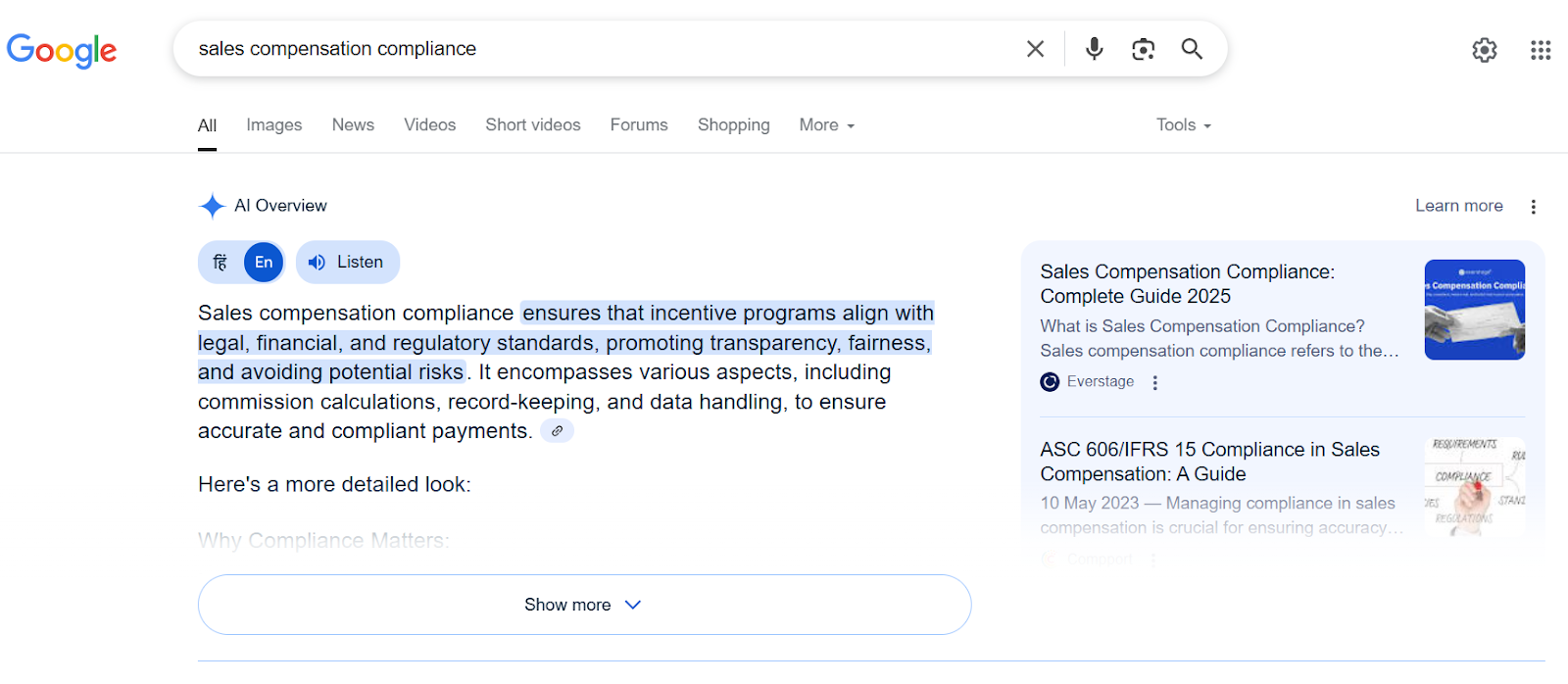
Ahrefs has shown that AI-generated content ranks and search results shift every few days as AI Overviews, SGE summaries, and LLM-powered engines change how pages appear, get cited, and get clicked. The teams who ignore AI fall behind. The teams who master it move faster and win more visibility.
We sit firmly in the second group.
At RevvGrowth, our entire content engine runs on AI workflows designed for scale, precision, and quality. We use AI to plan, write, analyze, optimize, and monitor. The results show up across Google, AI Overviews, and emerging answer engines, not just for us, but for our clients too.
So we decided to open the curtain. This is the exact AI content system we use, why it works, and how it helps us rank consistently with AI-written content.
Here’s the playbook, backed by examples and results.
What is AI SEO?
An AI SEO strategy uses artificial intelligence to analyze search intent, optimize content, and improve rankings with data-driven automation. AI evaluates keywords, user behavior, and SERP patterns to create smarter recommendations that enhance visibility and user experience.
AI models identify opportunities, predict trends, and personalize content to match search expectations. This approach improves performance, increases organic traffic, and streamlines SEO workflows with real-time insights.
Core Components of AI SEO Strategy
A strong AI SEO strategy depends on understanding the core components that shape how AI improves search performance. These pillars guide how AI analyzes intent, structures content, automates workflows, and enhances ranking potential.

Build a Search Intent Clustering Model
Search intent, often referred to as the “why” behind a user’s query, is fundamental to effective SEO. Whether a user is looking to purchase a product, gather information, or navigate to a particular page, understanding their intent is key to ranking well.
Traditional SEO strategies often rely on keyword targeting alone, but AI takes this a step further by categorizing keywords into specific buckets based on intent.
AI’s ability to parse search intent in-depth ensures that content aligns precisely with what users are actually looking for. It groups queries into four main categories: informational, transactional, navigational, and commercial. This classification enables the creation of highly targeted content.
For example, if a user searches for “best AI SEO tools 2025,” their intent is likely commercial (they’re considering a purchase or comparison). An AI tool can detect this intent and suggest content focused on product comparisons or in-depth reviews, optimizing for both user intent and search ranking.
Beyond just categorizing keywords, AI also helps mitigate issues like keyword cannibalization. When multiple pages on a website target similar keywords, it can result in pages competing with one another for rankings.
By clustering keywords according to intent, AI ensures that each page targets a unique goal, effectively preventing cannibalization. This strategy not only boosts rankings but also provides a seamless user experience, leading to better engagement and ultimately higher conversions.
Create AI-Enhanced Content Outlines
Effective content creation requires more than just listing subheadings. It demands a structure that mirrors how users search, how competitors rank, and how search engines evaluate topical completeness.
RevvGrowth’s Custom AI Workflow for Outline Creation
At RevvGrowth, we’ve built a custom AI workflow with proprietary prompts designed specifically for this purpose.
Instead of relying on generic content tools, our workflow performs a detailed SERP analysis and evaluates key factors such as headings used by top-ranking competitors, recurring semantic terms, contextual entities, and the overall information architecture.
This allows us to generate an initial outline that aligns with search expectations while uncovering gaps competitors may have overlooked. The result is an outline that balances depth, clarity, and keyword relevance in a way that improves both user experience and ranking potential.
Once the initial outline is generated, we take it through Step 2 of our workflow, where we ask GPT to conduct a thorough SWOT analysis of the outline. This helps identify sections that are weak, redundant, or unnecessary. It also highlights missing angles that users expect when searching for the topic. Our writers then refine the structure by removing irrelevant elements and adding depth where the outline falls short.
After this AI-assisted refinement, our writers perform their own manual SERP analysis to pressure-test the outline. They review competing pages, identify additional nuances, and tighten the structure to ensure it is both comprehensive and strategically aligned with user intent.
This final outline becomes the blueprint for producing high-quality, search-optimized content that stands up against the strongest competitors in the search results.
How we do Semantic Analysis at RevvGrowth
Moreover, AI goes beyond just creating an outline. It can suggest the ideal placement of keywords, the length of each section, and even identify semantic keywords (related terms) to incorporate into your writing.
At RevvGrowth, we use custom prompts to conduct a thorough semantic analysis of keywords, building content that is both semantically and contextually rich.
Our workflow suggests the ideal placement of keywords, the length of each section, and identifies related semantic terms to incorporate into your writing, ensuring your content aligns perfectly with user search intent.
For example, an outline for "AI SEO strategy" may suggest sections like “Core components of AI SEO strategy,” and “Step-by-step framework for AI SEO strategy.” By focusing on these specific, high-value sections, we ensure that the content is optimized for both search engines and user experience, effectively addressing the most relevant topics while filling gaps competitors may have missed.
Automate SERP Monitoring & Topic Refresh Cycles
SEO is an ongoing process, and staying on top of search engine fluctuations is crucial for long-term success. AI excels at monitoring these changes, particularly the volatility of SERPs (Search Engine Results Pages).
SEO teams traditionally conduct quarterly audits to assess performance, but with AI, these audits can be automated, providing real-time data on keyword movements, page performance, and SERP changes.
RevvGrowth’s Quarterly Content Optimization Sprints
Our SEO team at RevvGrowth runs quarterly optimization sprints, supported by custom AI agents that automatically monitor our blog's rankings.
Whenever a page starts slipping in rankings or a keyword's search volume declines, our AI agents send instant notifications. These alerts enable our team to prioritize and plan optimization sprints effectively.
Once a page or keyword is flagged, our SEO team identifies which posts need attention and creates a detailed optimization plan. They then share the blogs to be optimized with our content team, who proceed to enhance the keywords, perform a SERP analysis, and refine the content by adding or removing sections that don’t contribute to the user experience or SEO value.
This streamlined process ensures continuous content optimization and helps maintain strong rankings.
Use Predictive Analytics to Prioritize Content
One of the most powerful features of AI in SEO is its ability to use predictive analytics. Predictive models analyze historical data like keyword performance, search trends, and user behavior to forecast which content is most likely to succeed in the future.
This allows SEO teams to focus on high-impact opportunities and optimize resources effectively.
For instance, let’s say an AI model predicts that a certain keyword will experience a significant traffic boost in the next few months due to seasonal trends or market shifts. Instead of guessing which topics will perform best, SEO professionals can allocate resources to creating content around that keyword and related terms.
This proactive approach ensures that SEO teams aren’t reacting to changes after the fact but are instead planning content strategies that are more likely to generate positive results.
AI’s predictive capabilities can also help prioritize content that has the potential to rank faster or achieve higher visibility.
For example, if a blog post about "AI SEO trends in 2025" is gaining momentum in search results, predictive analytics can identify the most promising associated keywords to target, helping you refine your content for higher impact.
Build AI Guardrails to Maintain EEAT
Expertise, Experience, Authoritativeness, and Trustworthiness (EEAT) are integral to Google's ranking algorithm, especially when it comes to topics where accuracy is critical, such as health, finance, and legal industries.
As Google continues to place more emphasis on these criteria, AI can play an essential role in ensuring that content adheres to EEAT guidelines.
AI tools can monitor the accuracy of your content, flagging any factual errors or unsupported claims. Additionally, AI helps ensure that all content is appropriately cited with credible sources and that authorship is clear, reinforcing your site's authority.
For instance, AI can analyze whether your content presents a balanced view of a topic, offering insights from multiple perspectives, or whether it leans too heavily towards one side.
This approach ensures that your content is not only factually accurate but also perceived as authoritative and trustworthy by both users and search engines.
As a result, AI plays a vital role in ensuring that your content aligns with Google’s EEAT principles, which directly impacts your site’s ability to rank well on search engines.
By integrating these core components into your AI SEO strategy, you can automate critical aspects of SEO, improve content quality, and optimize user experience, all of which lead to higher rankings, more organic traffic, and greater long-term SEO success.
AI SEO Framework: A Step-by-Step Playbook of RevvGrowth
At RevvGrowth, we’ve developed a comprehensive AI-driven SEO framework that optimizes every facet of our SEO strategy. Our approach is rooted in advanced AI technologies that not only enhance efficiency but also improve the effectiveness of SEO initiatives.
Below is an in-depth breakdown of how we utilize AI at each step to build a high-performance SEO strategy.
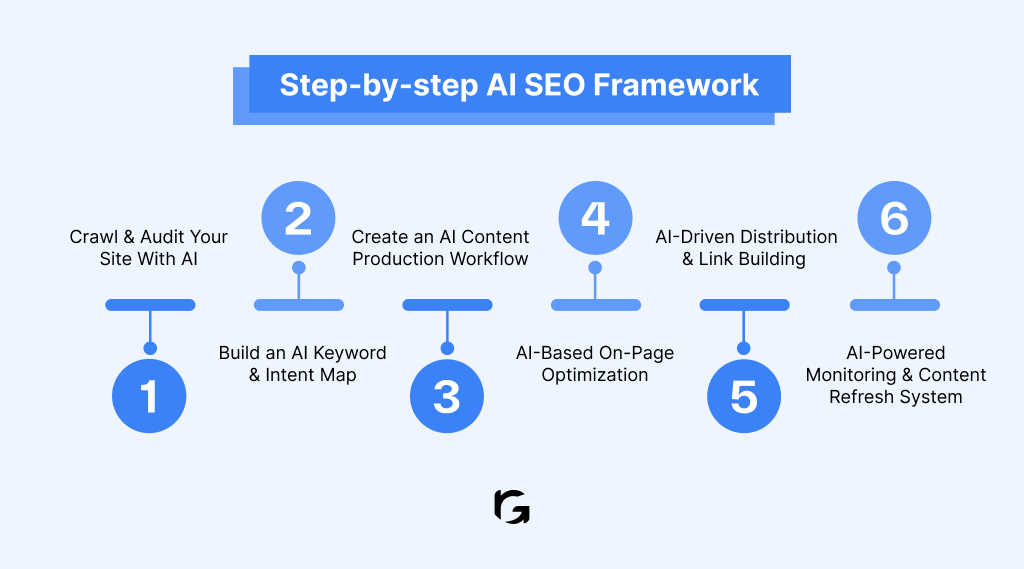
Step 1: Crawl & Audit Your Site With AI
Technical audits are the foundation of any successful SEO strategy. At RevvGrowth, we use AI-powered crawlers to conduct in-depth technical audits, replacing the traditional manual processes that can be time-consuming and prone to human error.
These crawlers scan your entire website, automatically identifying critical issues such as:
- Broken links: Broken links create a poor user experience and can signal to search engines that your site is outdated or unreliable.
- Slow-loading pages: Page speed is a crucial ranking factor. AI can quickly identify slow-loading pages that could negatively impact both user experience and SEO performance.
- Thin content: AI can flag pages that lack depth or substance, ensuring that your content is comprehensive and relevant.
- Schema gaps: Structured data plays a significant role in how search engines understand your content. AI identifies missing or incomplete schema, enabling your site to be more easily indexed.
This AI-driven audit process ensures that your site is optimized not only for search engine crawlers but also for your users, improving both visibility and user engagement.
Step 2: Build an AI Keyword & Intent Map
Building a keyword and intent map is crucial for aligning your content with what users are actually searching for. Traditional keyword research methods focus only on identifying high-volume search terms, often ignoring the context behind why users are searching for specific queries.
With AI, we take a more sophisticated approach by clustering keywords based on user intent such as informational, transactional, navigational, and commercial.
Using AI, we map out a comprehensive list of keywords and assign them to these intent categories. This ensures that every page on your website serves a specific, targeted purpose and aligns with the appropriate search goal.
By optimizing content to meet the intent behind a user’s query, we increase the likelihood of attracting highly relevant traffic that is more likely to convert.
At RevvGrowth, we have custom AI prompts designed to continuously monitor and update this keyword map as search trends evolve, ensuring that your content strategy remains aligned with shifting user behavior.
Step 3: Create an AI Content Production Workflow
AI’s role in content creation is transformative, but results depend entirely on how the workflow is designed.
At RevvGrowth, we built a custom AI production system with proprietary prompts that streamline every stage of content creation while maintaining editorial quality and SEO depth.
Outline Creation
Our workflow begins with AI-generated outlines. We use custom prompts that run a complete SERP analysis, reviewing headings, semantic terms, contextual entities, and patterns across the top-ranking pages.
This produces a first draft outline that already aligns with search expectations and topic depth. In the second stage of the workflow, we run a SWOT analysis on the outline using AI. This helps us identify weak sections, remove irrelevant ideas, strengthen high-value parts, and fill any missing angles.
After that, our writers perform their own manual SERP review to validate the outline, refine dense sections, and ensure no critical user perspective is missing.
Content Creation
Once the outline is approved, we move into content creation. We use dedicated prompts to generate an initial draft and separate research prompts for gathering statistics, data points, case studies, and credible references.
For example, the research process for this “Generative AI” blog, which includes multiple authoritative citations, took less than ten minutes with our AI workflow. A manual process would typically take several hours.
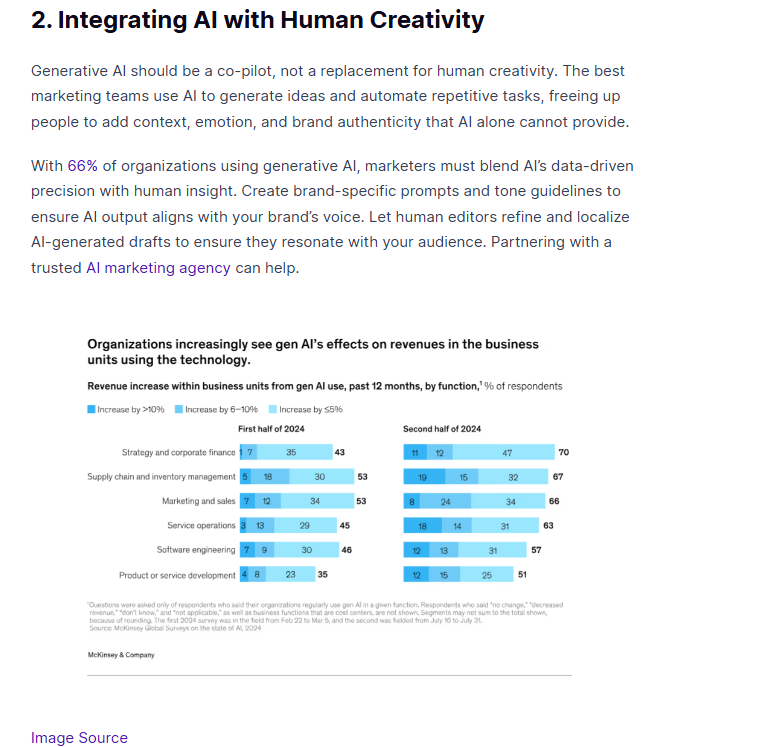
Because we combine research automation with semantic analysis, the content produced is both contextually rich and aligned with the broader meaning of the keyword.
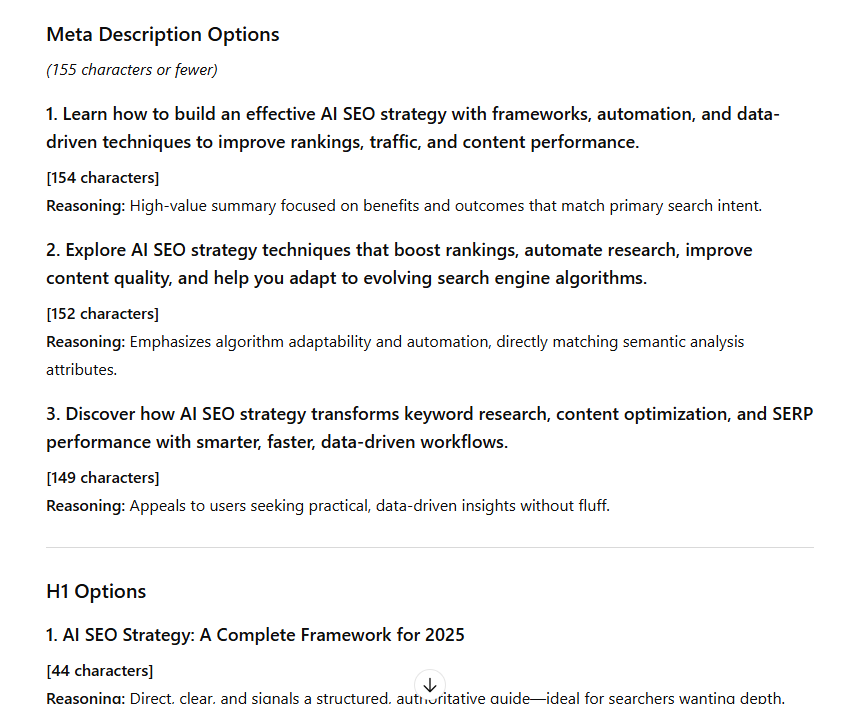
We then use AI to create the supporting SEO elements, including FAQs, meta titles, meta descriptions, and H1 recommendations.
After AI generates the draft, our writers step in. They proofread, refine the language, expand sections that need more clarity, adjust examples, and enhance the narrative flow. To ensure calibration, we run the entire blog through AI once more and ask it to critically analyze the structure, logic, and cohesion of the content.
The system performs another SWOT review, helping tighten weak transitions, improve reasoning, and strengthen arguments. This final layer of refinement is what gives RevvGrowth content its depth and completeness.
This workflow has helped us rank blogs consistently for ourselves and our clients, even in competitive SERPs. Each stage is designed to combine AI efficiency with editorial judgment, producing content that matches the quality users expect when they search for an AI SEO strategy.
Step 4: AI-Based On-Page Optimization
On-page optimization is essential for ensuring that your content ranks well on search engines. At RevvGrowth, we use AI to provide data-driven recommendations for optimizing the most critical on-page elements:
- Title tags: AI tools suggest title variations that are both engaging for users and optimized for target keywords.
- Meta descriptions: AI helps craft meta descriptions that clearly explain the page content while including important keywords for better visibility in search results.
- Headers: AI suggests header structures (H1, H2, H3) to ensure the content is well-organized and easy to read, all while targeting the right keywords.
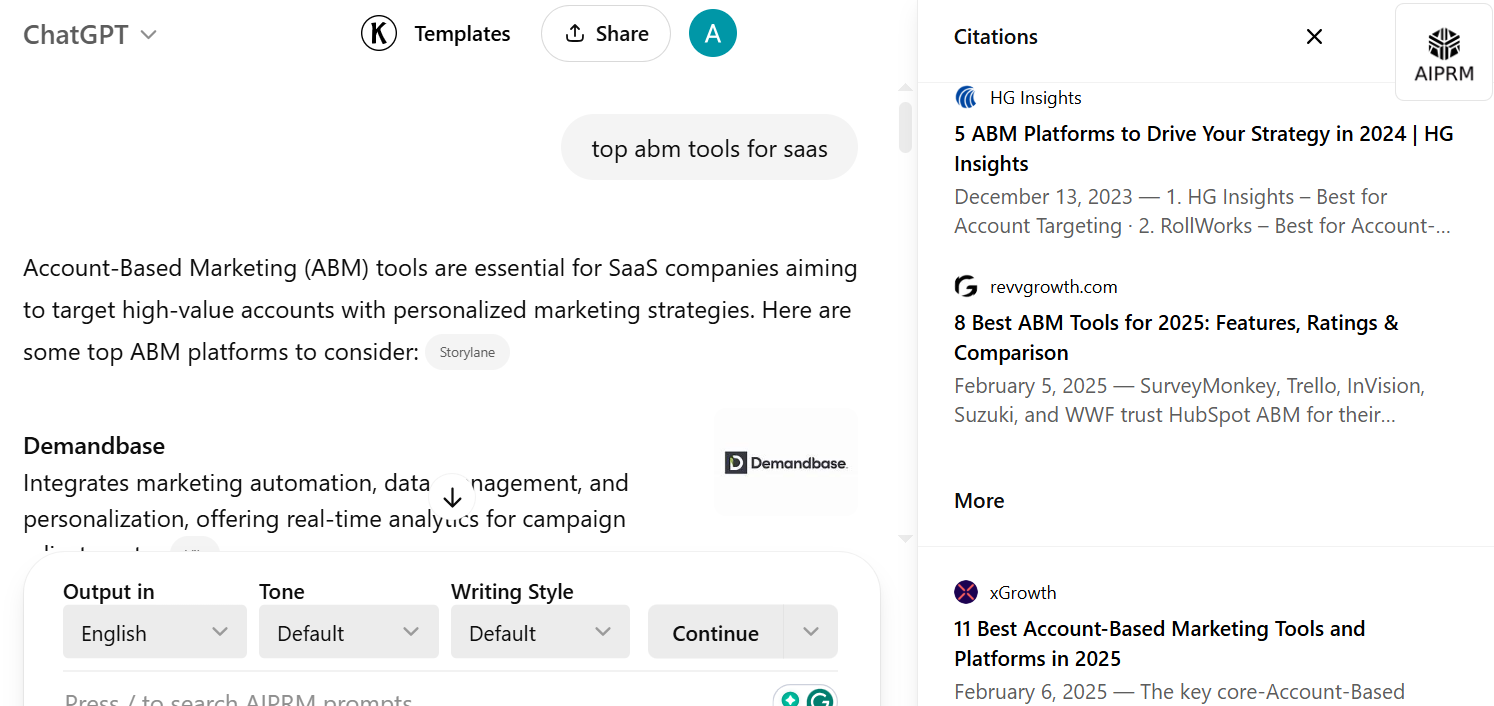
For example, here’s an output of meta titles, descriptions, and H1 titles generated with our custom prompt for this very blog. These components are optimized for click-through rate and keyword relevance.

- Schema markup: AI identifies areas where schema can be applied, making the content more understandable for search engines and improving rich snippets in search results.
At RevvGrowth, we use our custom AI-powered optimization system to ensure that every on-page element is finely tuned to maximize both ranking potential and user satisfaction.
Step 5: AI-Driven Distribution & Link Building
AI can also play a pivotal role in boosting your content’s reach through intelligent distribution and link-building.
At RevvGrowth, we utilize AI to identify potential backlink sources and help automate outreach efforts, ensuring that your content gains the authority needed to rank highly.
- Backlink Identification: AI scans the web for high-authority sites that are relevant to your content. It evaluates the quality and relevance of potential backlink sources, ensuring that you’re targeting the best sites for link-building.
- Outreach Automation: AI automates the outreach process by crafting personalized email templates that increase the likelihood of securing backlinks.
- Content Distribution: AI helps distribute your content to platforms where your target audience is most active, amplifying its reach and engagement.
At RevvGrowth, we rely on AI-driven insights to streamline the backlink acquisition process, ensuring that our content reaches the right audience and accumulates high-quality backlinks, improving overall SEO performance.
Step 6: AI-Powered Monitoring & Content Refresh System
SEO is a long-term game, and staying on top of performance is critical.
At RevvGrowth, we use AI-powered dashboards to track SEO performance in real-time, enabling us to monitor changes in rankings, traffic, and user behavior.
- Real-Time Monitoring: AI continuously tracks how well your content is performing, detecting shifts in keyword rankings or user engagement. This allows us to react quickly when things change, whether it’s a drop in rankings or a sudden surge in traffic.
- Automatic Content Updates: If AI detects that content is starting to underperform or has become outdated, it triggers automatic alerts, prompting content teams to update the material. This ensures that your content remains relevant and competitive over time.
For example, if a blog post on "AI SEO tools" starts losing traffic due to outdated information, AI will trigger a notification, and the content team will update the article with the latest tools and trends.
This proactive approach ensures that content remains fresh, relevant, and optimized for ongoing SEO success.
Conclusion
According to a 2023 Research Report by McKinsey on the Economic Potential of Generative AI on Marketing, the productivity of marketing could rise by 5% to 15% of total marketing spend, worth about 463 billion dollars annually.
This number is not a milestone. It’s a signal. It marks the end of an era where content teams won by producing more. Volume is now automated. Output is practically infinite. The new competitive edge is no longer how much you publish, but how well you decide what deserves to be published.
But most teams still haven’t asked the harder question.
- What do we do when speed is no longer a differentiator?
- What becomes the “skill” when writing is instant?
- What happens to teams that keep measuring productivity instead of insight?
These are the questions the industry is trying to avoid, but they define the next era of content.
- AI handles the typing.
- AI handles repetitiveness.
- AI handles the assembly-line work marketing teams never wanted to do in the first place.
Humans handle the judgment. Humans decide what messages are worth saying. Humans build the arguments AI can only support, not originate.
That flips the entire model of content upside down.
The question is no longer “How fast can we publish?”
It becomes: “What is worth publishing in a world where speed is free?”
The teams that answer that question honestly and build systems around insight, not output will own the next decade of organic growth. The rest will be buried under the very volume they thought would save them.
Book a call with RevvGrowth and get an AI SEO system that scales output, improves rankings, and removes the manual bottlenecks holding your growth back.
.svg)


.webp)
.avif)