


Introduction
Search is changing. People no longer just browse a list of links. Increasingly, they ask questions and expect direct answers.
AI-powered systems now aim to provide that answer instantly rather than sending users to multiple pages. This shift is already visible in user behavior. According to the Q4 2025 State of Search report from Datos and SparkToro, 56% of Google desktop searches in the US end without a click, meaning users increasingly get answers directly from AI-powered results like Overviews.
Platforms such as:
- Google AI Overviews
- Perplexity
- ChatGPT Search
- Microsoft Copilot (Bing)
- Google Gemini
- Voice assistants like Google Gemini, Alexa, and Siri
- Emerging tools like You.com and Grok
This is a clear indicator of the dominant artificial intelligence search engines and assistants in 2026, concentrating on those providing direct answers or summaries (such as Perplexity and ChatGPT Search). The featured snippet has been almost completely replaced by AI Overview and other generative formats.
That’s where Answer Engine Optimization (AEO) comes in. It focuses on structuring content so search engines and AI systems can understand it, extract it, and surface it as the answer.
Talk to an AEO Specialist - Book a Call
In this guide, we’ll walk through the best practices for AEO and how you can prepare your content for AI-driven search.
Why is AEO critical now?
Search has evolved from links to answers. Rather than having to sift through several web pages, people are now expecting search engines and artificial intelligence (AI) tools to present the answer right away.
Such a trend is mainly attributed to the rise of AI-based search technologies such as Google AI Overviews alongside other conversational search tools such as ChatGPT, Perplexity, and Bing Copilot.
According to research conducted by Semrush, how quickly this trend is occurring can be evidenced in their analysis of over 10 million keywords, where the occurrence rate of AI Overviews in US desktop searches was around 13.14%, doubling in two months of early deployment.
In most cases, these AI-based descriptions occur in informational queries, which are exactly the kinds of queries people make when researching various subjects, items, and solutions.
The implication for businesses is that the focus of search visibility needs to evolve. While ranking on Google is important, the emphasis is now shifting towards being selected or cited by AI in the answer itself.
Also Read → 7 Best AEO Agencies for Ranking in AI Answers
Best Practices for AEO Optimization
Optimizing for answer engines builds directly on strong SEO, but shifts focus from "rank higher" to "be the extracted answer." Make AI systems cite your content by prioritizing clarity, structure, and entity authority over link-building alone.
Here are the core strategies that help content perform well in AI-powered search:
1. Understand user intent and question demand
Answer engines prioritize natural questions over isolated keywords. Structure content around how users actually search: full sentences and conversational queries.
Target these for “AEO Optimization”:
- What is AEO?
- How does AEO work?
- How to optimize content for AI search?
3 Steps to Match User Intent:
- Research: Use AlsoAsked, AnswerThePublic, or Google "People Also Ask"
- Write conversationally: Full sentences for voice search compatibility
- Format: H2 question > 40-60 word answer immediately below
Case Study:
Everstage came to us with a blog full of generic keyword pages like "commission management software." It ranked fine on Google but was invisible in ChatGPT and Perplexity. Zero AI citations.
We rebuilt the blog around the questions their sales and finance buyers were actually asking: "How do you do fair variable compensation calculations?" and "How does CPQ differ from commission management?" instead of broad category terms.
Within 4-6 weeks of publishing, Everstage started surfacing in ChatGPT and Perplexity answers for commission-related queries. Same brand, same product. Different content strategy.
2. Optimize content format for direct answers
Answer engines favor answers that are provided swiftly in the content. An ideal strategy is the "answer first" approach, where you start by giving a succinct explanation before delving into the topic.
Use the Inverted Pyramid Structure: The core of the answer must be given right from the first 40-120 words of your content, or just after the heading. Don’t expect AI to have to search through irrelevant content for the answer. Answer the question about "Who, What, Where, When, Why, and How".
Format Best Practices for AI Extraction
Certain content formats make it easy for AI to extract and cite your answers. These include:
- Listicles - easy to parse and reference individual items
- Steps in a process - clear sequential structure, AI engines recognize
- Tables - structured data with clear headers
- Definition paragraphs - concise, standalone explanations
- FAQs - Q&A format naturally aligns with LLM response patterns
3. Implement Advanced Schema Formatting
- Use FAQPage, HowTo, Article, and Speakable schema.
- FAQPage + HowTo have the highest AI citation impact.
- Organization schema strengthens entity recognition.
- JSON-LD format; multiple types = 3x better Overviews visibility.
4. Prioritize E-E-A-T and Information Gain
Search engines need to believe in the facts presented in your content.
- Information Gain: Do not simply copy existing web information. Offer something new, unique, or valuable, like providing original data or an expert’s opinion. This will make your content the ultimate source.
Case Study:
OvalEdge came to us swamped in generic content that wasn't differentiating them from competitors. We shifted their strategy toward unique insights on niche topics their buyers actually cared about, like open source versus enterprise data catalogs, instead of broad category terms.
The targeted approach brought in a much sharper audience. In March 2026 alone, the blog generated 138 leads, and one post pulled in 519 clicks per month on its own. Same brand, same product. Different content strategy.
- Establish Credibility (E-E-A-T):
You must ensure that your content provides evidence of Experience, Expertise, Authority, and Trust:
- Link to reputable outside sources
- Include original data/statistics
- Provide author information establishing domain authority
- Cite properly and include source information
The inclusion of these elements will significantly improve the chances that your content will be used as a source by AI algorithms.
5. Keep content fresh and regularly updated
An up-to-date piece of writing is favored by LLMs, particularly on matters about technology, marketing, and business.
An update means the content remains current, whether it be through the following ways:
- Revamping statistical figures and examples used
- Including new chapters when trends shift
- Modifying screenshots and other tools used
6. Build entity-based content clusters
Answer engines make use of entities for topic comprehension. Entities refer to identifiable subjects like brands, companies, items, or abstract ideas.
Don’t publish standalone pieces of content, but rather topic clusters consisting of interrelated information.
Employing structured data, such as the schema Organization and sameAs relations, may be another way to help search engines link your brand to credible sources throughout the internet.
Case Study:
With the help of Revv Growth, Asymbl was able to transition from a vague “staffing software” business to a multi-business authority by creating three content clusters, namely Salesforce Staffing, Workforce Management, and Talent Intelligence, each with its own pillar pages and interlinking articles.
Outcomes include better search engine rankings and AI perception as a category specialist.
7. Build cross-channel trust signals
Build cross-channel trust, so AI sees your brand as credible and consistent.
Focus on:
- Wikipedia & industry knowledge bases
- Media mentions (e.g., TechCrunch, Forbes)
- Active LinkedIn presence
- Original research, case studies, analyst reports (Gartner, G2)
- Community engagement (Reddit, Stack Overflow)
Consistent mentions across these channels increase AI trust and recommendations.
8. AEO technical optimization
It is important to pay attention not only to content quality but also to technical optimization of the website for AEO. In order to analyze content correctly, answer engines use structured data, access via crawling, and clean HTML code.
- Semantic HTML: Use headings H1-H2-H3, lists, and tables to facilitate proper identification of blocks by AI.
- Structured data: Implement FAQPage, HowTo, Organization, Speakable, and Article schema.
- Access to crawling bots (AI): Add Bingbot and other AI crawlers into robots.txt file.
- Crawlability and Performance (Core Web Vitals): AI engines can't index content that can't be loaded fast. Make sure you pass Core Web Vitals to get fast-loading and accessible pages without JS blockers.
9. Monitoring and measuring AEO success
AEO success is based on the appearance in AI responses, not on clicks.
Where to look for it:
Google AI summaries, Perplexity AI, ChatGPT, Microsoft Copilot
Important metrics:
AI backlinks, brand presence, zero-click results, AI-generated leads
Analytics tools:
Google Search Console, Semrush, Ahrefs, Brand24
How to track:
Monitor AI references, share of voice, branded queries, and AI-led leads.
Here at Revv Growth, we track and measure AEO performance for you—across AI platforms, not just search engines.
We provide clients with custom AEO reports that show:
- AI mentions across platforms like ChatGPT and Perplexity AI
- Share of voice for high-intent queries
- Citation sources and content attribution
- AI-influenced pipeline and leads
How do answer engines work?
Answer engines search across many websites to find relevant information, synthesize concise answers, and produce quick summaries, emphasizing structured, up-to-date information with entity recognition over standard linking metrics.
Process
- Query Analysis: User poses a query ("What is AEO?")
- Source Searching: AI scans reputable online material, knowledge graphs
- Information Extraction: Extracts facts directly from highly structured data
- Information Synthesis & Citing: Synthesizes facts, cites 2-3 sources
Top answer engines (2026): Google AI Overview, Perplexity, ChatGPT Search, Microsoft Copilot, Google Gemini
Ranking Signals for Citations:
- Answer Clarity : Direct, 40-60-word responses
- Content Structure : H2+H3, lists, tables, schema
- Entity Signals : Brands/ topics in knowledge graphs
- Source Consensus: Matching info across Wikipedia/ Reddit/ industry sites
- Freshness : Updated within 6 hours
Entities & Knowledge Graphs
Entities (brands, topics, people) connect via knowledge graphs. AI checks consensus across sources:
- Single site = Weak signal
- Wikipedia + Reddit + G2 + publications = Strong citation probability
Bottom line: AEO means building authority across platforms, not just one page.
How Revv Growth Executes AEO: Our Real-World Workflow
At Revv Growth, we approach AEO as a structured workflow. The goal is to identify answer-driven queries, restructure content for direct answers, and strengthen entity signals so AI systems can easily extract and cite the information.
Here’s the 8-step process we follow:

1. AEO Discovery: Finding Winnable Queries
Firstly, we identify queries that have AI Overviews on which you can realistically unseat or get cited. This is done via analyzing data from Google Search Console exports, conducting incognito searches manually, and evaluating SERPs for each keyword. All possible opportunities will be entered into the AEO Opportunity Tracker that dictates the content flow in the engagement.
2. SEO Foundation: Architecture & Authority
Any content creation takes place after setting up the content architecture and E-E-A-T framework, which involves selecting 3-5 pillar pages based on certain topics, organizing 8-15 cluster pages per pillar, and creating trust frameworks such as author pages complete with credentials, case studies validated with data points, Organization Schema, and first-party research studies. The AI does not cite any website; it cites sources that it trusts.
3. Content Intelligence: Complete Brief Creation
Each page begins with an outline that includes information such as primary keyword, target URL, secondary keyword, SERP analysis, intent, Short Answer Block (50-80 words), H2 structure, word count target, FAQ questions, schema needed, internal linking, outbound linking, call-to-action location, and guidance on llm.txt. Short Answer Blocks have the most impact among all the elements used in AEO.
4. Content Production: Hybrid AI + Human Workflow
We use an authorship process that is 55% AI-based and 45% human editor input. The AI deals with structural formation and first drafts; human input ensures strategy, facts, relevance to the brand, and real-life applications. All articles have:
- Search intent focus, not word count
- “Citation bait” features such as original data, names of frameworks used, comparative tables, and steps involved
- Optimization via Clearscope for keywords and semantics
- Four stages of quality assurance, including copyediting, SEO editing, AEO validation, and fact checking
5. Technical Readiness: Schema, Speed & AI Signals
Article and FAQ JSON-LD schema are used by all pages along with the HowTo schema where appropriate. Core Web Vitals optimization ensures all scores are good. Your own llm.txt file is put in place at the root domain level, offering AI crawlers instructions on understanding and interpreting your brand. Your site is confirmed to be crawlable, and noindex tags are stripped from any pages.
6. Authority Building: Backlinks & Citations
Off-page authority is built via guest blog posts in publications that are topically relevant to our product, inclusion within “best of” lists, directories like G2, Capterra, and Clutch, competitor comparison pages, and niche edits of articles in existence. Cross-channel authority signals include Wikipedia pages, mentions in industry publications, LinkedIn company profile optimization, research paper submissions, and engagement in online forums.
7. Measurement: KPIs, Citation Quality & Recovery
There are three levels of metrics that we track:
• Content KPIs: Clearscope scores, schema validation, Core Web Vitals
• AI visibility KPIs: Google AI Overview citations, ChatGPT citations, Perplexity mentions, featured snippets
• Business impact KPIs: Organic traffic growth, traffic value estimates, leads from AI-cited pages
If we lose a citation, we follow our predetermined process for recovery within 48 hours.
8. Optimization & Scale: Quarterly Refreshes & Expansion
These pages get refreshed every quarter, with new statistics and samples. Clusters of keywords are discovered and then optimized. This system becomes exponential as several good pages keep being cited frequently within AI software systems, creating a snowballing effect.
Results Timeline
AEO results compound over time. Typically:
- Months 1-2 (Foundation): Discovery complete, site architecture audited, first 4-6 briefs approved, technical SEO fixes deployed.
- Months 3-4 (First Wins): First 10-15 content pieces live and indexed, schema validated, first AI Overview citation captured.
- Months 5-7 (Scale): Full production at pace, multiple citations across Google AI Overviews, ChatGPT, and Perplexity.
- Months 8-12 (Optimization): Citation quality improving, lead attribution tracking live, top 10 pages refreshed with updated data, year 2 roadmap planned.
Proven Outcomes
The method is reliable as it has been proven through real case studies:
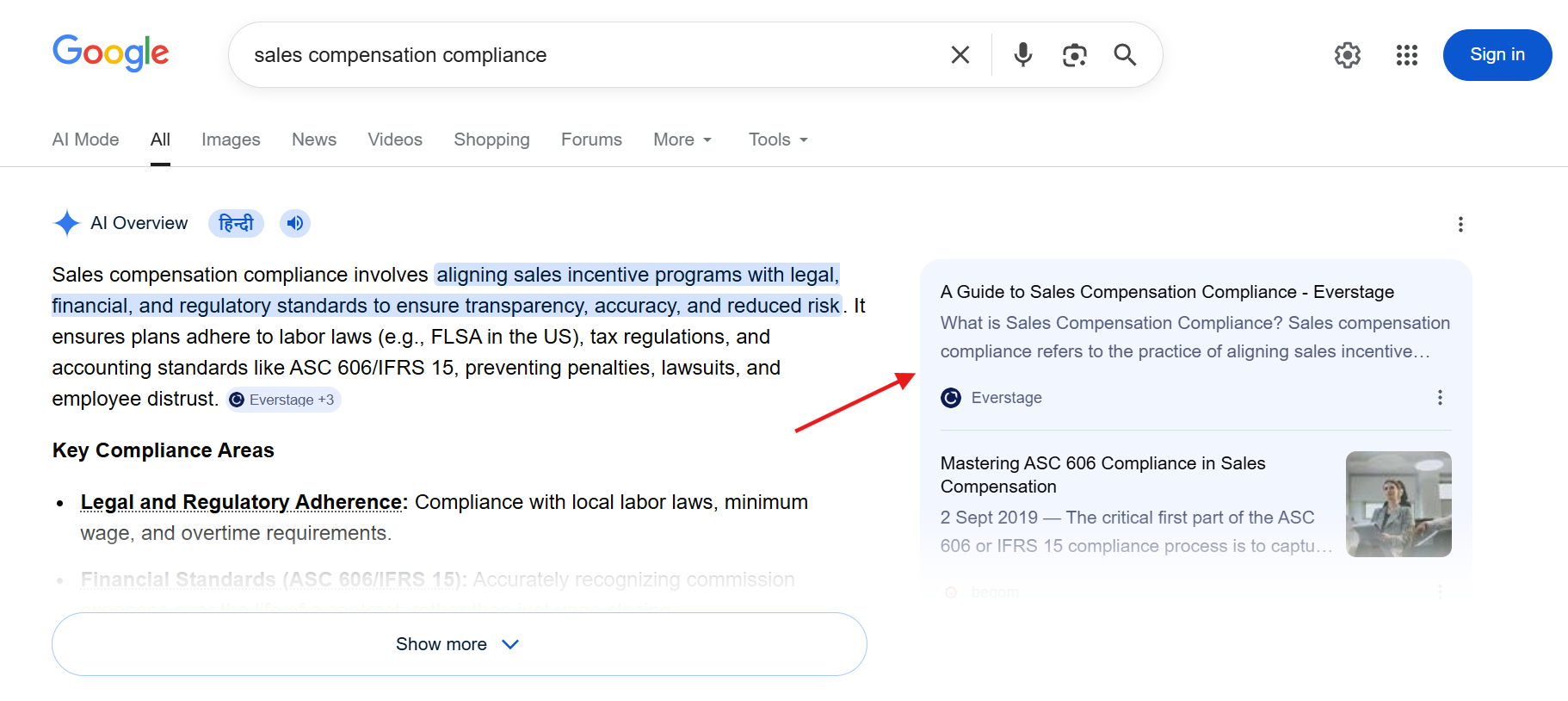
Everstage (B2B SaaS – ICM & Sales Compensation): Over 40 long-form blog posts published within 2 months; appeared on Google AI Overviews for “enterprise sales compensation” and other relevant keywords; actively referenced in ChatGPT and Perplexity.
OvalEdge (B2B SaaS – Data Governance): Highest lead count of 138 leads generated in March 2026; LLM referral sessions increased by 178%; top page received 519 monthly clicks; referenced as the main source for data governance and open-source data catalog queries on several AI platforms.
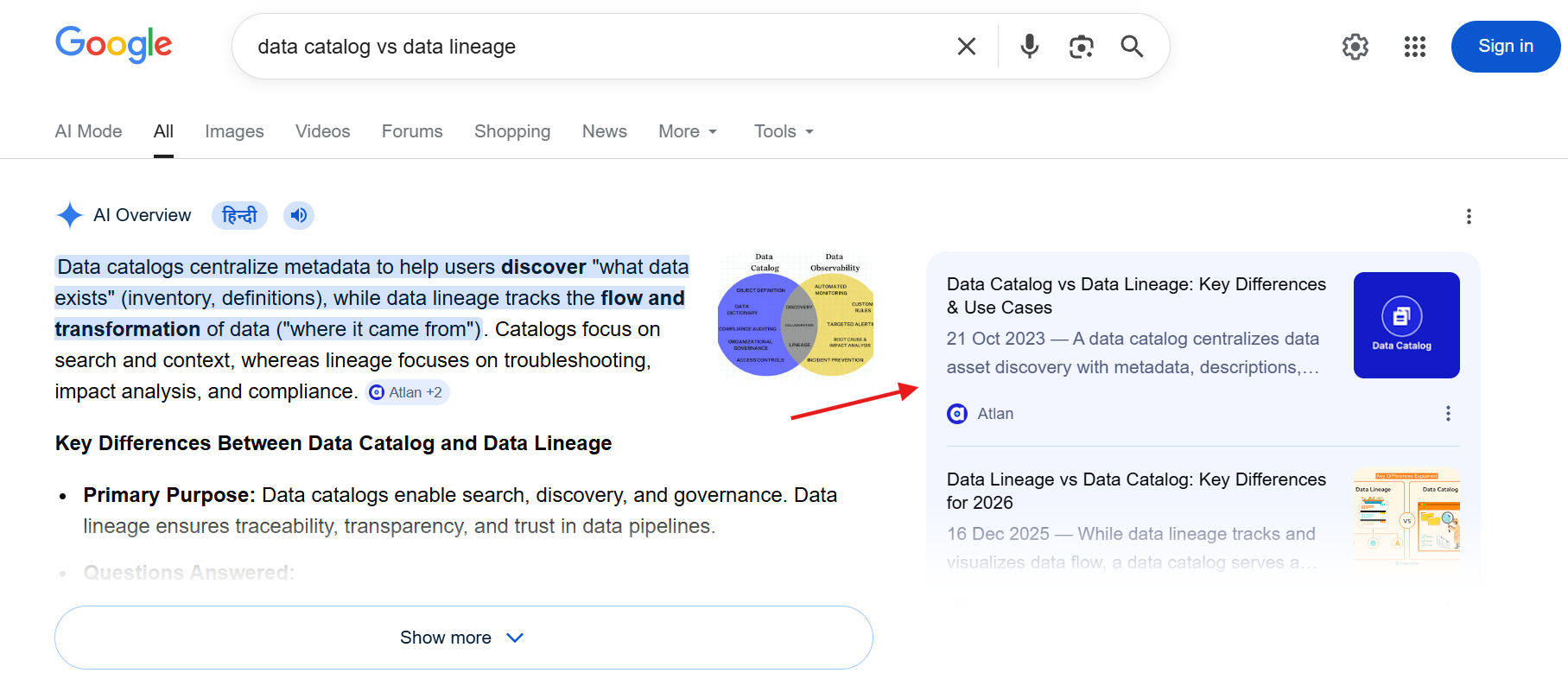
Atlan (Data Collaboration Platform): More than 130 blogs written with SEO optimizations published each month; secured several Google Featured Snippets; featured in Google AI Overviews for “data catalog vs data lineage” and other related searches; served as the primary source in ChatGPT 40.
AI engines have become the first point of contact for millions of research requests by professionals. The brands that will get cited in the future are setting themselves up for this now by creating the process to earn citations. This system encompasses all facets of citation from discovery to architecture, implementation, technology readiness, authority development, and measurement.
Are you intrigued by our AEO methodology and would like to see how this would play out in the context of your brand? Schedule a call with us, and we’ll run through the process with you.
[Book a demo with our AEO experts]
Key Takeaways
The focus of search is moving away from links to answers. No longer do people have to sift through various websites for information; now, they depend on artificial intelligence tools such as Google AI Overviews, Perplexity AI, and ChatGPT to give them immediate answers. This is where AEO comes into play.
- AEO is about being the solution, not just appearing in search results
- Organize information around clearly defined questions & answers (40-60 words)
- Format information for easy extraction by AI: lists, instructions, charts, FAQs
- Establish entity authority using clustering, markup, and cross-channel signals
- Focus on E-E-A-T and unique perspectives to improve the chances of citations
- Ensure robust technical infrastructure: schema markup, crawlability, fast-loading website
- Assess performance based on AI mentions, citations, and share of voice, not clicks alone
- Cross-channel consistency on various platforms (LinkedIn, G2, Reddit) improves AI credibility
- The effects of the AEO compound over time: early adopters have a significant visibility edge
FAQs: AEO Best Practices
What is AEO optimization, and why is it important?
.svg)
Answer engine optimization (AEO) is the process of structuring content so AI systems and search engines can extract and present it as a direct answer to user queries. It matters because search platforms increasingly provide answers directly in the results page instead of sending users to multiple websites. Optimizing for AEO helps ensure your content is cited or summarized in those AI-generated responses.
How do I optimize my site for ChatGPT, Perplexity, and Bing Copilot?
Start by structuring your content around clear questions and concise answers. Place a short explanation directly after the heading and support it with well-organized sections. Consistent entity signals and structured data also help AI systems understand and reference your content.
How is AEO different from traditional SEO?
Traditional SEO focuses on ranking pages in search results. AEO focuses on making your content the answer that AI systems summarize or cite. While SEO prioritizes keywords and backlinks, AEO emphasizes clear answers, structured formatting, and entity signals.
What technical elements should I prioritize for AEO?
Key technical elements include clean semantic HTML, structured data, and fast-loading pages. These help search engines and AI systems interpret your content more easily. Clear heading structures and accessible HTML also improve answer extraction.
How do I track and measure AEO impact?
AEO performance is usually measured by visibility in AI-generated answers rather than just traffic. This includes checking whether your brand or content appears in AI summaries or citations. Monitoring impressions, brand mentions, and assisted conversions can help show the impact.
What content formats work best for AI citation?
Answer engines prefer content that is clearly structured and easy to extract. Short definitions, concise explanations, and structured sections improve the chances of appearing in AI answers. Headings followed by direct answers are particularly effective.
How often should content be updated for AEO?
Content should typically be reviewed every three to six months. Updating statistics, examples, and explanations helps maintain freshness signals. Regular updates also improve the likelihood that AI systems will cite the content.
How do off-site signals like Reddit or Wikipedia help AEO?
AI systems often rely on information that appears consistently across multiple sources. When a topic or brand is referenced across trusted platforms, it strengthens entity credibility. This consensus increases the chances of content being cited in AI answers.
How can brands address incorrect AI answers or brand mentions?
If AI systems generate incorrect information, the first step is correcting the underlying sources where the information appears. Ensuring accurate brand details across trusted platforms helps reduce future errors. Most AI platforms also allow users to submit feedback to report inaccurate responses.
.svg)


.webp)
.avif)