
Introduction
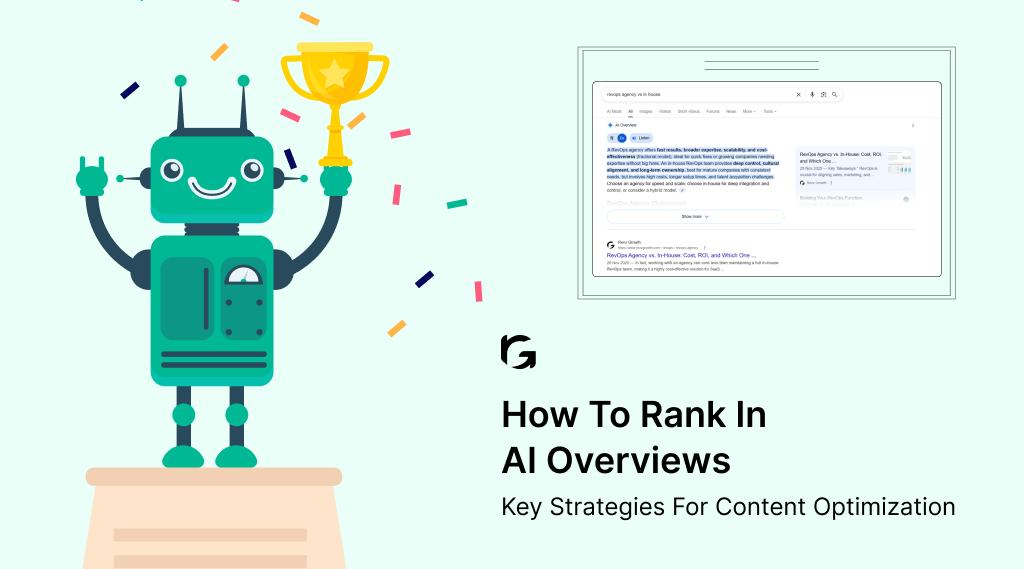
If you've searched Google lately, you've probably noticed something different at the top of results: AI-generated answer boxes that pull information from multiple sources and summarize it right there on the search page.
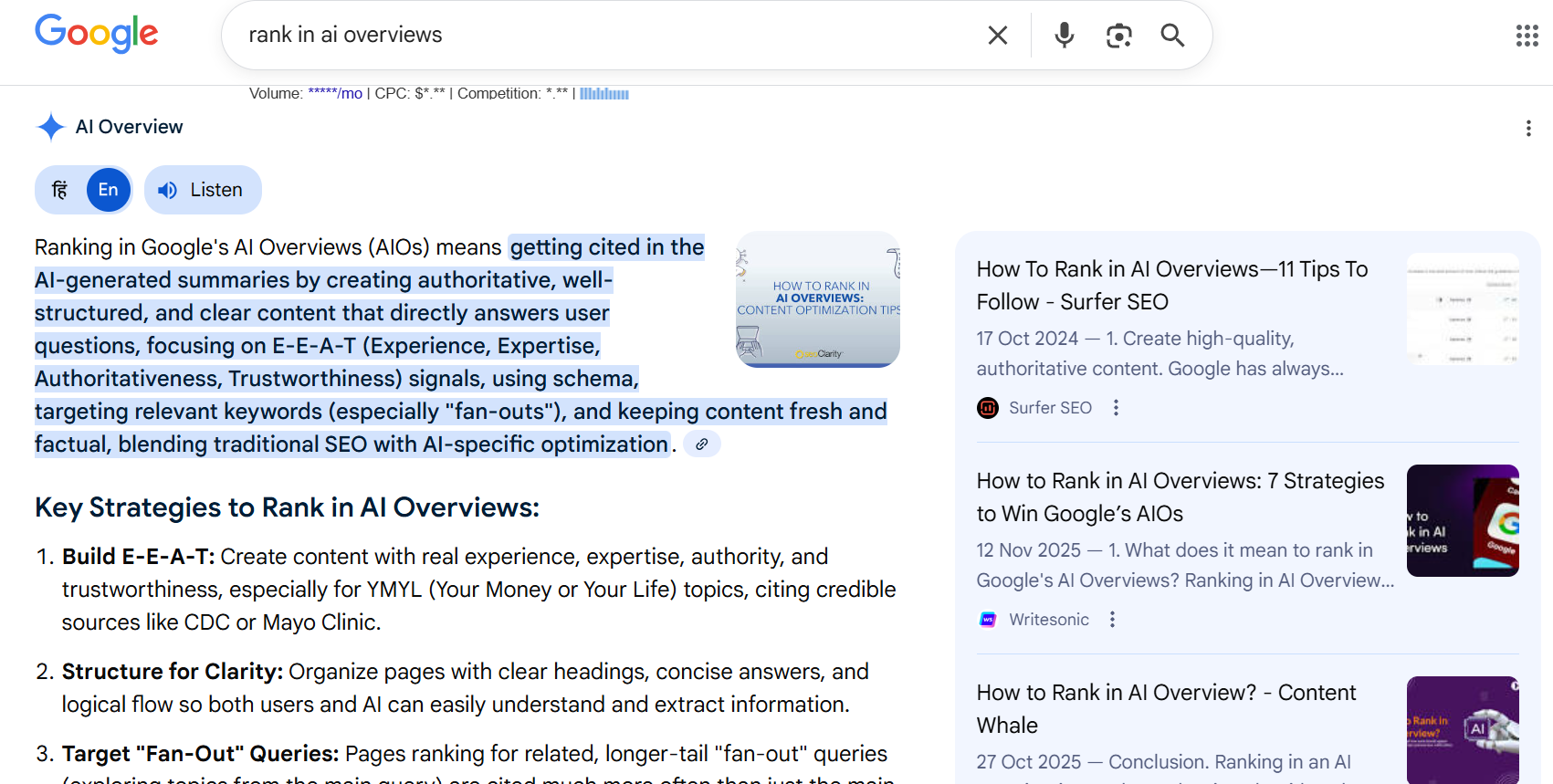
These are Google's AI Overviews, and they're changing the game for SEO.
The problem? People are getting their answers without clicking through to your site. All that work you put into ranking on page one feels less valuable when the AI just extracts your answer and presents it as part of a summary.
But before you panic about zero-click searches killing your traffic, consider this: Getting cited in AI Overviews can actually be more valuable than a traditional ranking. When Google's AI pulls from your content, you're being positioned as a trusted authority. Your brand shows up right at the top, alongside the answer people are looking for.
The catch is that you can't optimize for AI Overviews the same way you've been optimizing for traditional search. The rules are different. AI systems care less about keyword stuffing and more about how clearly and directly you answer questions. They reward structure, not fluff. They prioritize content that's easy to extract and synthesize.
Most SEO advice on this topic is theoretical. We're going to skip that and give you the practical playbook instead. This guide breaks down exactly how Google selects sources for AI Overviews, what makes content "AI-ready," and the specific steps you can take to increase your chances of being featured.
Let's get into it.
What Are AI Overviews?
AI Overviews are Google's AI-generated answer summaries that appear at the top of search results. They used to be called Search Generative Experience (SGE) during the testing phase, but Google officially launched them as AI Overviews in mid-2024.
Here's how they work: When you search for something, Google's AI pulls information from multiple sources across the web, synthesizes it, and presents a cohesive answer right there on the search results page. You get the information you need without clicking through to any individual site.
Think of it like this: Instead of reading five different articles to understand a topic, the AI does that work for you and gives you the consolidated answer upfront. It typically includes citations to the sources it pulled from, but those show up as small links within or below the summary.
How AI Overviews are different from featured snippets
If you're familiar with featured snippets, AI Overviews might seem similar. But there's a key difference.
Featured snippets pull content directly from a single source. You see a block of text or a list, and it's attributed to one specific page. If your content gets featured, you own that snippet.
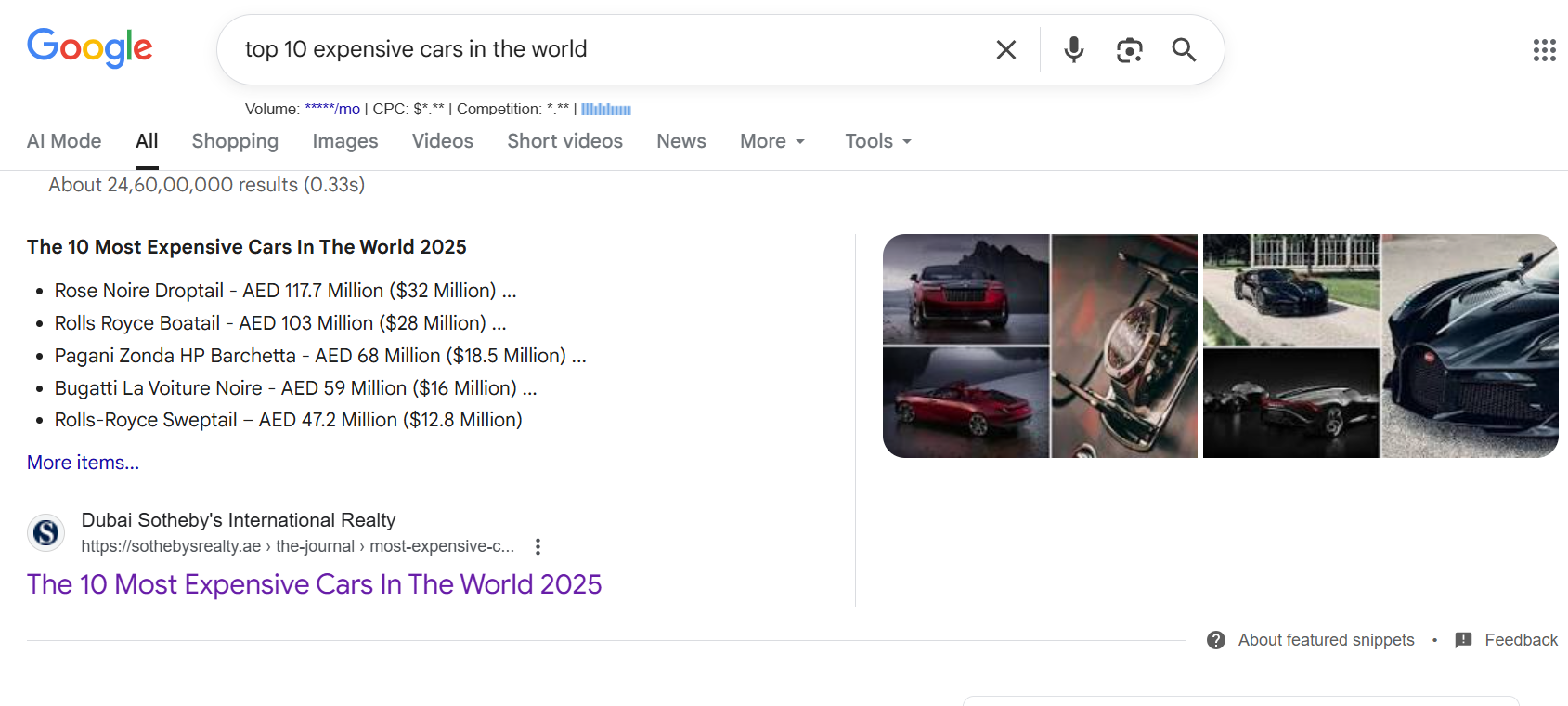
AI Overviews synthesize information from multiple sources. The AI reads several pages, extracts relevant information from each, and creates a new summary that combines insights from all of them. You might be one of five sources cited, or you might not be cited at all, even if your content was used.
When do AI Overviews appear?
You won't see AI Overviews for every search. Google tends to show them for informational queries where people are looking for explanations, definitions, comparisons, or how-to guidance.
Common trigger patterns include:
- "How to" questions (how to optimize for AI search)
- "What is" definitions (what is account-based marketing)
- Comparison queries (Salesforce vs HubSpot)
- Problem-solving searches (why is my email deliverability low)
Transactional searches like "buy project management software" or navigational searches like "LinkedIn login" typically don't trigger AI Overviews. Google knows you're not looking for an explanation in those cases.
How Google AI Overviews Choose Sources
This is the part everyone wants to know: How does Google decide which content to cite in AI Overviews?
Google hasn't published an official algorithm for this (and probably never will), but we've spent months analyzing AI Overviews across hundreds of queries for our clients at Revv Growth. The patterns are clear. Sources that consistently get cited share specific characteristics. Here's what we've found.
1. Topical authority and E-E-A-T signals
Google's AI doesn't just grab content from anywhere. It prioritizes sources that demonstrate expertise, experience, authoritativeness, and trustworthiness. This isn't new, but it matters even more for AI Overviews.
Pages that get cited tend to come from sites with:
- Strong domain authority in their niche
- Author bios that establish credibility
- Consistent publishing history on the topic
- Backlinks from other authoritative sources
If you're a B2B SaaS company writing about marketing automation, your content is more likely to be cited than a random blog with no established authority in that space. Google's AI recognizes topical expertise, and it weighs that heavily when choosing sources.
We've seen this play out with our own clients. Sites with established thought leadership in their vertical get cited more frequently than newer sites, even when the content quality is comparable. Authority matters.
2. Content clarity and directness
Here's where things get different from traditional SEO. AI systems don't care about your clever introduction or your storytelling arc. They're looking for clear, direct answers that can be easily extracted.
Pages that get cited usually:
- Answer the question within the first 100-150 words
- Use definitive, straightforward language
- Avoid ambiguity or hedging ("this might work" vs "this works")
- Present information in a logical, scannable structure
Think about it from the AI's perspective: It needs to quickly identify the answer, extract it cleanly, and integrate it into a summary. If your content is buried under three paragraphs of context or written in vague marketing language, the AI will move on to a clearer source.
When we audit content for AI Overview optimization at Revv Growth, one of the first things we look for is whether the answer appears early and clearly.
Most B2B content fails this test. Companies spend 300 words setting up context before they get to the actual answer. That's fine for human readers who are committed to reading the whole article, but it's a deal breaker for AI extraction.
3. Structured data and formatting
AI systems love structure because it makes extraction easier. Pages with clean HTML, proper heading hierarchies, and structured data markup have a significant advantage.
We consistently see citations from pages that use:
- Descriptive H2 and H3 headers that match question patterns
- Short paragraphs (2-4 sentences)
- Bulleted or numbered lists
- Tables that organize information
- Schema markup for FAQs, How To, or Article content
The formatting signals to Google's AI that this content is well-organized and easy to parse. That increases the likelihood of citation.
In our testing, pages with FAQ schema or How To schema get cited at roughly twice the rate of pages without structured data, assuming the content quality is equal. The structure makes it easier for the AI to understand what the content is about and how to extract specific pieces of information.
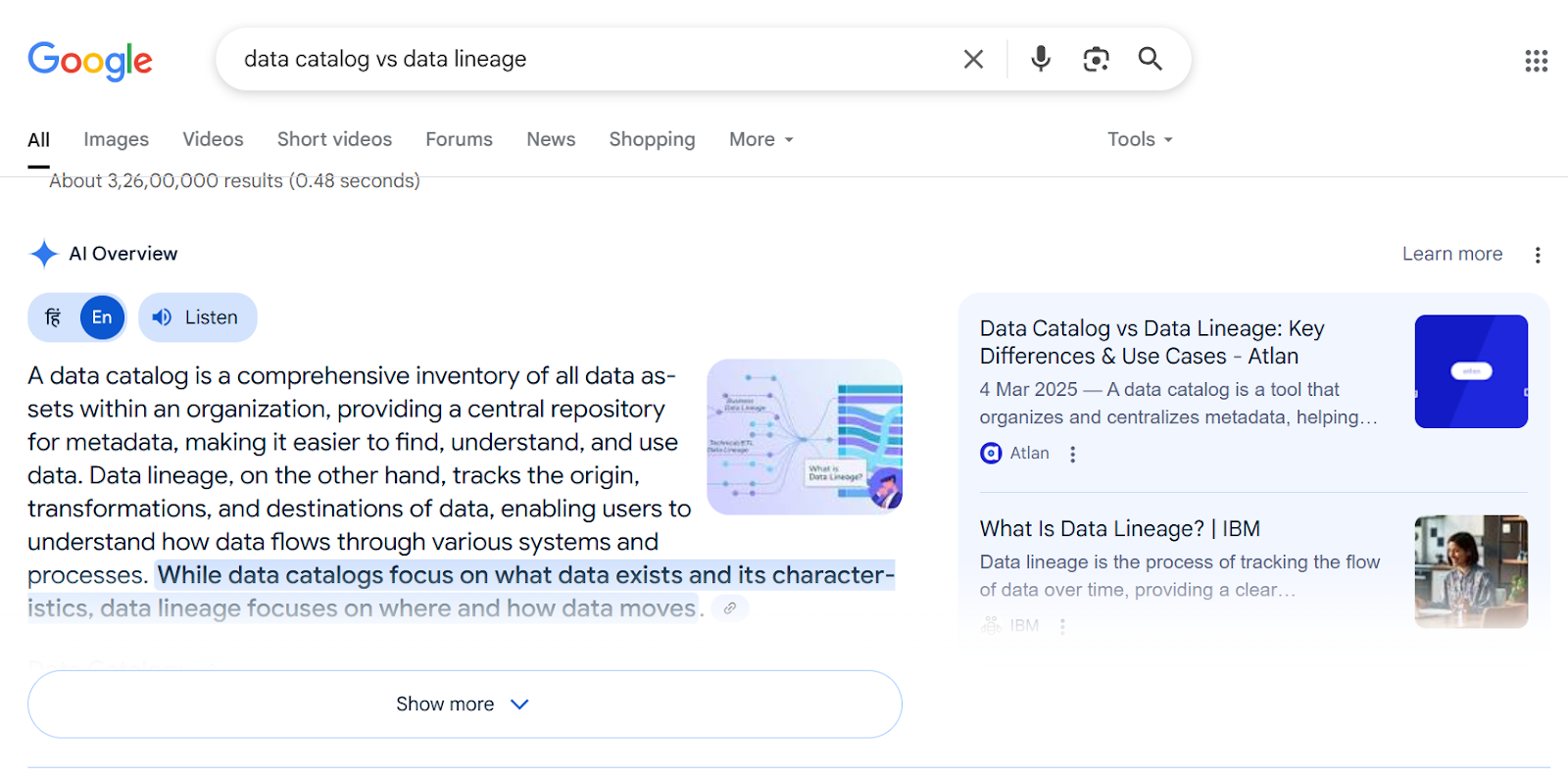
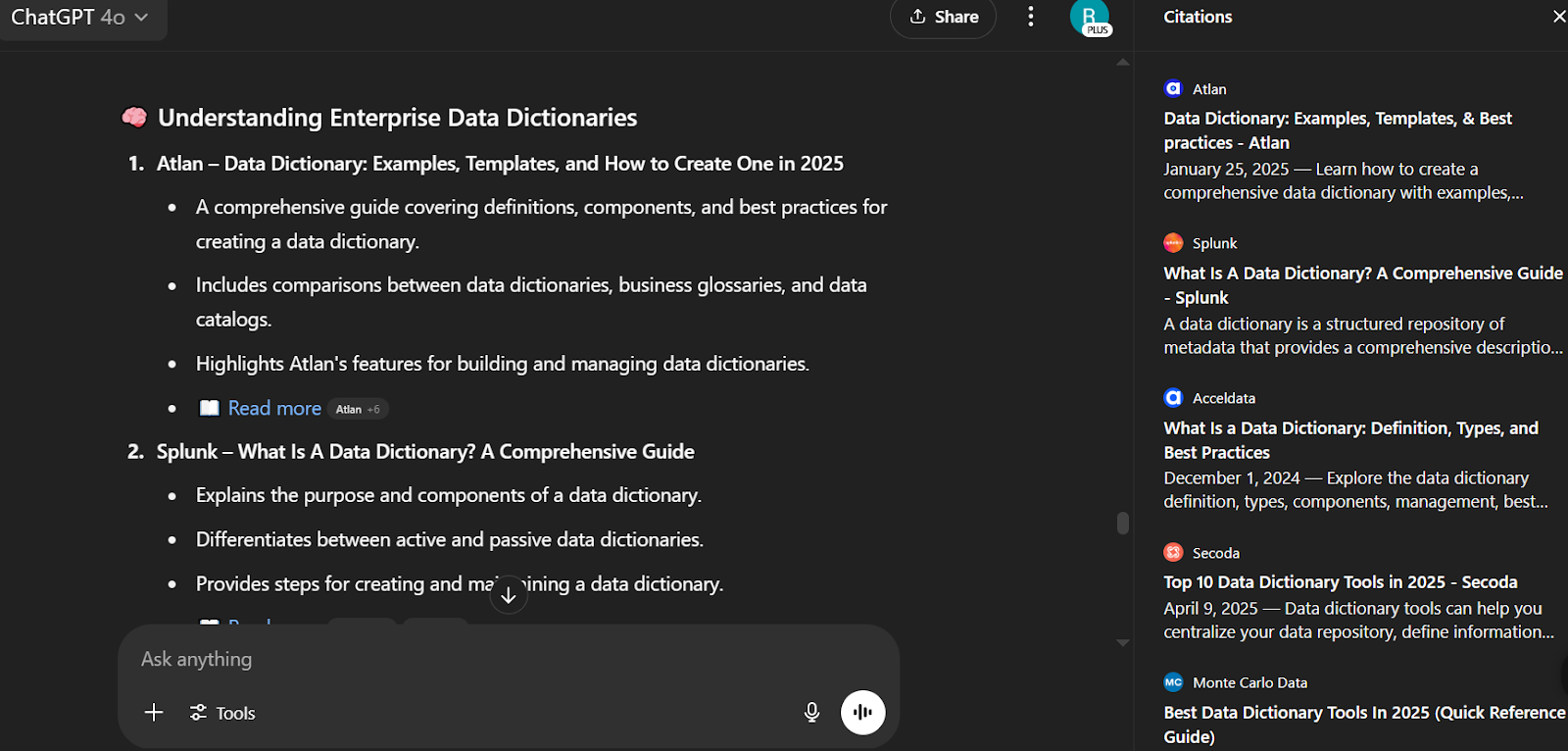
We saw this firsthand when working with Atlan, a data collaboration platform. By structuring content specifically for featured snippet formats (definitions, lists, structured paragraphs) and optimizing for extractability, their content not only secured multiple Google featured snippets but also started appearing in AI chatbots like ChatGPT. The key was making the content easy for AI systems to parse and cite.
4. Intent alignment
This one's critical: Your content needs to match what the searcher actually wants.
If someone searches "how to create a content calendar," they want step-by-step instructions, not a philosophical essay about the importance of planning. AI Overviews prioritize content that directly addresses the user's intent.
This means you need to:
- Understand what people are really asking when they search for a keyword
- Analyze the current AI Overviews and featured snippets for that query
- Deliver content that matches or exceeds that level of relevance
Intent alignment is about understanding the job the searcher is trying to get done and making sure your content does that job better than anyone else's.
5. Entity recognition and clarity
Google's AI needs to understand what your content is about at an entity level. That means it needs to recognize the people, products, concepts, and relationships you're discussing.
Content that gets cited tends to:
- Define terms and concepts explicitly
- Use consistent terminology throughout
- Provide context about who, what, where, and when
- Connect related entities in clear ways
For example, if you're writing about "lead scoring," don't assume the AI knows what that means. Define it. Explain how it relates to marketing automation, CRM systems, and sales processes. The clearer you are about entities and relationships, the easier it is for AI to understand and cite your content.
An important caveat: Rankings don't guarantee citations
Here's something that surprises people: Content cited in AI Overviews doesn't always come from the top 10 organic results.
We've tracked cases where pages ranking at position 15 or 20 get cited in AI Overviews while higher-ranking pages get ignored. Why? Because the AI is optimizing for a different goal. It's not looking for the "best" page by traditional SEO metrics. It's looking for the page with the clearest, most extractable answer.
This is actually good news. It means you don't have to outrank your competitors on every metric to get featured. You just need to present your information in a way that makes it easy for the AI to use.
At Revv Growth, we've helped clients get featured in AI Overviews for competitive keywords where they weren't even ranking on page one organically. The difference? We restructured their content to prioritize clarity, directness, and extractability over traditional SEO factors.
The Core Principles: What Makes Content AI Overview-Ready
Now that you understand how Google selects sources, let's get into the practical principles that make content easy for AI systems to extract and cite.
These aren't theoretical best practices. These are the specific characteristics we build into every piece of content we create at Revv Growth when we're optimizing for AI visibility.
1. Answer Questions Directly and Early
The biggest mistake we see in B2B content? Burying the answer.
Most articles follow the traditional blog structure: intro, context, background, maybe some company positioning, and then finally, three scrolls down, the actual answer to the question.
That doesn't work for AI Overviews.
AI systems scan content looking for the answer. If they have to wade through 400 words of setup to find it, they'll move on to a source that gets to the point faster.
What this looks like in practice:
Your first 100-150 words should directly answer the core question. No fluff. No preamble. Just the answer.
If someone searches "what is customer data platform," your opening should be something like:
"A customer data platform (CDP) is a software system that consolidates customer data from multiple sources into a single, unified database. It collects data from websites, mobile apps, CRM systems, email platforms, and other touchpoints, then makes that data accessible to other marketing and analytics tools."
You can add context and depth later. But the answer needs to come first.
Before and after example:
- Before (typical structure): "In today's digital landscape, businesses are collecting more customer data than ever before. With touchpoints spanning multiple channels and platforms, understanding your customers has become increasingly complex. Companies need a way to make sense of all this information. That's where customer data platforms come in..."
- After (AI-ready structure): "A customer data platform (CDP) consolidates customer data from multiple sources into a single database, making it accessible across your marketing and analytics tools. CDPs collect behavioral data, transaction history, and demographic information from websites, apps, CRM systems, and email platforms, then unify it under individual customer profiles."
See the difference? The second version answers the question immediately. The AI can extract that answer cleanly and move on.
2. Structure for Scannability
AI systems don't read content the way humans do. They scan for patterns, structure, and signals that indicate where information lives.
That means your content needs to be organized in a way that makes extraction easy.
1. Use descriptive headers that match question patterns
Your H2 and H3 tags should reflect the questions people are actually asking. Not clever or creative headlines. Actual questions.
If you're writing about email deliverability, use headers like:
- "What affects email deliverability?"
- "How to improve email deliverability."
- "Common email deliverability mistakes"
These headers tell the AI exactly what information is in each section. That makes it easier to pull relevant answers.
2. Keep paragraphs short
Long, dense paragraphs are hard for AI to parse. Aim for 2-4 sentences per paragraph. Each paragraph should cover one clear idea.
Short paragraphs also make your content more scannable for human readers, which improves engagement signals that Google tracks.
3. Use lists and tables strategically
Bulleted lists and tables are gold for AI extraction. They present information in a structured format that's easy to pull from.
When you're explaining a process, use numbered lists. When you're comparing options, use tables. When you're listing features or benefits, use bullets.
Just don't overdo it. Lists work when they organize information logically. Random bullets scattered throughout your content don't help anyone.
Example of strategic list usage:
Instead of writing: "There are several factors that affect email deliverability. Your sender reputation matters a lot, and so does the quality of your email list. Authentication protocols like SPF, DKIM, and DMARC play a role too. Content quality and engagement rates are also important."
Write: "Five factors affect email deliverability:
- Sender reputation and domain authority
- Email list quality and hygiene
- Authentication protocols (SPF, DKIM, DMARC)
- Content quality and spam trigger words
- Engagement rates (opens, clicks, replies)"
The second format is easier for AI to extract and easier for readers to scan.
3. Demonstrate Topical Authority
AI systems prioritize sources that demonstrate expertise. That means you need to show, not just tell, that you know what you're talking about.
1. Cover topics comprehensively
Surface-level content doesn't get cited. AI Overviews pull from sources that go deep on a topic and cover multiple angles.
If you're writing about "sales forecasting," don't just explain what it is. Cover the methods, the challenges, the tools, the best practices, and the common mistakes. Show that you understand the topic inside and out.
2. Link to related content on your site
Internal linking helps establish topical authority. When you link to other relevant articles on your site, you're signaling to Google that you have comprehensive coverage of a topic area.
This also helps Google understand the relationship between different concepts in your content, which improves entity recognition.
3. Reference credible external sources
Citing authoritative external sources like Gartner, Forresster, Mckinsey, etc adds credibility to your content. It shows you've done your research and you're building on established knowledge.
This matters especially for YMYL (Your Money Your Life) topics or technical subjects where accuracy is critical.
4. Update content regularly
Fresh content gets prioritized by AI systems. If your article was published three years ago and hasn't been touched since, it's less likely to be cited than a recently updated piece.
At Revv Growth, we build content refresh cycles into our client strategies. Regular updates signal that the information is current and maintained.
4. Optimize for Entity Clarity
This one's more technical, but it's important: Google's AI needs to understand the entities (people, places, products, concepts) in your content and how they relate to each other.
1. Define terms explicitly
Don't assume the AI knows what you're talking about. Define key terms, especially if they're industry-specific or technical.
If you mention "lead scoring," define it. If you reference "account-based marketing," explain what that means. Clear definitions help the AI understand context.
2. Use consistent terminology
Pick one term for each concept and stick with it throughout the article. If you're talking about "customer data platforms," don't switch between CDP, customer database, and data management platform. Pick one primary term and use it consistently.
Variation might feel more natural to human readers, but it confuses AI systems that are trying to understand what you're discussing.
3. Provide context about relationships
Help the AI understand how different entities connect. If you're discussing "Salesforce integration with HubSpot," explain what each platform does and why companies integrate them.
The clearer you are about relationships and context, the easier it is for AI to extract and accurately represent your information.
These four principles form the foundation of AI-ready content. When you apply them consistently, you're making it easy for AI systems to understand, extract, and cite your content.
Also read → Top AEO Agencies in 2026: Get Your Brand Featured in AI Search & Snippets
Actionable Steps to Optimize for AI Overviews
Alright, principles are great. But let's get tactical. Here's exactly what you need to do to optimize your content for AI Overviews.
Step 1: Target the Right Keywords
AI Overviews often pull from content answering clear informational queries. Focus on “how to,” “what is,” “why,” and comparison searches, such as "how to structure a content calendar" or "what is email marketing automation."
Use tools like Semrush or Ahrefs to find question-based keywords with decent search volume (100-500 searches per month). These tend to trigger AI overviews and offer less competition than high-volume keywords.
Step 2: Format Content for Easy Extraction
Structure your content for maximum AI extractability. Start with a concise, 40-60-word answer block early in the content. Make sure this block answers the query directly, and place it within the first 150 words.
Use structured data like FAQ, How To, and Article schemas to tell Google exactly what your content is about. Also, incorporate tables or lists when presenting comparisons or data, as AI systems prefer these formats for quick extraction.
Step 3: Build Strong E-E-A-T Signals
AI prioritizes content from credible sources. Include author bios with credentials, link to authoritative external sources, and use case studies or original research to demonstrate your expertise.
Ensure your "About Us" page highlights your authority, and back up claims with data from recognized research or industry authorities. These E-E-A-T signals increase your chances of being featured in AI overviews.
Step 4: Improve Technical SEO Foundations
Solid technical SEO is essential. Ensure fast page speed by optimizing Core Web Vitals, mobile optimization for responsive design, and a clean, crawlable structure. Secure your site with HTTPS, and use proper canonical tags to avoid duplicate content. These technical elements help AI systems access and evaluate your content.
Step 5: Create Answer-First Content Architecture
Design your content to answer specific sub-questions directly. Reverse-engineer the current AI overviews for your target keywords, and create content that fills gaps or presents the answer more clearly. Use FAQs to address common queries and implement the FAQ schema for easy extraction.
Step 6: Test and Iterate
Monitor which of your pages are featured in AI overviews using Google Search Console or SEO tools. A/B test answer formats, FAQ placement, and schema implementations. Learn from competitors and update your content regularly to keep it fresh, ensuring it stays relevant for AI systems.
These six steps give you a complete framework for optimizing content to rank in AI Overviews. It's not magic, and it's not overnight. But if you follow this process consistently, you'll see results.
Common Mistakes to Avoid in Optimizing for AI Overviews
To successfully rank in AI-generated overviews, it’s crucial to avoid these common mistakes:
Mistake 1: Burying the Answer Too Deep in the Content
AI systems prioritize answers that are clear and accessible right away. If your core answer is buried too deep in the content, AI may miss it. Always provide your direct answer in the first 100-150 words of your content, ideally before diving into detailed explanations.
Mistake 2: Using Vague or Marketing-Speak Language Instead of Clear Answers
AI systems prefer clarity and precision. Avoid using buzzwords, jargon, or overly promotional language that can confuse AI algorithms. Instead, focus on providing straightforward, definitive answers that directly address the user’s query.
Mistake 3: Ignoring Structured Data and Formatting
Structured data is crucial for AI systems to correctly interpret and extract your content. Without using schema markup (like FAQ, How To, or Article schemas), your content may be overlooked by AI. Additionally, proper formatting, such as bullet points, numbered lists, and clear headers, makes your content more scannable and easier for AI to extract.
Mistake 4: Focusing Only on High-Volume Keywords
While high-volume keywords are important, don’t overlook low-volume, question-based queries. These long-tail keywords often trigger AI overviews and have less competition. Target informational queries that match common user questions, even if they don’t have massive search volume.
Mistake 5: Publishing Thin Content Without Depth or Authority
AI systems favor content that demonstrates depth and expertise. Avoid publishing superficial content that only scratches the surface. Provide comprehensive, well-researched information, and support your claims with credible sources to establish authority.
Mistake 6: Not Updating Existing Content (Freshness Matters)
AI values fresh, up-to-date content. If your articles are outdated, they may be bypassed in favor of newer, more relevant content. Regularly review and refresh your content to keep it aligned with the latest trends and information, ensuring it remains competitive in AI overviews.
By avoiding these mistakes, you can optimize your content more effectively for AI overviews and improve your chances of being featured in Google's AI-generated search summaries.
Tools and Resources for Optimizing AI Overviews
To successfully optimize your content for AI Overviews, you’ll need the right tools and resources to track performance, implement structured data, and analyze your results.
Here are some key tools and resources to help you along the way:
1. Google Search Console
Google Search Console is an essential tool for tracking the performance of your content in search results. Use it to monitor impressions and clicks, see which pages are being featured in AI Overviews, and identify opportunities for optimization. It’s an invaluable resource to understand how AI is interacting with your content.
2. Schema Markup Generators
Structured data helps AI systems understand your content more effectively. Using schema markup generators (like Schema.org or plugins like Yoast SEO for WordPress) simplifies the process of adding structured data to your pages. Markup types like FAQ, HowTo, and Article schemas tell AI what to extract, making it more likely your content will be featured in AI summaries.
3. SEO Tools That Track AI Overview Appearances
Several SEO tools allow you to track AI Overview appearances and monitor keyword performance. Tools like Semrush, Ahrefs, and BrightEdge provide insights into which pages are being cited in AI overviews, helping you identify which content is working and which may need further optimization. These tools also allow you to research question-based keywords that often trigger AI Overviews.
4. Google’s AI Overview Documentation
Google’s official documentation on AI overviews is a valuable resource for understanding how Google’s algorithms generate AI answers. It offers insights into how AI systems process content and what Google looks for when selecting which pages to include in overviews.
This documentation is essential for staying up-to-date on how to optimize content for Google’s evolving AI tools.
5. Testing Tools to Preview How Content Appears
Before publishing, use testing tools to preview how your content might appear in search results. Tools like Google’s Structured Data Testing Tool or Rich Results Test can help you verify if your structured data is implemented correctly. Additionally, testing tools like Screaming Frog or ContentKing can help ensure that your content is technically optimized for crawling and extraction by AI systems.
By leveraging these tools and resources, you’ll be able to track your AI Overview performance, implement the right structured data, and continuously optimize your content for better results in AI-driven search summaries.
Conclusion
AI Overviews are changing the way we approach SEO, and optimizing your content for them is more important than ever. By focusing on clarity, structure, and authority, you can increase your chances of being featured in these AI-generated summaries.
The key is to create content that answers questions directly, is easy to read and scan, and demonstrates expertise, qualities that AI systems prioritize.
Now is the time to get ahead. Those who start optimizing for AI overviews today will have a distinct advantage as AI continues to shape search results. It's not just about ranking for today, but setting yourself up for sustained visibility in the future.
To get started, pick one high-value piece of content and apply the principles we’ve covered. Whether it’s targeting the right keywords, improving your content structure, or adding strong E-E-A-T signals, every step will bring you closer to optimizing for AI-driven search results.
Remember, the best optimization for AI comes down to creating genuinely helpful content. When you provide real value, both your audience and AI systems will recognize it.
If you’re ready to optimize your content for AI Overviews, we can help. Get a free AI Overviews audit today to see how your content is performing and what improvements can be made. Let’s work together to make sure your content stands out in the AI-powered future of search.

.svg)
.png)


.webp)