

Introduction
Search is broken. Or at least, the way we've been thinking about it is.
Right now, millions of people are asking questions to ChatGPT, Perplexity, and Google's AI Overviews instead of scrolling through ten blue links. They're getting complete answers without ever clicking on a website. And if your brand isn't part of those answers, you might as well not exist.
The numbers tell the story. Gartner predicts that by 2026, traditional search engine volume will drop 25% due to AI chatbots and virtual agents. Meanwhile, nearly 60% of Google searches now end without a single click, according to SparkToro's 2024 analysis.
Traditional SEO focused on getting people to your website. Answer Engine Optimization (AEO) is about making sure AI systems actually talk about your brand when people ask questions. It's about being cited, quoted, and recommended before users ever see a search result.
The shift is massive, and the window to adapt is closing. Companies that optimize for answer engines now will own their categories tomorrow. Those who don't risk becoming invisible to the fastest-growing segment of searchers.
This guide walks through the 11 most important AEO trends shaping 2026. No fluff, no theory. Just the practical strategies working right now to help brands show up where their buyers are actually searching.
What is Answer Engine Optimization (AEO)?
Answer Engine Optimization (AEO) is the practice of optimizing your content so AI systems like ChatGPT, Perplexity, Google AI Overviews, Claude, and Gemini can easily understand, extract, and cite your brand as the authoritative answer to user queries.
Here's the fundamental difference: SEO aims for clicks and rankings. AEO aims for citations, mentions, and brand authority within AI-generated responses.
The buying journey has fundamentally changed. Discovery now happens inside AI answers before users ever reach your website. Someone researching project management software might ask ChatGPT for recommendations, get a detailed comparison with the three top options, and form an opinion about your brand without ever visiting your site. If you're not in that answer, you don't exist to that buyer.
The scale of this shift is staggering. ChatGPT reached 800 million weekly active users by October 2025, according to OpenAI CEO Sam Altman. Meanwhile, 91.3% of queries that trigger Google AI Overviews are informational, according to Semrush's analysis of over 10 million keywords. These aren't experimental features anymore. They're how millions of people search every single day.
Traditional SEO isn't dead, but it's no longer enough. You need both. SEO gets you found in traditional search results. AEO ensures AI platforms actually recommend you when it matters most.
Why Answer Engine Optimization Matters More Than Ever in 2026
The business case for AEO isn't theoretical anymore. It's showing up in traffic reports, conversion data, and revenue numbers across every industry. Here's why this matters right now.
The Zero-Click Search Reality
Nearly 60% of Google searches now end without a single click. Users get their answers directly on the search results page and move on. SparkToro's 2024 analysis found that for every 1,000 US Google searches, only 360 clicks go to the open web.
When Google AI Overviews appear, the impact on traditional organic results is even more severe. Research analyzing over 300,000 keywords found a 34.5% decrease in click-through rates for top-ranking pages when AI Overviews are present.
“In fact, if you put content and links within AI Overviews, they get higher clickthrough rates than if you put it outside of AI Overviews.” – Sundar Pichai, CEO, Google
This means your content must work as brand marketing, not just traffic generation. Even if users don't click through, being cited in an AI answer builds awareness, credibility, and preference.
AI Search Adoption is Accelerating
The numbers don't lie. AI-powered search has gone from experiment to everyday habit faster than almost any technology in history.
ChatGPT's weekly active users surged from 300 million in December 2024 to 800 million by October 2025, according to OpenAI. That's more than a 2.6x increase in less than a year.
McKinsey found that 44% of AI-powered search users now consider AI their primary source of insight, compared to 31% who still rely most on traditional search.
Google AI Overviews now appear in approximately 30% of all searches and 74% of problem-solving queries, according to research from Authoritas analyzing 10,000 keywords across seven US industries.
Voice search is following the same trajectory. By 2026, voice commerce is projected to hit $80 billion, according to industry forecasts.
Brand Discovery Happens Before Website Visits
Here's what's changed: users now form opinions about your brand inside AI summaries before they ever click through to your website.
If your competitors appear in ChatGPT comparisons, Perplexity answers, or Google AI Overviews and you don't, you're starting every buyer conversation at a massive disadvantage. You're not just losing clicks. You're losing mindshare.
Early citation presence creates lasting competitive advantages. When users see your brand mentioned consistently as the solution for a specific use case or industry, that positioning becomes harder for competitors to displace over time.
The brands optimizing for answer engines now aren't just protecting traffic. They're claiming territory in the new discovery landscape while the window is still open.
The 11 Most Important AEO Trends Shaping 2026
These aren't predictions. These are the measurable shifts happening right now that separate brands winning AI visibility from those falling behind.
1. Entity-First Optimization Replaces Keyword-First Strategies
Search engines have moved beyond matching keywords to understanding entities. AI systems now map people, products, places, and concepts as interconnected nodes in a knowledge graph. They prioritize clear entity definitions over keyword density.
Entity clarity, source authority, and citation context now determine whether your brand gets mentioned in AI answers. This is fundamentally different from traditional SEO's focus on keyword placement and backlink volume.
Why it matters:
LLMs need to understand three things about your brand: what it is, who it serves, and how it compares to alternatives. Strong entity signals increase your citation frequency across all major AI platforms.
Brands with clear knowledge graph presence see measurably higher AI visibility. When Google, ChatGPT, or Perplexity can confidently identify your brand and its relationships to other entities, you show up more consistently in relevant answers.
How to optimize:
- Define entities consistently across all content. Use the exact same brand name, product names, and key concepts everywhere. Inconsistency confuses AI systems.
- Build robust Wikipedia presence and structured data markup. Wikipedia is one of the most-cited sources by AI systems. If you're notable enough for a Wikipedia page, claim and maintain it. If not, focus on getting mentioned in existing Wikipedia articles related to your industry.
- Create content that reinforces entity associations and relationships. Don't just say what your product does. Explicitly state who it's for, what category it belongs to, and how it relates to other solutions in your space.
- Use Schema.org markup religiously. Implement Organization, Product, Service, and FAQ schema on all relevant pages. This structured data helps AI systems extract and understand your information accurately.
Entity-based content with clear definitions and relationships consistently sees higher citation rates in LLM responses.
2. AI Overviews Dominate the SERP and Answer Engines
Google AI Overviews have exploded from appearing in 6.49% of queries in January 2025 to over 30% by late 2025, according to Semrush's analysis of 10 million keywords. Business and technology sectors see AI Overviews in over 33% of results.
These AI-generated summaries now appear before traditional blue links, occupying prime real estate at the top of search results. On mobile, users often need to scroll through multiple screens before seeing the first organic result.
Why it matters:
Your first impression with potential buyers now happens inside an AI summary, not on your homepage. This fundamentally changes how brand discovery works.
Zero-click behavior means you get visibility without traffic. But featured content still builds brand authority and influences later purchasing decisions. Users may not click immediately, but they remember which brands were cited as authoritative sources.
How to optimize:
- Structure content for snippet eligibility. Lead with a direct 40-60 word answer to your target question. Then expand with supporting details.
- Use H2/H3 tags that mirror question formats. Format your headers as actual questions: "What is [topic]?" "How does [solution] work?" "Why choose [approach]?"
- Include statistics, definitions, and comparison tables. AI systems love pulling specific data points. Make them easy to extract.
- Keep paragraphs brutally short. Aim for 2-3 sentences max. AI systems extract cleaner information from concise, scannable paragraphs.
Example format:
H2: What is Answer Engine Optimization?
Answer Engine Optimization (AEO) is the practice of optimizing content so AI systems can easily understand, extract, and cite your brand as the authoritative answer. Unlike traditional SEO which aims for clicks and rankings, AEO focuses on citations and brand authority within AI-generated responses.
[Supporting details with data follow...]
3. Conversational and Voice Search Optimization Becomes Standard
Voice search now accounts for over 30% of online searches. Users no longer type "project management tools." They ask, "What's the best project management tool for a remote team of 15 people?"
Queries are getting longer, more specific, and more conversational. The average voice search query contains 7-10 words compared to 2-3 words for typed searches.
Why it matters:
Voice assistants pull answers almost exclusively from featured snippets and structured content. If your content isn't formatted for voice extraction, you're invisible to this massive and growing segment of searchers.
"Near me" searches and local intent drive significant traffic for location-based businesses. Voice queries are 58% focused on local business information, representing users with extremely high purchase intent.
Natural language processing rewards content that sounds like actual human speech, not keyword-stuffed copy written for bots.
How to optimize:
- Target question-based keywords religiously. Build content around Who, What, When, Where, Why, and How questions your audience actually asks.
- Use natural, conversational language throughout your content. Write like you're explaining something to a colleague, not reciting a keyword list.
- Create FAQ sections with question-as-heading format. Use the actual questions as H2 or H3 tags, then provide direct answers immediately below.
- Optimize for long-tail conversational phrases. Instead of "CRM software," target "What CRM software works best for small insurance agencies?"
- Focus on local SEO and Google Business Profile. Keep your business information accurate, complete, and current across all platforms.
- Add speakable schema markup. This tells voice assistants which parts of your content work best for audio playback.
Voice assistant users in the US are forecast to reach 157.1 million by 2026. Meanwhile, voice commerce is expected to hit $80 billion by 2026, driven by growing voice-activated shopping behaviors.
4. Multimodal Content (Text, Images, Video) Drives AI Citations
AI systems now process text, images, audio, and video simultaneously. Google Lens alone processes over 12 billion visual searches monthly, according to Semrush's AI search trends report.
Gemini and other multimodal AI models like GPT-4o can understand content across formats. They analyze images, read text within those images, and connect visual information to written content to build comprehensive answers.
Why it matters:
Visual and video content increases your discoverability across AI platforms. When your images have proper alt text and your videos include transcripts, AI systems can cite you even when users search visually or ask questions about topics shown in your media.
Properly tagged multimedia improves AI comprehension of your content. When text, images, and video all reinforce the same message with consistent terminology, AI systems gain higher confidence in citing you as an authoritative source.
Multimodal optimization strengthens both traditional and AI search performance. The same practices that help AI understand your images also improve accessibility, page speed, and user experience.
How to optimize:
- Add descriptive alt text to all images. Don't just write "product image." Describe what's actually in the image: "Dashboard showing real-time sales analytics with quarterly revenue graphs."
- Use keyword-rich file names for media assets. Instead of "IMG_1234.jpg," use "sales-dashboard-analytics-tool.jpg."
- Include video transcripts and captions. AI systems can read transcripts to understand video content. This also makes your content accessible and indexable.
- Pair visuals with supporting text content. Don't rely on images alone to convey information. Always have text that reinforces what the visual shows.
- Add images or diagrams every 500-700 words. This improves both user experience and gives AI systems more context about your content topics.
- Use image schema markup. Implement ImageObject schema to help AI systems understand image context, licensing, and relationships to surrounding content.
Google Lens processes 12+ billion visual searches each month, demonstrating massive adoption of multimodal search behavior. The rise of multimodal search means content must be clear, organized, and accessible across all formats.
5. Structured Data and Schema Markup Are Non-Negotiable
Structured data has moved from "SEO best practice" to absolute requirement for AI visibility. Schema markup is now the foundation for how AI systems extract and understand content.
JSON-LD format has become the cleanest, most reliable implementation method. Google, ChatGPT, and other AI platforms can parse JSON-LD faster and more accurately than microdata or RDFa formats.
Why it matters:
Schema tells AI systems exactly what information exists on each page. Without it, AI must guess at your content structure, meaning, and relationships. With schema, you're explicitly labeling what everything is.
Properly structured pages appear significantly more often in AI answers. When AI systems can confidently extract your data because of clean schema markup, citation rates increase measurably.
Rich results like FAQs, How-Tos, and Product listings stand out in SERPs and get pulled into AI Overviews more frequently than plain text content.
How to optimize:
- Implement core schema types across your site. At minimum, use Organization, Product, Service, FAQ, How-To, Article, and Review schema where applicable.
- Use JSON-LD format for clean implementation. Add schema as a script block in your HTML rather than cluttering your markup with microdata attributes.
- Mark up questions and answers explicitly. Use FAQPage schema for FAQ sections and Q&A schema for individual question-answer pairs.
- Include author information and expertise signals. Use Person schema with credentials, affiliations, and areas of expertise clearly defined.
- Add breadcrumb and local business markup where relevant. Help AI systems understand your site hierarchy and, if you're a local business, your location and service areas.
Semrush's research shows that structured data is the foundation for AI content extraction. Pages with proper schema markup have measurably higher inclusion rates in AI-generated answers.
6. E-E-A-T Signals Drive Content Credibility and Citations
AI platforms now actively prioritize content demonstrating Experience, Expertise, Authoritativeness, and Trustworthiness. This isn't just Google's ranking factor anymore, it's how all AI systems evaluate source credibility.
LLMs check for proof points, not just keyword matches. They look for author credentials, publication dates, citations to reputable sources, and signals that real experts created the content.
Sourcing reputation matters more than traditional domain authority. A newer domain with clear expertise signals and transparent authorship can outperform high-authority sites with anonymous, generic content.
Why it matters:
AI systems cite content that feels legitimate and authoritative because they're optimizing for accuracy. Getting an AI answer wrong damages user trust in the AI platform itself, so they're extremely selective about sources.
Fresh content with clear authorship gets pulled more often. When AI systems can verify who wrote something, when they wrote it, and why they're qualified to write it, confidence in citing that source increases dramatically.
Third-party mentions strengthen your entity credibility. When authoritative sites mention your brand, product, or team members, AI systems gain additional confidence that you're a real, trustworthy entity worth citing.
How to optimize:
- Add detailed author bios with credentials. Don't just list a name. Include relevant experience, certifications, education, and why this person is qualified to write about this topic.
- Include publication dates and update timestamps. Show "Published: [date]" and "Last Updated: [date]" prominently. Update timestamps when you refresh content.
- Cite reputable sources and statistics. Link to original research, industry studies, government data, and other authoritative sources. This shows you're building on credible information.
- Link to original research, case studies, and customer data. First-party data and proprietary research are gold for E-E-A-T signals. AI systems love citing unique insights they can't find elsewhere.
- Get mentioned in trusted third-party publications. Digital PR, guest posting on authoritative sites, and earning editorial mentions all strengthen your entity's trustworthiness.
- Use clear, confident language (avoid hedging). Write definitively when you know something. Excessive qualifiers like "might," "possibly," "perhaps" signal uncertainty.
Content with strong author expertise signals and E-E-A-T markers shows measurably higher citation rates across AI platforms.
Need help building E-E-A-T signals into your content strategy? Revv Growth specializes in creating AEO-optimized content that AI systems actually cite.
From structured data implementation to expert-authored articles with proper credibility signals, we help B2B brands show up in the answers that matter. Get in touch to see how we can boost your AI visibility.
7. Zero-Click Searches Require New Success Metrics
Nearly 60% of Google searches now end without a click, according to SparkToro's 2024 analysis. Users get their answers directly from AI Overviews and featured snippets without ever visiting a website.
Traditional traffic metrics no longer tell the full story. You can have declining organic traffic while simultaneously increasing brand visibility and influence in your target market.
Why it matters:
Visibility and citations matter more than click-through rates in the AI era. If you're being cited in AI answers that reach millions of users, that brand exposure has real value even without immediate clicks.
Brand awareness happens inside AI responses. When ChatGPT recommends your product to 100,000 users researching solutions, those impressions influence future purchase decisions even if users don't click through immediately.
Zero-click results still influence later purchasing decisions. Users remember which brands were cited as authoritative sources. They return with branded searches when they're ready to buy.
How to optimize:
- Lead content with quotable brand positioning statements. Make it easy for AI to extract your core value proposition in one clean sentence.
- Include "best for X" descriptors early in content. Help AI systems understand your specific use case: "Best for enterprise teams managing complex projects" or "Ideal for early-stage B2B SaaS companies."
- Bake brand name into summaries and descriptions. Don't rely on page titles alone. Mention your brand name naturally throughout introductory paragraphs.
- Track AI citation metrics, not just traffic. Use tools like Profound, Conductor, or Scrunch to monitor how often your brand appears in AI-generated answers.
- Measure branded search growth as AI visibility indicator. When people see you cited in AI answers, branded search volume typically increases. Track this as a leading indicator.
- Monitor impression growth and SERP presence. Even without clicks, impressions in AI Overviews and featured snippets build awareness. Google Search Console shows impression data.
New metrics to track:
- Answer inclusion rate: How often is your brand cited when relevant queries are asked across ChatGPT, Perplexity, Google AI Overviews?
- Share of voice in AI responses: What percentage of AI answers in your category mention your brand versus competitors?
- Brand mention frequency in AI platforms: Track monthly mentions across different AI systems to identify trends.
- Referral traffic from AI platforms: ChatGPT, Perplexity, and other AI tools do generate some referral traffic. Track these sources separately in analytics.
Zero-click doesn't mean zero value. It means the value shows up differently, in brand awareness, category positioning, and long-term mindshare rather than immediate website visits.
8. Content Freshness and Regular Updates Drive Sustained Visibility
AI systems actively prioritize recently published or updated content. Stale content loses citation frequency over time as AI platforms favor sources with current information.
RAG (Retrieval-Augmented Generation) systems like ChatGPT's browsing mode and Perplexity specifically favor fresh, up-to-date information when generating answers. They're designed to provide current, accurate responses.
Why it matters:
LLMs actively seek fresh, accurate information. When choosing between two similar sources, AI systems consistently prefer the one with more recent publication or update dates.
Updated content signals relevance and accuracy to AI. Regular refreshes tell AI systems that you're actively maintaining quality and keeping information current.
Regular refreshes maintain competitive positioning. If competitors update their content and you don't, AI systems gradually shift citations toward the fresher sources.
How to optimize:
- Conduct quarterly content audits and refreshes. Review your top-performing content every 90 days. Update statistics, examples, and outdated information.
- Update statistics, examples, and case studies regularly. Replace old data with current numbers. Swap outdated examples for recent ones.
- Add clear "Last Updated" timestamps. Display update dates prominently at the top of articles. Make it easy for both users and AI to see content freshness.
- Refresh metadata and internal links. When you update content, also review meta descriptions and update internal links to reflect new information or new related content.
- Monitor content performance and update underperforming pages. If a page that used to get AI citations stops appearing, it probably needs a refresh.
- Create new content around emerging topics. Stay ahead by publishing content on new trends, technologies, or approaches in your industry before competitors.
AI citation tracking shows that pages with recent update timestamps consistently outperform identical content with older dates. Content freshness has become a critical ranking signal in the AI era.
9. Listicles, Comparisons, and Structured Formats Dominate Citations
AI platforms strongly favor predictable, easy-to-parse content structures. Comparison tables and "best of" lists get cited far more frequently than long-form narrative paragraphs.
Research shows that 78% of AI Overviews use list-based formatting, with unordered lists appearing in 61% of responses. Structured formats outperform prose across all major AI platforms.
Why it matters:
LLMs can easily extract and repackage structured content. When information is organized in clear sections with consistent formatting, AI systems can pull exactly what they need.
Comparison content directly answers common buyer questions. Users ask "What's the difference between X and Y?" or "What are the best options for Z?" Structured comparisons answer these perfectly.
Scannable formats serve both human readers and AI systems. The same structure that helps AI extract information also improves user experience.
How to optimize:
- Use H3 headers with consistent formatting. Keep your header structure predictable. If one product gets "Features | Pricing | Best For," apply that pattern to all products.
- Create "Best [Product] for [Use Case]" style content. This format maps directly to how users ask questions and how AI generates answers.
- Build comparison tables with key features and benefits. Tables are extraction gold for AI systems. Use clear column headers and consistent row labels.
- Include pricing, ratings, and integration information. Specific data points like "$99/month" or "4.7/5 rating" are exactly what AI systems look for.
- Use bullet points and numbered lists strategically. Break information into scannable points rather than dense paragraphs.
- Add clear section headers that mirror search queries. Use headers like "How does [solution] work?" or "When should you use [approach]?"
Example structure that works:
H3: [Product Name] - Best for [Specific Use Case]
- Brief 2-3 sentence description
- Key features:
• Feature 1
• Feature 2
• Feature 3
- Pricing: Starting at $X/month
- Best for: [Specific audience/use case]
AI systems consistently extract from structured formats. Pages with clear hierarchies, comparison tables, and list-based content see citation rates 3-4x higher than equivalent information buried in long paragraphs.
10. LLM Perception Drift Becomes a Measurable SEO Metric
AI systems' understanding of brands evolves with training updates and new data. LLM perception drift tracks how AI describes your brand over time, and that perception can shift rapidly.
Brand positioning in AI responses isn't static. What ChatGPT says about your company today might be different next month based on new content it's trained on or retrieved through browsing.
Why it matters:
AI brand perception directly influences buying decisions. When prospects ask "What's the best [solution] for [use case]" and your brand consistently appears with favorable positioning, that shapes real purchase intent.
Tracking drift helps identify positioning problems early. If AI systems start describing you differently than you intend, or stop mentioning you entirely, you need to know immediately so you can course-correct.
Consistent entity optimization minimizes unwanted perception shifts. Brands with strong, consistent messaging across all owned and earned content see more stable AI perception over time.
How to optimize:
- Use tools like Profound, Conductor, or Evertune to track AI brand scores. These platforms monitor how often your brand appears in AI responses and how you're positioned relative to competitors.
- Monitor how often your brand appears in category comparisons. Track whether you're included when users ask about "best project management tools" or "top CRM platforms."
- Track sentiment and positioning in AI-generated responses. Are you described as "expensive but powerful" or "affordable and easy to use"? Monitor the specific language AI uses about your brand.
- Build consistent messaging across all owned and earned content. Use the same positioning statements, value propositions, and "best for" descriptors everywhere. Repetition trains AI on how to describe you.
- Strengthen knowledge graph presence through Wikipedia and structured data. The more authoritative your entity signals, the less likely AI perception will drift unexpectedly.
- Create authority content that reinforces desired brand associations. If you want to be known as "the enterprise solution," consistently create content for enterprise use cases with that positioning explicitly stated.
LLM perception tracking is becoming standard practice by 2026, according to industry analysis. Brands with strong entity signals show measurably more stable AI perception across training updates and data refreshes.
11. Search Everywhere Optimization Expands Beyond Google
Discovery now happens across TikTok, Reddit, Amazon, YouTube, ChatGPT, and Perplexity, not just Google. 64% of consumers start their research on TikTok, according to Adobe and Google internal data, rather than traditional search engines.
Gen Z and younger users search directly on social platforms. They ask TikTok for product recommendations, check Reddit for honest reviews, and use YouTube as a how-to search engine.
Why it matters:
Single-platform strategies miss massive discovery opportunities. If you're only optimizing for Google, you're invisible to the significant percentage of users who start their research elsewhere.
Each platform requires tailored optimization approaches. What works for Google SEO doesn't automatically work for TikTok discovery or Reddit visibility.
Cross-platform visibility reinforces brand authority. When users see your brand mentioned on Reddit, cited in ChatGPT, featured on YouTube, and ranking in Google, that repetition builds trust.
How to optimize:
- Optimize content for platform-specific search. Understand how search works on TikTok (hashtags, sounds, captions), YouTube (titles, descriptions, transcripts), Reddit (post titles, subreddit relevance), and Amazon (product titles, bullet points).
- Create short-form video content for social search. TikTok and Instagram Reels are full-fledged search engines for younger demographics. Create educational, helpful video content.
- Participate in relevant Reddit discussions and Quora threads. Build genuine presence in communities where your audience asks questions. Provide helpful answers, not promotional spam.
- Optimize product listings for Amazon search. If you sell products, Amazon is a primary search destination. Invest in title optimization, A+ content, and review generation.
- Build topic clusters that work across multiple platforms. Create interconnected content on the same topic optimized for different platforms: blog post, YouTube video, TikTok series, Reddit AMA.
- Monitor where your target audience actually searches for solutions. Use analytics to understand which platforms drive awareness and consideration in your specific market.
Search behavior has fragmented. There's no single dominant platform anymore. Successful brands build visibility across the entire ecosystem where their buyers discover solutions.
Want RevvGrowth to help you dominate AI search across all platforms?
We build comprehensive AEO strategies that get your brand cited everywhere, from Google AI Overviews to ChatGPT to platform-specific search on TikTok, Reddit, and beyond. Let's talk strategy.
How to Build an AEO Strategy for 2026
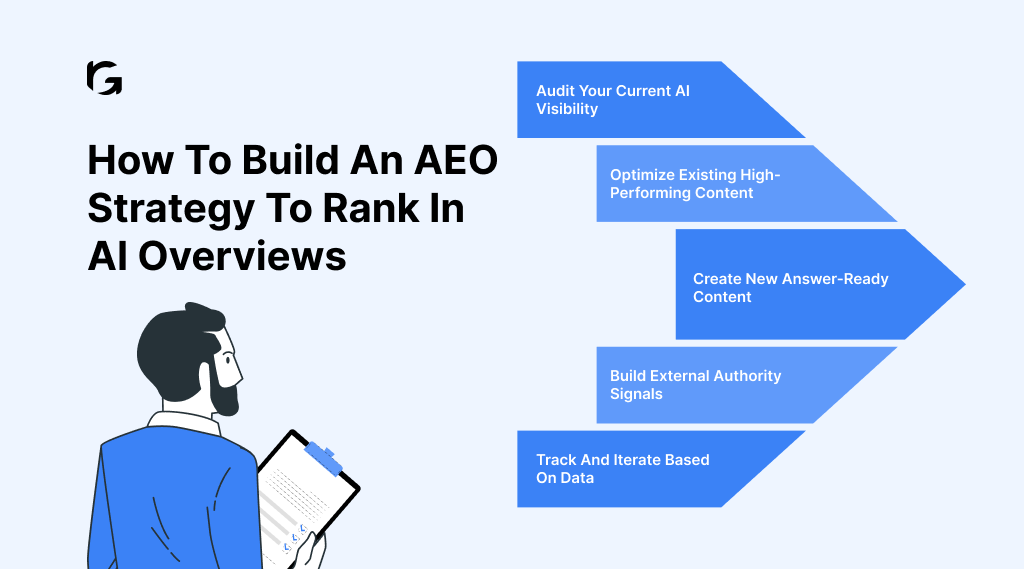
Knowing the trends is one thing. Building a strategy that actually works is another. Here's the practical framework for getting your brand cited in AI answers.
Step 1: Audit Your Current AI Visibility
Before you optimize anything, you need to know where you stand right now.
- Use AI tracking tools to measure baseline performance. Tools like Scrunch, Profound, and Conductor track how often your brand appears in AI-generated answers across ChatGPT, Perplexity, Google AI Overviews, and other platforms. Run an initial audit to establish your baseline citation rate.
- Identify prompt gaps where competitors appear but you don't. Test queries your target audience asks. Search for "best [your category]" or "how to solve [problem your product solves]" across different AI platforms. Note where competitors get cited and you don't.
- Analyze which content formats get cited most often. Look at your existing content that does appear in AI answers. Is it mostly comparison pages? How-to guides? FAQs? Understanding what's already working helps you replicate success.
- Map your current entity presence. Check if you have a Wikipedia page, whether your brand appears in knowledge graphs, and how consistently your brand information appears across different sources.
Step 2: Optimize Existing High-Performing Content
Don't start from scratch. Your best-performing content just needs an AEO upgrade.
- Refresh top-performing pages with AEO best practices. Take your highest-traffic or most important pages and apply the trends we've covered: add structured data, create clear Q&A sections, include comparison tables, update statistics.
- Add structured data, clear headers, and direct answers. Implement FAQ schema, use H2/H3 tags formatted as questions, and lead each section with a concise 40-60 word direct answer.
- Include entity-based optimization and E-E-A-T signals. Add author bios, publication dates, citations to reputable sources, and explicit statements about who your product serves and how it compares to alternatives.
- Update outdated information and timestamps. Replace old statistics, refresh examples, and prominently display "Last Updated: [current date]" to signal content freshness.
Step 3: Create New Answer-Ready Content
Build content specifically designed for AI extraction from day one.
- Target question-based keywords and conversational queries. Use tools like AnswerThePublic, AlsoAsked, or Google's "People Also Ask" to find actual questions people ask. Build content around these questions.
- Build comparison pages and "best for X" content. Create structured comparison content that directly answers "What's the difference between X and Y?" or "What's the best [solution] for [specific use case]?"
- Structure content with AI extraction in mind. Use consistent formatting, clear hierarchies, short paragraphs (2-3 sentences max), and explicit "best for" descriptors throughout.
- Include specific data points AI systems love. Pricing, ratings, statistics, timeframes, concrete numbers are extraction gold. Don't say "affordable pricing," say "starts at $49/month."
Step 4: Build External Authority Signals
Your own content is only part of the equation. External validation matters enormously.
- Get featured in third-party "best of" lists. Pitch editors creating roundup articles in your category. Being listed in "15 Best [Category] Tools" on authoritative sites feeds directly into AI training data.
- Pursue digital PR and guest posting opportunities. Write expert articles for industry publications. Get quoted in news stories. Every authoritative mention strengthens your entity credibility.
- Strengthen Wikipedia and knowledge graph presence. If you're notable enough for a Wikipedia page, create and maintain it meticulously. If not, get mentioned in relevant existing Wikipedia articles or work on building the notability required.
- Build presence on platforms AI systems cite frequently. Participate authentically on Reddit. Create helpful YouTube content. Maintain an active, informative Quora presence. These are among the most-cited sources by AI.
Step 5: Track and Iterate Based on Data
AEO isn't set-it-and-forget-it. It requires ongoing measurement and optimization.
- Monitor AI citation rates and brand mentions. Track weekly or monthly how often your brand appears in AI answers for target queries. Look for trends—are citations increasing or decreasing?
- A/B test content formats and structures. Try different approaches to see what works. Test comparison tables versus prose descriptions. Measure which format gets cited more often.
- Double down on what drives citations. When you identify content that consistently gets pulled into AI answers, create more content using the same format, structure, and approach.
- Refresh underperforming content quarterly. Set a recurring calendar reminder to review and update your most important pages every 90 days. Keep content fresh, statistics current, and positioning consistent.
- Measure beyond traffic. Track branded search volume, impression growth in Search Console, referral traffic from AI platforms, and most importantly, citation frequency across AI systems.
AEO strategy isn't radically different from good SEO. It's SEO executed with AI extraction in mind. Clear structure, authoritative signals, fresh content, and consistent entity optimization win in both traditional and AI search.
The brands getting this right aren't doing magic. They're being systematic about optimization, consistent about measurement, and disciplined about iteration.
Also read → Top AEO Agencies in 2026: Get Your Brand Featured in AI Search & Snippets
Common AEO Mistakes to Avoid in 2026
Even brands with solid SEO foundations make critical mistakes when optimizing for AI. Here are the pitfalls that kill AI visibility.
- Ignoring traditional SEO fundamentals. AEO doesn't replace SEO, it builds on it. If your site is slow, uncrawlable, or has broken internal linking, AI systems can't extract your content effectively. Fix crawlability, site speed, and technical issues first.
- Keyword stuffing instead of entity-based optimization. Repeating keywords 50 times doesn't help AI understand what you do. Clear entity definitions, consistent terminology, and explicit positioning statements work. Keyword density doesn't.
- Creating content without clear answers or structure. Wall-of-text paragraphs don't get cited. AI needs scannable sections, clear headers, and direct answers to specific questions. Structure beats volume every time.
- Neglecting content freshness and regular updates. Publishing once and forgetting about it guarantees declining AI visibility. Set up quarterly refresh cycles for important content. Update timestamps. Keep information current.
- Failing to track AI visibility metrics. You can't optimize what you don't measure. If you're not tracking AI citations, brand mentions in AI platforms, and answer inclusion rates, you're flying blind.
- Not optimizing for voice and conversational queries. Typed search queries are dying. Voice and conversational searches are growing. If your content doesn't answer natural language questions, you're missing a massive opportunity.
- Hiding key information behind PDFs or images. AI can't easily extract information from PDFs or read text in images. Put important content in HTML with proper structure and schema markup.
- Lacking author credentials and E-E-A-T signals. Anonymous content with no author bio, no publication date, and no source citations doesn't get cited by AI. Build credibility signals into every piece.
Conclusion: Start Optimizing for Answer Engines Today
The shift to AI-powered search isn't coming. It's here.
By 2026, 25% of traditional search traffic will move to AI chatbots and answer engines. Nearly 60% of searches already end without a click. ChatGPT has 800 million weekly users asking questions and getting answers without ever visiting websites.
AEO isn't optional anymore. It's where discovery happens. It's where brand positioning is established. It's where buying decisions begin.
The opportunity is real: brands optimizing for answer engines now are capturing 3.4x more visibility than late adopters. But the window for first-mover advantage is closing fast.
Start with these three steps:
- Audit your AI visibility. Use tools like Profound or Conductor to track where you appear (or don't appear) in AI-generated answers.
- Optimize your best content. Add structured data, clear Q&A sections, author credentials, and "best for" positioning to your top-performing pages.
- Track citations, not just traffic. Measure answer inclusion rates, brand mentions in AI platforms, and share of voice in category comparisons.
The brands that show up in AI answers will define their categories in 2026 and beyond. The ones that don't will wonder where their visibility went.
Which side of that divide will you be on?
Ready to dominate AI search results? Revv Growth specializes in AEO strategies that get B2B SaaS brands cited across ChatGPT, Perplexity, Google AI Overviews, and beyond.
We handle the technical implementation, content optimization, and ongoing tracking so you can focus on closing deals. Let's build your AEO strategy.

.svg)
.png)


.webp)