AEO

/
hire-aeo-agency-questions

Hiring an AEO Agency: 21 Strategy Questions SaaS Teams Must Ask

Karthick Raajha
November 27, 2025
Mins Read
Table of Contents

Introduction

If you are thinking about hiring an AEO agency, you already feel how fast AI search is reshaping the SaaS buyer journey. AI Overviews, ChatGPT Search, Perplexity, and Copilot now influence which products appear in comparisons, what features get highlighted, and which brands get recommended before a buyer ever visits your website. That shift affects trial volume, demo requests, and pipeline quality.

Most SEO programs cannot keep up because they were never built for how AI engines interpret entities, schema, and product context. This is why SaaS teams often lose visibility in high-intent AI queries even when organic traffic looks stable. At this moment, hiring an AEO agency becomes a strategic decision with real revenue impact.

The hard part is knowing which agencies truly understand AI search and which ones simply rebrand SEO services. SaaS leaders often overlook one critical question that reveals the difference. This guide gives you 21 strategy questions designed to expose whether an AEO partner can strengthen your authority, improve AI visibility, and influence pipeline outcomes. Use them to make a confident, informed agency choice.

What does an AEO agency own in your SaaS growth strategy?

An AEO agency should own the strategy and execution required to make your SaaS product visible inside AI-generated answers. Their role is to ensure your brand is recognized as a trusted entity, your content is answer-ready, and your AI visibility contributes directly to trials, demos, and revenue. Before comparing vendors, you should know what a strong AEO partner is responsible for and how their work supports your broader growth engine.

1. What is an answer engine optimization agency, and when SaaS teams should hire one?

An answer engine optimization agency improves your visibility inside AI-generated answers by optimizing your brand entities, content structure, and schema for AI Overviews, ChatGPT Search, Perplexity, and Copilot. SaaS teams typically hire an AEO agency when AI search becomes a major source of discovery and their product stops appearing in high-intent AI queries.

Here are the clearest signs that hiring an AEO agency becomes necessary:

  • Your product disappears from AI-driven comparison queries such as “best onboarding software,” even though organic traffic looks stable.

  • AI engines misinterpret your product or company details because entity signals are incomplete or inconsistent.

  • Your team lacks the technical expertise to manage schema, structured data, or AI answer formatting at scale.

  • Competitors begin showing up more often than you in AI-generated summaries, which affects trial and demo volume.

These signals show when traditional SEO is no longer enough and when AEO expertise is required to protect visibility and pipeline.

2. How does hiring an AEO agency improve your SEO, content, and AI search visibility?

Hiring an AEO agency strengthens your SEO and content programs by making your brand easier for AI engines to understand, trust, and cite. Their work helps your SaaS product appear inside AI Overviews, ChatGPT Search, Perplexity, and Copilot by improving entity clarity, structured data, and answer-ready formats.

Here are the core improvements an AEO agency delivers:

  • An AEO agency formats your content so AI engines can extract direct answers, comparisons, and product descriptions without misinterpreting your messaging.

  • An AEO agency builds and maintains your entity graph, so AI systems consistently recognize your company, product names, features, and use cases in conversational queries.

  • An AEO agency implements structured data aligned with Google guidelines, which helps AI engines classify your content correctly and cite it in multi-step answers.

  • An AEO agency improves cross-platform visibility by optimizing signals that influence AI-driven results beyond Google, including Perplexity citations and ChatGPT-generated comparisons.

These improvements ensure your brand shows up accurately and consistently across AI-first discovery channels, which traditional SEO alone cannot achieve.

3. Which is the best AEO agency for SaaS that should influence the pipeline, activation, and revenue?

The best AEO agency for SaaS should influence revenue-driving moments by improving how your product appears inside AI-generated comparisons, recommendations, and category queries. Their work should help you show up in the exact AI answers buyers read when they evaluate tools, shortlist solutions, and choose vendors.

Here is where a top AEO agency makes a measurable difference:

  • A top AEO agency increases your presence inside AI-generated “best tools,” “top platforms,” and “alternatives to…” queries where SaaS buyers evaluate competing products.

  • A top AEO agency strengthens the accuracy of your product descriptions in AI summaries so your features, use cases, and differentiators appear the way you want them presented.

  • A top AEO agency improves trial and demo conversions by ensuring AI models extract messaging that aligns with your highest-converting ICP segments.

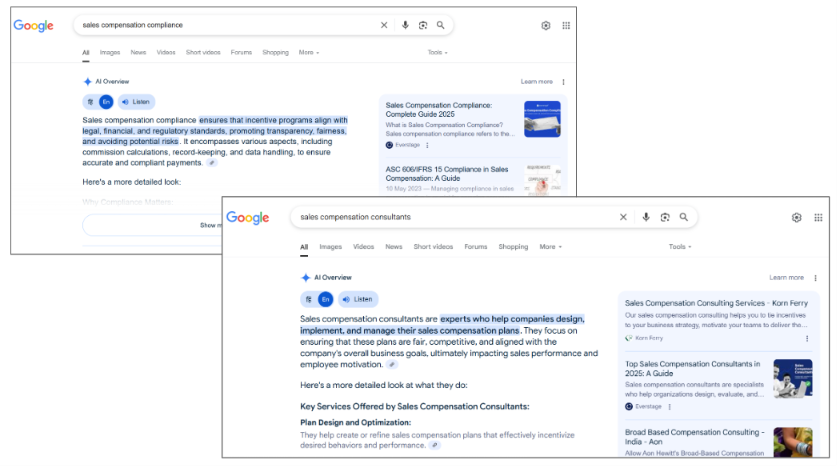
  • A top AEO agency builds authority signals that help your brand earn recurring placement in AI Overviews, similar to how Everstage’s RevvGrowth-powered content now appears inside Google’s AI Overview results for high-intent queries, strengthening credibility during evaluation.

This is the level of influence SaaS companies should expect when hiring an AEO agency: visibility that moves real pipeline, not just rankings.

21 strategy questions to ask before hiring an AEO agency for SaaS

Before hiring an AEO agency, SaaS teams should ask a defined set of strategy questions that reveal the agency’s technical depth, fit for your ICP, and ability to influence AI-driven visibility and revenue. These questions help you evaluate whether an AEO partner can improve your presence in AI-generated answers and contribute to trial, demo, and SQL growth.

Use the questions below to compare agencies and identify which ones truly understand AI search behavior, entity optimization, and multi-engine visibility. Each question highlights a capability that separates top AEO partners from repackaged SEO vendors.

Question 1: What outcomes do we expect from hiring an AEO agency, and how will we measure success in the first six to twelve months?

Before hiring an AEO agency, define the business outcomes you expect across AI-driven discovery. A strong AEO program should influence visibility in high-intent AI queries and contribute measurable improvements to trial, demo, and SQL volume.

You can use these outcome signals to evaluate agencies:

  • Your product appears more often in AI-generated comparison and solution queries.

  • Your brand entities and product descriptions become more accurate across AI engines.

  • Your content earns more citations in AI Overviews and conversational searches.

  • Your pipeline shows early improvements tied to AI-driven traffic.

Clear outcomes ensure you evaluate agencies based on real impact, not activity.

Question 2: Which ICP segments, use cases, or products should our AEO agency prioritize first?

Your AEO agency should prioritize the ICP segments and product lines that drive the highest-value pipeline for your SaaS business. AEO only works when the agency understands which audiences generate revenue and which use cases buyers search for inside AI engines.

Here is what a strong AEO partner will help you prioritize:

  • They identify the ICP segments that contribute the most to trials, demos, and SQLs, then optimize AI visibility around those buyer profiles.

  • They determine which use cases your buyers search for across AI Overviews, ChatGPT Search, and Perplexity, then structure entities and content to match those queries.

  • They prioritize product lines or modules that have the strongest commercial impact instead of spreading effort across low-value features.

  • They adjust the AEO focus based on regional or market differences if your SaaS company operates across multiple geographies.

This prioritization ensures your AEO program strengthens discovery where it matters most for revenue.

Question 3: How will you design an AEO strategy around our SaaS ICP, intent patterns, and buying journeys?

An AEO agency should design your strategy by mapping your ICP’s real questions, buying triggers, and comparison behaviors across AI Overviews, ChatGPT Search, Perplexity, and Copilot. The strategy must reflect how your highest-value buyers search, evaluate options, and progress through the funnel.

A strong AEO partner will clarify this by showing how they build your strategy around four essentials:

  • They analyze AI engine intent data to identify the questions, comparisons, and solution queries your ICP asks at each buying stage.

  • They map your features, modules, and value propositions to the intents that drive the most conversions, not just the most impressions.

  • They align content, schema, and entity structures with the ICP’s evaluation journey so AI engines present your product accurately in early decision moments.

  • They create intent clusters for each product line or geography if your SaaS business sells into multiple regions or market segments.

An agency’s strategy should be built around your ICP’s AI behavior, not generic SEO patterns.

Question 4: How will you align AEO with our SEO, paid, and lifecycle channels so that we choose an AEO agency that removes silos?

Your AEO agency should align AEO with your SEO, paid, and lifecycle channels to prevent fragmented messaging and duplicated work. AEO only performs when every channel uses the same entities, intent patterns, and product positioning that AI engines rely on to generate accurate answers.

A capable AEO partner will demonstrate alignment through these actions:

  • They unify SEO, paid, and lifecycle teams around the same intent clusters, so every channel reinforces the signals AI models use to describe your product.

  • They build one shared entity and messaging framework that ensures your value proposition appears consistently across AI Overviews, search results, ads, and nurture sequences.

  • They coordinate AEO content with SEO roadmaps to avoid redundant work and ensure technical changes, schema updates, and content improvements support both programs.

  • They use AEO insights, such as which queries drive the strongest AI engagement, to strengthen paid keywords, landing pages, and lifecycle campaigns across regions.

This level of alignment prevents channel silos and ensures your AEO investment amplifies the entire growth engine, not just organic search.

Question 5: What makes you the best AEO agency for SaaS, and how will you prove strategic fit?

Your AEO agency should demonstrate why they are the best fit for your SaaS business by showing expertise in AI search behavior, entity optimization, and AI-generated answer influence. They must prove they understand your category, your ICP, and the buying moments where AI visibility leads to demos, trials, and SQLs.

A strong AEO agency proves strategic fit through actions like these:

  • They show examples where their AEO work helped SaaS clients gain recurring visibility in AI Overviews and comparison-style queries for high-intent topics.

  • They explain their methodology for entity modeling, schema implementation, and answer-ready content, so you see how they influence AI-generated responses.

  • They demonstrate category understanding by mapping your competitors, alternatives, and adjacent tools that AI engines compare you against.

  • They provide clear expectations of results, timelines, and leading indicators that show early movement in AI-driven visibility.

This question helps you distinguish true AEO experts from SEO vendors who simply rebrand their services.

Question 6: How will you structure our entities, schemas, and product context so AI engines understand our SaaS platform accurately?

Your AEO agency should structure your entities, schemas, and product context so AI engines interpret your SaaS platform correctly and present it accurately in AI-generated answers. This work ensures AI systems understand your product relationships, features, and categories.

A skilled AEO partner will show how they deliver this:

  • They build a clear entity graph that defines your company, product names, modules, and use cases.

  • They implement structured data that follows Google and schema guidelines for high-context SaaS products.

  • They map product features to the intents and comparisons AI engines use in category queries.

  • They correct inconsistencies across your site, documentation, and external listings so AI models avoid misclassification.

This foundation helps AI engines represent your platform precisely in high-intent searches.

Question 7: How will you ensure our product positions correctly in AI-generated comparison and alternative queries?

Your AEO agency should ensure your SaaS product appears accurately in AI-generated comparison and “alternatives to” queries, because these influence trial and demo decisions. Proper positioning depends on clear entities, category signals, and structured product context.

A strong AEO partner will do this by:

  • Mapping your competitors, adjacent tools, and substitute products AI engines compare you against.

  • Structuring entities so AI systems place your product in the correct category and use-case clusters.

  • Optimizing content formats for extraction into comparison-style responses across AI Overviews and ChatGPT Search.

  • Ensuring your differentiators and ICP-specific value points appear in AI-generated summaries.

This helps AI place your product correctly when buyers evaluate options.

Question 8: What technical improvements will you make to our site to support AEO, and how will you prioritize them?

Your AEO agency should outline the exact technical improvements required to help AI engines understand, classify, and cite your SaaS product. These updates ensure your site sends consistent, structured signals across all AI platforms.

A capable AEO partner will prioritize work like:

  • Fixing schema gaps and implementing entity-focused structured data across product and solution pages.

  • Improving internal linking to strengthen entity relationships and clarify product hierarchies.

  • Enhancing page structures, metadata, and content formats for answer-ready extraction.

  • Addressing duplicate, outdated, or conflicting product information that confuses AI engines.

Clear technical prioritization ensures your AEO strategy works from a solid foundation.

Question 9: How will you create answer-ready content that AI engines trust, cite, and use in category or comparison responses?

Your AEO agency should create answer-ready content that AI engines can extract directly into category, comparison, and solution-based responses. This requires structured clarity, trusted sources, and consistent product context.

A skilled AEO partner will build this by:

  • Structuring content around the questions your ICP asks inside AI Overviews and ChatGPT Search.

  • Using concise, high-authority formats that AI engines can cite without rewriting your messaging.

  • Aligning product descriptions, differentiators, and use cases with entity and schema structures.

  • Ensuring every page has clear, consistent signals that match how AI systems interpret your category.

Answer-ready content increases your chances of appearing in high-intent AI results.

Question 10: How will you identify and fix AI misinformation, incorrect summaries, or outdated product references that affect our visibility?

Your AEO agency should proactively detect and correct AI misinformation, including incorrect product descriptions, outdated features, or misclassified use cases. These errors directly affect how buyers perceive your SaaS platform during evaluation.

A strong AEO partner handles this by:

  • Monitoring AI Overviews, ChatGPT Search, Perplexity, and Copilot for inaccurate summaries.

  • Updating entities, schemas, and content to correct misinterpretations at the source.

  • Creating authoritative reference pages that AI engines can cite for accurate product details.

  • Removing conflicting or legacy information across your site and external listings.

Correcting misinformation protects brand trust during high-intent AI discovery moments.

Question 11: How will you decide which pages to update, consolidate, or retire to strengthen our AEO performance?

Your AEO agency should evaluate your existing content to decide which pages to improve, merge, or remove so AI engines receive consistent, high-quality signals about your SaaS product. This prevents duplication, confusion, and misclassification.

A strong AEO partner will determine this by:

  • Auditing pages that rank or appear in AI-generated responses to identify gaps and inconsistencies.

  • Consolidating overlapping content to strengthen entity clarity and topical authority.

  • Retiring outdated or low-value pages that send conflicting product signals.

  • Prioritizing updates that support category alignment, comparison queries, and answer-ready formats.

AEO-focused content decisions ensure AI engines interpret your platform accurately.

Question 12: How will you monitor AI engines and adjust our AEO strategy as models evolve?

Your AEO agency should continuously monitor AI engines to track changes in how models interpret queries, entities, and categories. AEO performance depends on adapting quickly when AI systems shift ranking factors or answer patterns.

A strong AEO partner manages this by:

  • Reviewing AI Overviews, ChatGPT Search, Perplexity, and Copilot outputs for shifts in visibility and positioning.

  • Identifying new intent patterns or comparison formats that AI engines begin using.

  • Updating entities, schemas, and content structures to match evolving model expectations.

  • Reprioritizing pages and topics when AI systems change how they generate category or alternative queries.

Ongoing monitoring ensures your AEO strategy stays effective as AI evolves.

Question 13: What data, benchmarks, and sources will you use to guide our AEO strategy and measure progress?

Your AEO agency should use reliable data and benchmarks to guide your strategy and track early improvements in AI visibility. This ensures decisions are grounded in measurable signals, not assumptions.

A strong AEO partner uses data sources like:

  • AI Overviews, Perplexity, and ChatGPT Search outputs to track citations, summaries, and category placement.

  • Entity audits and schema validation tools to monitor technical accuracy.

  • Competitor and category benchmarks to see how other SaaS tools appear in AI-generated queries.

  • Intent and query-pattern analysis across regions if you serve multiple markets.

Data-driven inputs keep your AEO strategy aligned with real AI behavior.

Question 14: How will you ensure our AEO strategy supports international or multi-region SEO and AI visibility?

Your AEO agency should adapt your AEO strategy for each region you target, because AI engines generate different queries, comparisons, and category interpretations across markets. Regional relevance improves both accuracy and visibility.

A strong AEO partner does this through:

  • Creating region-specific intent clusters that reflect local terminology and buyer behavior.

  • Adjusting entities and schema fields to support multi-region product names, modules, or compliance details.

  • Monitoring AI outputs in each market to identify regional inconsistencies or misclassifications.

  • Localizing answer-ready content so AI engines understand context even when queries vary by geography.

This ensures your SaaS product is interpreted correctly across global AI ecosystems.

Question 15: How will you evaluate competitors’ AEO performance and use it to shape our strategy?

Your AEO agency should evaluate how competitors appear in AI Overviews and conversational search results to identify gaps and opportunities for your SaaS product. Competitor insight helps you position your platform more effectively.

A strong AEO partner does this by:

  • Tracking competitor visibility across AI Overviews, ChatGPT Search, Perplexity, and Copilot.

  • Analyzing which features or use cases competitors are cited for and where they win placement.

  • Identifying weak spots, misinformation, or missing comparisons that you can claim.

  • Using category-level patterns to guide your content, entities, and schema priorities.

Competitive AEO analysis ensures your SEO search strategy targets high-leverage opportunities.

Question 16: What role will subject-matter experts play in shaping our AEO content and entity accuracy?

Your AEO agency should involve subject-matter experts to ensure AI engines receive accurate, high-context explanations of your product, features, and use cases. SME input reduces the risk of vague or incorrect AI interpretations.

A capable AEO partner includes SMEs by:

  • Interviewing product, solutions, and sales teams to capture nuanced feature explanations.

  • Using SME insights to correct entity gaps and improve product definitions in structured data.

  • Validating comparison points and differentiators so AI-generated summaries reflect reality.

  • Ensuring technical accuracy for complex modules or multi-product SaaS platforms.

SME involvement strengthens the credibility of signals AI engines rely on.

Question 17: How will you manage cross-functional collaboration so our internal teams support AEO without adding a heavy workload?

Your AEO agency should manage cross-functional coordination, so your internal teams contribute expertise without taking on extra operational burden. AEO succeeds when workflows are lightweight and structured.

A strong AEO partner handles this by:

  • Leading cross-team alignment across product, SEO, paid, and lifecycle teams.

  • Providing templates, briefs, and intake forms that simplify SME contributions.

  • Running all technical implementation, testing, and updates without relying on internal bandwidth.

  • Centralizing communication so teams stay informed without managing the work.

Effective collaboration keeps AEO progress consistent without increasing workload.

Question 18: What will your 90-day AEO roadmap look like, and how will you sequence the highest-impact work first?

Your AEO agency should provide a clear 90-day roadmap that prioritizes technical fixes, entity alignment, and answer-ready content. The roadmap must focus on actions that influence AI visibility fastest.

A strong AEO partner sequences work by:

  • Fixing critical schema, entity, and product-context gaps in the first 30 days.

  • Updating high-impact pages that AI engines already reference in early queries.

  • Creating or restructuring content that supports category and comparison visibility.

  • Establishing monitoring systems to track early changes in AI-generated responses.

A structured 90-day plan reveals whether the agency understands AEO momentum.

Question 19: How will you report AEO performance, and what early indicators will show progress before revenue impact appears?

Your AEO agency should report performance using metrics that reflect improvements in AI visibility before revenue impact fully materializes. Early indicators confirm whether your AEO investment is moving in the right direction.

A strong AEO partner tracks signals like:

  • Growth in citations across AI Overviews, ChatGPT Search, Perplexity, and Copilot.

  • Improvements in entity clarity, schema validation, and product-context accuracy.

  • Increased presence in category, comparison, and “alternatives to” AI queries.

  • Early lifts in trial- and demo-intent traffic from AI-driven discovery.

Clear reporting helps you evaluate whether the agency is driving meaningful progress.

Question 20: What level of access, communication, and transparency can we expect from your team during AEO execution?

Your AEO agency should provide clear communication and transparent workflows, so you always understand progress, roadblocks, and upcoming priorities. Strong communication ensures AEO work stays aligned with your product and GTM plans.

A reliable AEO partner will commit to:

  • Weekly or biweekly check-ins covering technical updates and AI visibility shifts.

  • Transparent dashboards that track entity accuracy, schema status, and AI citations.

  • Clear ownership of tasks, timelines, and dependencies across teams.

  • Direct access to strategists and technical specialists, not only account managers.

Consistent communication ensures your AEO program stays on track.

Question 21: What ongoing maintenance, updates, and AI monitoring will be required after the initial AEO implementation?

Your AEO agency should outline what ongoing work is needed to maintain accurate AI visibility, because AI models continuously update how they interpret entities, categories, and comparison queries. AEO is not a one-time implementation.

A strong AEO partner manages ongoing work like:

  • Monitoring AI Overviews, ChatGPT Search, and Perplexity for new summaries or positioning changes.

  • Updating schema, entities, and product context as features evolve.

  • Refreshing answer-ready content to match new buyer intents and category shifts.

  • Identifying new risks, misinformation, or competitor advantages that require action.

Continuous maintenance protects long-term AI visibility and revenue.

How to choose the best AEO agency for SaaS using these questions?

Choosing the best AEO agency for SaaS requires a clear framework that separates true AEO specialists from SEO vendors repositioning their services. The right agency should demonstrate repeatable systems for entity modeling, AI engine monitoring, and answer-ready content. 

They should also show real examples of clients gaining visibility in AI Overviews and conversational search.

For a deeper look at how AI marketing evaluates SaaS brands, see our guide on AI Marketing Strategies 

Use the scoring models and signals below to identify AEO partners who can actually drive trials, demos, and SQLs through AI-search visibility.

How to score and compare AEO agencies

You can evaluate and compare AEO agencies effectively by using a weighted scoring model. This method helps your team identify which partner has the deepest AI-search expertise and the strongest technical execution.

A scoring model that reveals true AEO specialists includes:

  • Strategy weight (35 percent): Their ability to map entities, intent clusters, and competitor categories based on your SaaS ICP.

  • Execution weight (40 percent): Their skill in schema implementation, entity cleanup, multi-engine monitoring, and answer-ready content formats.

  • Measurement weight (25 percent): Their ability to track citations, category placement, summary shifts, and comparison visibility across AI engines.

  • Procurement alignment: Transparent scoping, weekly communication, and clarity in ownership.

For Example, Everstage’s content appears inside Google AI Overview after RevvGrowth’s AEO work.

Because these scoring criteria are based on real AEO capabilities, agencies with live AI Overview visibility will naturally rise to the top.

Signals of a top answer engine optimization agency

A top AEO agency demonstrates technical maturity, cross-engine monitoring, and consistent execution. More importantly, they have proof that their methodologies result in real AI visibility.

Look for these signals:

  • Entity-mapping expertise shown through clear product graphs and alignment across all product lines and regions.

  • AI visibility dashboards that track how AI engines cite your content, categorize your platform, and surface your product in comparisons.

  • AEO-specific execution that focuses on AI Overviews, ChatGPT Search, Perplexity, and Copilot, not legacy SEO-only tactics.

  • Cross-engine reporting with insights across multiple AI platforms and conversational systems.

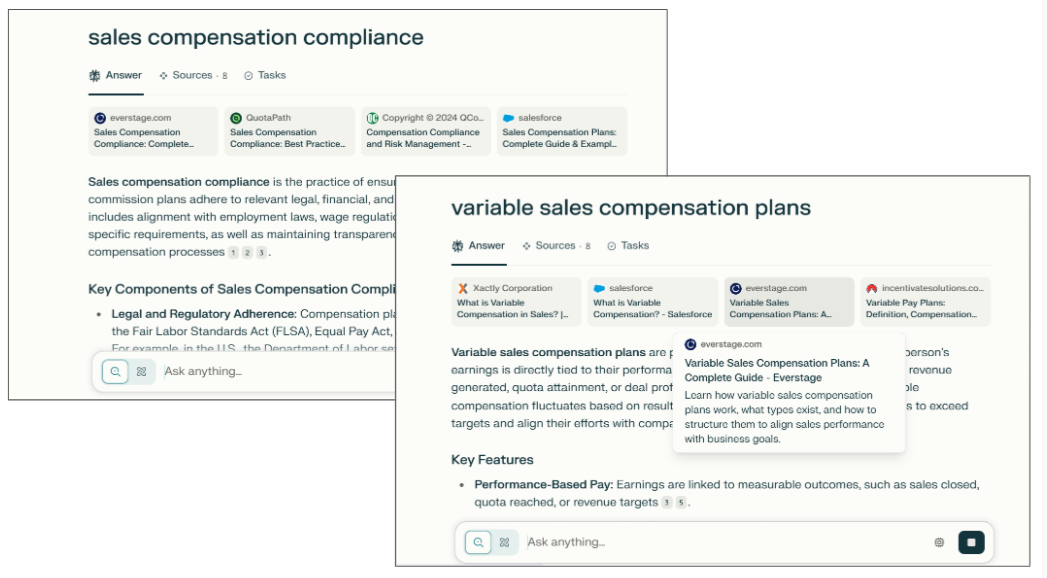
For Example, MassMailer appears in AI-generated answers after working with RevvGrowth.

These are the signals that distinguish a top answer engine optimization agency from vendors who simply add a few schema fields and call it AEO.

Conclusion

Hiring an AEO agency is a high-impact decision because the right partner shapes how AI engines understand your SaaS product, compare you with alternatives, and present you in high-intent AI answers. 

When you use structured questions and scoring criteria, you can quickly see which agencies have real AEO expertise and which ones rely on outdated SEO models. The strongest partners show technical depth, transparent workflows, and evidence that their work improves visibility in AI Overviews and conversational search.

RevvGrowth stands out from typical AEO agencies because our work consistently helps SaaS teams gain meaningful visibility inside AI Overviews, comparison queries, and conversational search. 

Our approach combines entity modeling, schema accuracy, and answer-ready content that AI engines trust, with results already visible across clients like Everstage, Atlan, and MassMailer. 

If you want a partner that understands AI search at a technical level and executes with precision, you can request a quick AEO readiness check to see where your biggest opportunities lie.

How much budget should SaaS teams plan when hiring an AEO agency?

Most SaaS companies investing in AEO should expect budget ranges similar to specialized technical SEO retainers, but with added work in entities, schema, and AI visibility. Budgets typically align with scope, complexity, and the number of product lines. The right partner will give clear pricing based on technical depth, not page volume.

What internal roles do SaaS teams need in place before hiring an AEO agency?

You only need light involvement from product, SEO, or content leaders to validate accuracy. Strong AEO agencies own strategy, execution, and technical work, so internal teams focus on approvals and SME input rather than operations.

How long does it take to see results after hiring an AEO agency?

Most SaaS teams see early movement in entity clarity, schema validation, and citations within 45 to 90 days. Stronger shifts in category placement, comparison visibility, and AI-generated answers typically appear as AI engines refresh summaries over multiple cycles.

Does hiring an AEO agency replace your existing SEO agency?

No. AEO complements SEO by improving how AI engines interpret your product, while SEO maintains rankings across traditional search. SaaS teams get the strongest results when both work together under consistent entities, intent clusters, and product positioning.

How do you know if your SaaS product already needs hiring an AEO agency?

If AI engines describe your product inaccurately, omit you from comparisons, or misclassify your category, you need AEO support. Early signals include inconsistent summaries across AI platforms, missing entities, or outdated product descriptions in AI-generated answers.

What outcomes should SaaS teams expect in the first months after hiring an AEO agency?

You should expect clearer entity structures, fixed schema gaps, improved product-context accuracy, and early citations in AI Overviews or conversational queries. These signals show your platform is becoming easier for AI engines to understand and reference during evaluations.

man in blue shirt with light background

Karthick Raajha

CEO / Founder

Helping companies to get their marketing strategies right for 2 decades