TL;DR
- An AEO checklist helps you measure whether AI engines can find, trust, and cite your content, not just whether you rank on Google.
- Less than half of AI Overview citations come from top-10 pages. Traditional rankings alone won't earn AI visibility.
- The 8-step AEO audit checklist covers content structure, schema, E-E-A-T, entity consistency, crawlability, freshness, internal linking, and citation tracking.
- Google's May 2026 spam policy update extended all existing spam rules to AI Overviews and AI Mode, so gaming citations carries real risk.
- AEO is ongoing. Monthly refreshes for top pages and quarterly full audits keep you visible as AI search evolves.
Introduction
A client came to us last quarter with strong organic rankings, consistent content output, and a site that looked healthy by every traditional SEO metric. Then we asked ChatGPT and Perplexity the same questions their buyers ask. The brand didn’t show up once.
That gap is exactly what an AEO audit exposes. Ranking well on Google no longer guarantees visibility in AI-generated answers. It’s the starting point, not the finish line.
This blog is your AEO checklist. It covers the 8 steps we use at RevvGrowth to audit AI visibility, our 4-phase audit process, and a practical worksheet to help you evaluate and score your website’s AI search readiness.
Why you need an AEO audit
A traditional SEO audit checks rankings, indexation, and technical health. It doesn’t measure whether AI engines can extract and cite your content. A page can rank #3 on Google and never appear in a single AI-generated answer.
Ahrefs analyzed 1.9M AI Overview citations, and only 38% of them come from top-10 organic pages. The remaining were pulled from pages that wouldn’t flag anything in a standard SEO audit. If your audit stops at rankings, you’re missing where AI visibility is actually coming from.
The difference comes down to what each audit actually measures.
How do SEO, AEO, and GEO audits differ?
SEO, AEO, and GEO audits each measure visibility in a different layer of search. Here’s how they compare:
Most B2B SaaS brands need all three working together. An AEO audit specifically answers: can AI systems extract a clear, accurate answer from your content and cite it with confidence? The differences between GEO, AEO, and AI SEO visibility matter when deciding where to start.
The AEO audit checklist: 8 steps to evaluate
The checklist starts where AI starts: with what it can extract from your pages. From there, it moves into the trust and authority signals that determine whether AI cites you over a competitor.
Here’s how that plays out in practice. Everstage is a global sales compensation platform that had strong product traction but near-zero AI citation presence. We ran a full audit covering the following 8 areas. The baseline showed content extractability issues across most pages, missing schema on key blogs, and competitors owning sales compensation queries on Perplexity and ChatGPT.
1. Content structure and answer formatting
AI extracts answers from individual sections. Can each passage provide a clear, complete answer without surrounding context?
Every H2 needs a direct, standalone answer in the first 40 to 60 words: 2 to 3 declarative sentences; lead with the direct answer, primary keyword in sentence 1, factually complete without surrounding context.
Beyond the answer block, check sentence-level extractability. Compact sentences with key terms close together get extracted more reliably than long, complex ones.
- Weak: "In today's competitive landscape, many companies are finding that their approach to data governance needs to evolve. There are several factors to consider when thinking about..."
- Strong: "Data governance is a framework of policies, processes, and standards that ensures data is accurate, consistent, and secure across an organization. Companies that implement it typically see faster compliance and better decision-making."
The difference matters. Princeton University’s research on GEO suggests that including direct answers, citations, and statistics in your content can increase AI engine visibility by up to 40%.
What to check:
- Each H2 followed by a direct answer in 40 to 60 words
- Headings reflect actual buyer questions where the content genuinely answers them
- Tables for comparisons, bullets for steps, bold for key phrases
- Paragraphs max 3 to 4 lines
2. Schema and structured data
Schema tells AI systems what your content is about, who wrote it, and when it was last updated. According to SE Ranking, 65% of Google AI Mode citations and 71% of ChatGPT citations come from pages with structured data. But not all schema types carry equal weight in 2026.
What to check:
- Article or BlogPosting schema on all blog content
- Organization schema with SameAs links on homepage
- Person schema with name, job title, and profile URL on author pages
- Structured data matches visible on-page content
- No conflicting information across multiple markup blocks
- Publication and modification dates reflect actual content history
- Validated via Google Rich Results Test and Schema.org Validator
3. E-E-A-T and authority signals
AI search systems draw on third-party sources when answering questions about brands. A page can be perfectly structured for extraction and still not get cited if the AI doesn't trust the source. LLMs actively reference G2, Capterra, Clutch, and Product Hunt when generating answers about tools and service providers.
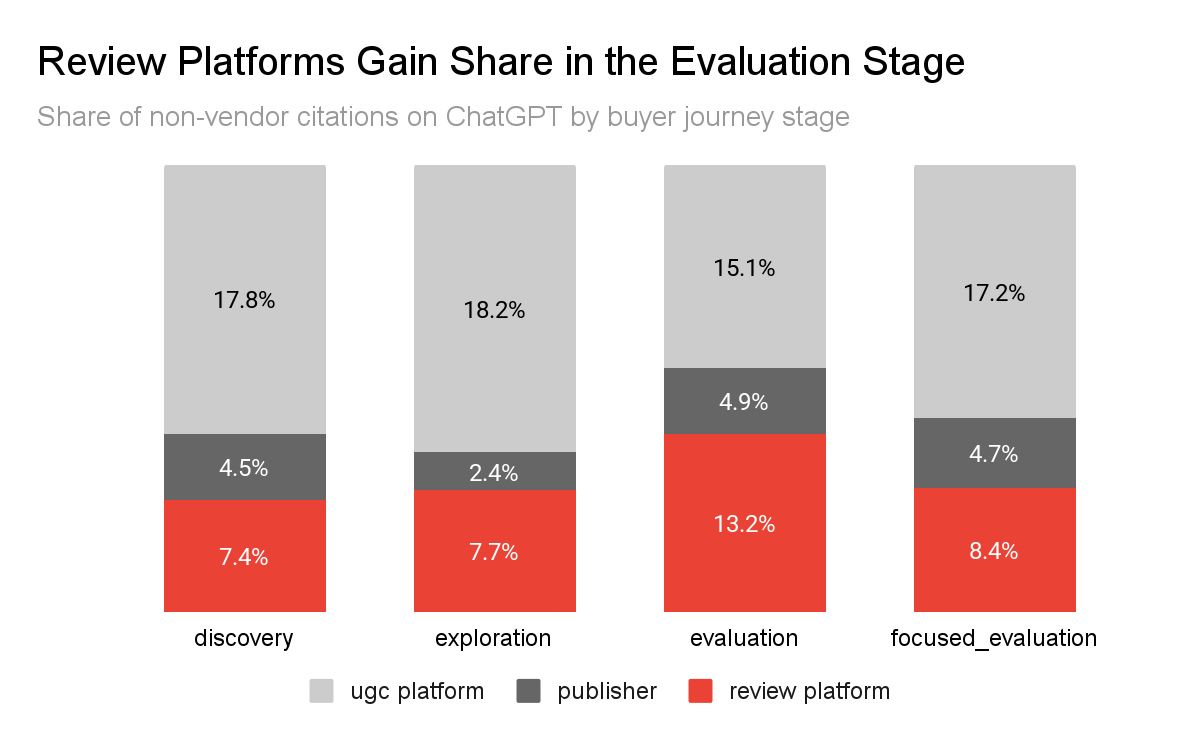
According to G2's February 2026 US-focused study, review platforms accounted for 13.2% of ChatGPT's cited domains in evaluation queries, compared with 7.4% in discovery queries. The closer a buyer gets to a decision, the more weight AI gives to third-party reviews.
What to check:
- Real author name, bio, and LinkedIn on every blog
- About, Team, Contact, and relevant policy pages provide clear business information
- 2 to 3 external citations per page (research, industry data, case studies)
- Case studies and testimonials are accurate and verifiable
- Visible "last updated" date
- Active presence on G2, Capterra, and relevant review platforms
- Mentions in curated industry roundups and topically relevant publications
4. Entity consistency across the web
AI builds your brand identity from external consensus, not your homepage. If G2 says you're a "CRM" but your site says "data platform," AI systems get confused. And confusion means fewer citations.
What to check:
- Same one-line description across website, LinkedIn, G2, and Crunchbase
- Product names identical everywhere
- Founders' LinkedIn profiles mention the company consistently
- SameAs schema links on homepage connecting all key profiles
5. Technical crawlability for AI bots
AI bots need to access and render your content before they can cite it. That means your robots.txt, server-side rendering, page speed, and sitemap all directly affect whether AI systems can even evaluate your pages. If they can’t access it, it doesn’t exist for citation purposes.
What to check:
- robots.txt allows GPTBot, ClaudeBot, PerplexityBot, Google-Extended, and Bingbot
- No accidental noindex directives or blocked directories on priority pages
- Key pages server-side rendered or static
- No critical content behind expand/click elements or lazy-loaded sections
- Page load under 2 seconds; Core Web Vitals healthy (LCP under 2.5s, CLS under 0.1)
- llms.txt implemented at domain root
- Sitemap up to date and including all priority pages
6. Freshness and update cadence
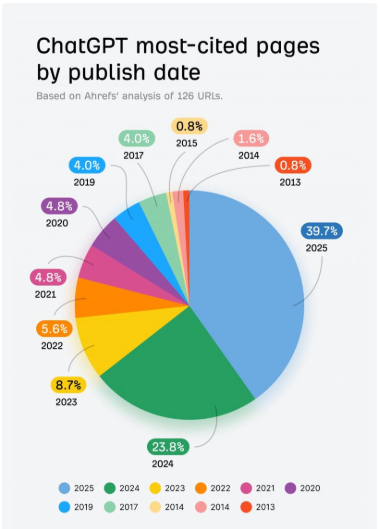
According to a 2025 Ahrefs study, AI prefers recent, maintained content. 76.4% of ChatGPT citations come from content updated within the last 30 days.
What to check:
- Every page shows the last updated date
- Stats from the current or previous year (replace anything older than 2 years)
- Monthly refreshes for your top 10 citation targets, quarterly for the rest
- Broken link audit every 90 days
- Content decay monitoring for pages losing traffic or rankings
7. Internal linking for topical authority
AI understands topic clusters, not isolated pages. A cluster of 10+ interlinked pages covering different angles of the same topic gets cited repeatedly. A single article rarely does.
What to check:
- Every page links to 3 to 5 related pages and 1 to 2 commercial pages
- Natural-language anchor text (not "click here" or exact-match keyword spam)
- Navigation and breadcrumbs communicate a clear site hierarchy
- Pillar pages link to all cluster pages and vice versa
- No orphan pages on priority topics
8. Citation tracking and measurement
Citation tracking measures whether AI platforms are actually surfacing and citing your content when buyers ask questions. Without it, you're optimizing blind. Semrush says, right now, only 22% of marketers currently track AI visibility.
Citation rates vary wildly by platform. The same brand can see fewer citations on ChatGPT and more on Grok. A single "AI search" dashboard that lumps everything together misses the picture entirely.
What to check:
- Citation checks across ChatGPT, Perplexity, Google AI Overviews, and Gemini, tracked per platform
- Results distinguish brand mentions from linked citations
- Cited URLs and brand descriptions are recorded for each platform
- Query set of 20 to 30 high-intent queries tracked regularly
- LLM referral sessions segmented in GA4 (ground-truth metric)
- Downstream conversions tracked by landing page. Demo requests, sign-ups, contact form submissions
- Pages missing relevant citations receive specific improvement actions and follow-up checks
What the audit delivered for Everstage
Remember the Everstage baseline from the top of this checklist? After running the full 8-area audit, Everstage’s keywords in the top 3 grew by 181%, daily traffic jumped 144%, and the brand now earns AI citations across ChatGPT, Perplexity, Gemini, and Google AI Overviews for 7+ sales compensation queries.
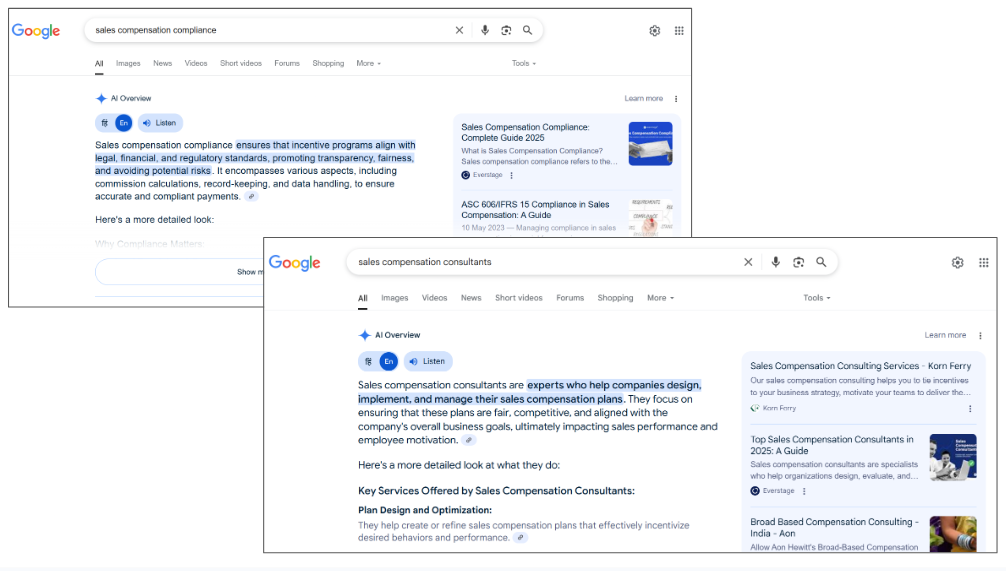
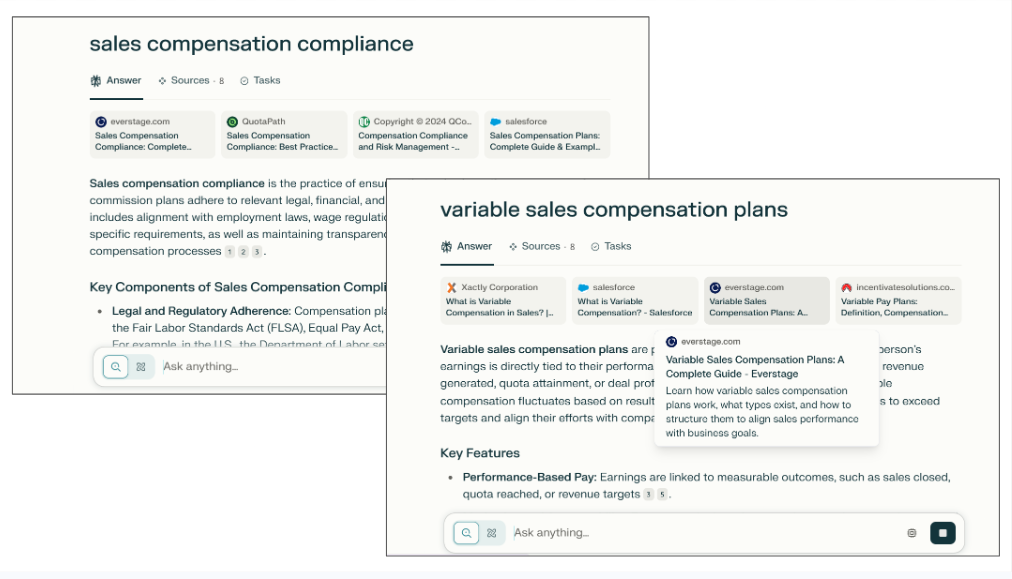
We ran a similar process for OvalEdge in data governance. The Google impressions grew 85%, and LLM referral sessions jumped from 100 to 278/month in a single month. The audit framework works across different business verticals. The 8 areas don’t change, only the content and competitive landscape do.
Common AEO audit mistakes
Even with a solid checklist, most first-time audits trip up in the same places.
- Adding schema without validating it first. Invalid schema is worse than no schema.
- Optimizing content for extraction without fixing entity consistency. If AI doesn't trust the brand, it won't cite the content.
- Tracking AI citations in aggregate instead of per platform. ChatGPT, Perplexity, and Google AI Overviews cite from different source pools at different rates.
- Treating the audit as a one-time project. Citation patterns shift every time models update.
- Auditing only blog posts. Pricing pages, product pages, customer stories, and documentation all get cited too.
Once you’ve scored all 8 areas and know where the gaps are, the next step is running the audit itself. Here’s the 4-phase process to go from baseline to roadmap in two weeks.
How to run an AEO audit: a 4-phase process
Phase 1: AI visibility baseline (days 1–4)
Run structured prompt simulations across ChatGPT, Perplexity, Gemini, and Google AI Mode using the exact queries your buyers ask. Test 50 to 100 buyer-intent queries. Don't just check whether your brand appears. Check whether AI accurately explains what you do.
Visibility without differentiation doesn't create demand. Audit brand descriptions across G2, Capterra, LinkedIn, and Crunchbase.
Output: baseline citation report, query map, and entity inconsistency report.
Phase 2: Content and schema deep dive (days 5–8)
Scope your top 30 pages by traffic and citation potential, not just blog posts. Pricing pages, product pages, and documentation all get cited. Check schema implementation, content extractability, answer block placement, and internal linking. Validate every schema through Google's Rich Results Test.
Output: prioritized fix list per page with implementation examples, schema gap report, and content revision list with the reason for each priority.
Phase 3: Competitive citation benchmarking (days 9–11)
Run the same query set against the top 3 to 5 competitors. Document which competitors dominate which platforms, which queries no one owns, and which third-party sources keep getting cited.
Output: citation comparison, untapped query opportunities, and a list of cited publications, communities, and review platforms.
Phase 4: Prioritized roadmap (days 12–14)
Build a 90-day implementation roadmap with assigned owners, effort estimates, and dependencies, sequenced into 30-day sprints. Days 0–30: fix crawl blockers, add dates, implement core schema. Days 30–60: restructure high-value pages, tighten answers. Days 60–90: build authority signals, expand schema, formalize monitoring.
Output: 90-day roadmap, a tracking framework for citations, referrals, and conversions, and a handoff document explaining recommendations and dependencies.
AEO audit tools
Most teams can start with free tools and add paid AEO tracking tools as citation volume grows.
DIY audit vs. agency audit: When to outsource
Not every team needs an agency to run an AEO audit. The right choice depends on internal bandwidth, competitive complexity, and whether your team can act on the findings without outside support.
If your team needs competitive benchmarking or a prioritized roadmap, an AEO audit service can fill that gap.
Download: the AEO audit worksheet
Copy this worksheet into your project tracker, or download the spreadsheet version to run the audit with your team.
Scoring guide: Score each of the 8 areas as Pass (2), Partial (1), or Fail (0). Maximum score: 16.
Turn your audit findings into an action plan
An AEO audit becomes useful when each finding leads to a clear next step. Start with issues that block access to priority pages or prevent accurate understanding, then assign content, technical, and brand updates to the right people.
After implementation, rerun the same tests and review citations, referrals, and conversions separately to see what moved.
Download the AEO audit worksheet to score your site against all 8 areas. And if you need help scoping or prioritizing the work, talk to RevvGrowth's AEO team.