Introduction
A B2B SaaS company started tracking AI visibility last quarter. Its marketing team exported 150 keywords from its SEO tool, added them to an AEO (Answer Engine Optimization) tracker, and waited for results. A week later, the dashboard wasn’t helping much. Visibility scores jumped from 40% to 18% to 35% across three days. No clear pattern and nothing to act on.
Sound familiar? The problem was the keywords. AI engines respond to full conversational queries, and short search fragments don’t give them enough context.
A phrase like “AEO tracking tools” works for traditional search. Think about how a buyer would actually ask AI for a recommendation. For example, “What’s the best way to track if my brand shows up in AI search results?” The question is more specific, and that changes both the response and what you’re measuring.
Choosing the right prompts to track for AEO starts with understanding how your ICP (Ideal Customer Profile) phrases AI search queries during a buying decision. Once that’s clear, prompt selection, buying stage mapping, and reading the results all fall into place.
What is AEO prompt tracking (and why prompts aren’t keywords)
AEO prompt tracking involves running a fixed set of questions through AI engines at regular intervals. Each run helps you see whether ChatGPT, Perplexity, Gemini, or Google AI Mode mentions, cites, or recommends your brand.
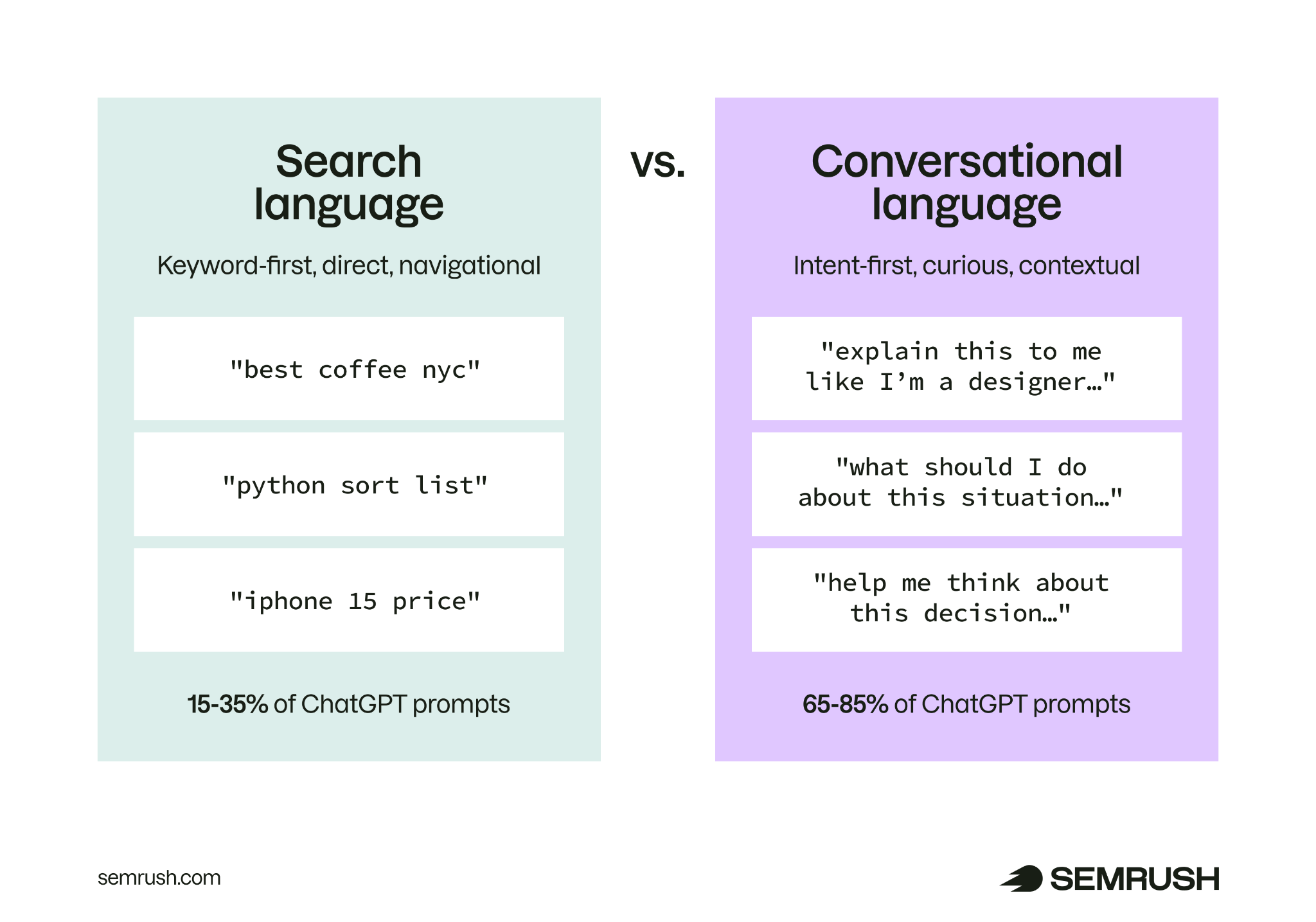
The questions you're tracking aren't the same as keywords. Semrush analyzed over 1 billion lines of U.S. clickstream data across 17 months in 2025 and found that 65-85% of ChatGPT prompts match no keyword in its database. Keywords are typically short search phrases, while prompts are full questions that reflect a buyer persona's needs and context. Even small changes in how a question is asked can affect which brands appear in AI responses.
The wording matters more than you might think. Prompts asking for specific options tend to surface more brands than open-ended questions. Negative phrasing can also lead to more caveats in the response. That's why prompt selection matters. Keep your phrasing neutral and consistent within each bucket.
Source: The April 2026 Semrush Study
Here are four metrics you'll want to track:
- Mention rate: How often AI mentions your brand
- Citation rate: How often it links to your domain as a source
- Share of voice: Your mentions compared to all brands mentioned for that prompt
- Sentiment: Whether your brand is presented positively, neutrally, or negatively
Remember, each AI engine draws from different indexes and training data. Your brand might appear in ChatGPT responses but be completely absent from Perplexity. Tracking just one engine means you're only seeing part of the picture. Your AI visibility prompt set should cover at least two engines.
The 4-bucket framework: Organizing prompts by buying stage
The 4-bucket framework groups AEO prompts around four buying intentions: discovering solutions, solving problems, comparing vendors, and validating purchase decisions. Measure visibility at each stage to identify where your brand appears, where competitors outperform you, and which buying-stage gaps need attention.
G2’s March 2026 survey of 1,076 B2B software buyers found that 69% chose a different vendor than planned based on AI chatbot guidance. Buyers are already forming their shortlists during AI conversations. Your prompt set needs to cover the entire buying journey so you can identify visibility gaps before buyers finalize their vendor choices.
Your brand may appear frequently when buyers ask about you directly but rarely when they explore solutions in your category. To capture this difference, organize your prompts into four buckets:
- Category prompts (discovery): Unbranded. Buyers explore available solutions without a specific vendor in mind. It helps you measure whether AI engines mention your brand in the category at all. These prompts can be harder to win but more valuable to track.
- Problem prompts (awareness): Unbranded. Buyers describe a challenge and look for ways to solve it. They show whether AI engines associate your brand with the problems your ICP cares about. You can find relevant questions in support tickets and sales call objections.
- Comparison prompts (evaluation): These include both branded and unbranded questions. Buyers are comparing vendors and weighing their options. You can track how AI engines position your brand against competitors and spot inaccurate information, such as outdated features or pricing.
- Brand prompts (decision): Branded. The buyer validates a near-final choice. These prompts measure how accurately AI engines describe your brand, the sentiment of their responses, and whether they recommend or warn against it. Since these prompts target buyers already familiar with your brand, limit them to roughly 20% of your prompt set.
The table gives you a starting point. The free template below includes 50 prompts across all four buckets. Each one is pre-mapped to ICP roles with a weekly tracking log built in.
7 sources to research AEO prompts from real buyer language
The best prompts reflect how your buyers actually ask questions. Sales conversations, search queries, and community discussions help you capture their language directly. Competitor pages, AI follow-ups, and LLM rewrites can help you find additional questions worth testing. Together, these sources show how to research prompts for AEO from real buying situations.
1. Sales and support conversations
This is a good place to start. Look at the questions prospects ask before buying, including objections, feature comparisons, and use-case questions. CRM call notes, Gong transcripts, and support chat logs are useful sources. Prioritize questions that come up often rather than one-off scenarios.
Don't limit your research to existing customers. Sales data tends to reflect buyers who already chose you. Review lost-deal notes and competitor objections to find questions you might be missing.
You can also explore what AI engines suggest about your brand. Search your company name in ChatGPT or Perplexity and look at the follow-up questions they generate. Your prospects are likely asking similar questions.
2. Google Search Console (GSC) (6+ word queries)
In GSC, filter for queries with six or more words, especially those starting with question words. You can use this regex to find them: ^(how|what|which|why|when|where|can|does|is|should)(\s+\S+){5,}$. Sort the results by impressions. Longer queries can help you understand how buyers phrase specific problems, making them useful starting points for AI prompt research.
3. People also ask and forum threads
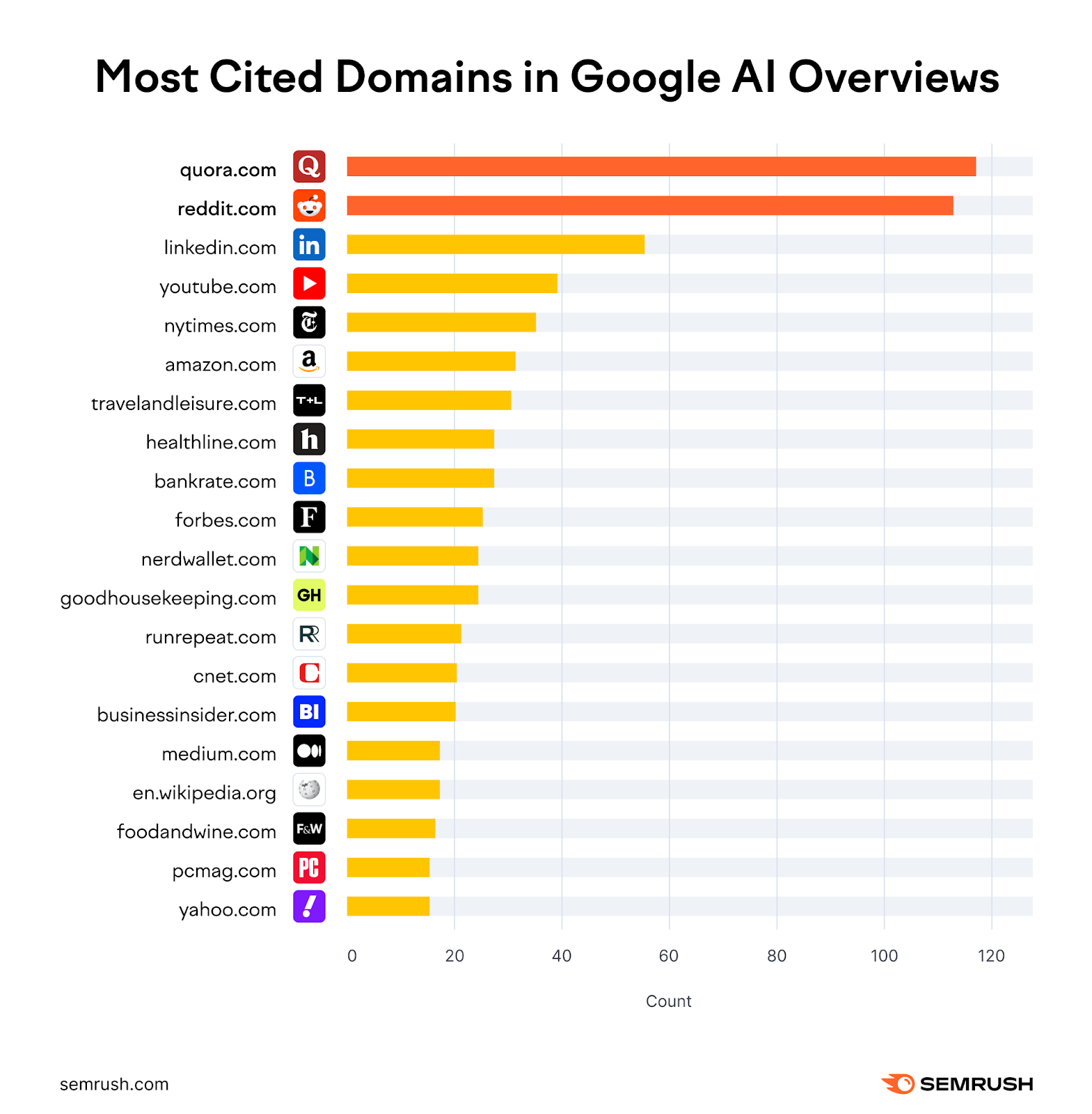
Google's People Also Ask (PAA) questions are a useful starting point because they're already phrased naturally. Reddit threads, G2 community posts, and industry Slack groups can give you more conversational context. You can also use Google's &udm=18 parameter to find forum results directly. Focus on questions that appear across multiple discussions rather than simply picking the most-upvoted answers.
Source: Semrush’s July 2025 AI Search Study
4. Competitor and category pages
Review the H2s and FAQ sections on competitor blogs and landing pages. They can help you understand which questions AI engines are already pulling answers from. Look closely at questions your competitors address, but your content doesn't. The idea is to find gaps in your prompt list, and not copy their questions.
5. AI Engine follow-up questions
Enter a broad prompt into Perplexity or ChatGPT. Review the follow-up questions suggested after the response. They can surface angles that traditional keyword research misses.
These are AI-generated suggestions, not confirmed buyer questions. Cross-check them against sales conversations or community discussions before adding them to your set.
6. LLM rewrite of your top keywords
Take your top 20 keywords based on traffic or conversions and ask a large language model (LLM) to turn each into a conversational question with buyer context. Give instructions to preserve the original intent, add a persona or constraint where it fits naturally. Include the current year when relevant.
Share your ICP description along with each keyword. When the LLM understands your buyer's role and constraints, it can generate more relevant prompts instead of generic rewrites.
Review the results before adding them to your list. Ask yourself, “Would someone actually type this question into ChatGPT?” If it still sounds like a keyword turned into a sentence, refine it.
Keep only the buyer details that could change the AI's recommendation. Company size, budget, existing software, and compliance requirements can matter. Generic details about the persona usually don't help.
7. Pages already getting AI referral traffic
Check your analytics to see which pages are already receiving traffic from AI engines. Use the topics covered on those pages to find relevant prompts.
You can also dig deeper into server logs. Look for user-agents like ChatGPT-User, OAI-SearchBot, PerplexityBot, and DuckAssistBot to identify pages accessed by AI-related services, including those that aren't yet generating referral traffic.
These visits don't guarantee citations. They can help you identify pages worth reviewing for content gaps and AI visibility opportunities.
Aim for 150-200 raw candidates. Knowing how to research prompts for AEO is only half the work. The other half is cleaning them down:
- Remove duplicates: Group similar questions based on the buying situation and keep one canonical prompt.
- Add buyer context: Include the buyer's role, situation, or constraints where it feels natural.
- Organize by buying stage: Sort prompts into the four buckets and check whether they match your target distribution.
- Test across engines: Run a pilot on 2-3 engines and remove prompts that produce off-topic responses.
- Finalize your set: Lock the prompts once they consistently produce relevant, easy-to-interpret answers across engines.
Reading AI visibility reports (and how they work)
An AI visibility report shows how often AI engines mention, cite, or recommend your brand for a set of tracked prompts. It breaks down performance by prompt and AI engine. Metrics like mention rate, citation rate, share of voice, and sentiment are used to help you understand where your brand stands.
Once you start tracking your prompts, these reports help you see which buying-stage questions your brand appears for, where competitors are getting more visibility, and which areas need attention.
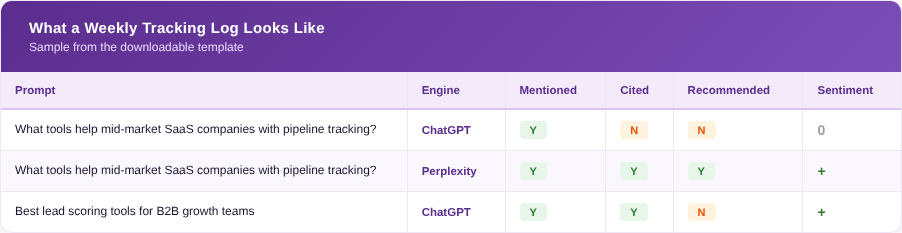
Keep in mind that these numbers indicate trends rather than definitive results. AI responses can change between runs. Your brand might be cited in one response and missing from the next. Look at trends over at least two to four weeks. Weekly snapshots can help you spot patterns, while daily screenshots often show too much variation.
Citations are worth paying attention to, especially when you're looking at potential traffic opportunities. Semrush’s AI search study found that the average LLM-referred visitor converts at 4.4x the rate of a traditional organic visitor. Mentions help build awareness, while citations can bring visitors to your website who are more likely to convert.
What matters most is understanding what the patterns mean for your brand. Here are four common signals to look for:
Signal 1. Mentioned but not cited: AI engines mention your brand but don't link to your content. Your brand is being recognized, but your pages aren't being used as sources. Review the relevant pages and apply LLM search optimization techniques to improve content depth and source authority, and increase their chances of earning citations.
Signal 2. Not mentioned at all: AI engines aren't connecting your brand to a particular buying situation. You might be missing content on the topic, or your existing pages might not have enough authority to appear. Look for opportunities to create or strengthen content around that specific query. Understanding how to rank on ChatGPT can help you build pages that earn mentions from the start.
Signal 3. Cited but with negative sentiment: An AI engine links to your website but presents your brand negatively. It could be referencing outdated pricing, old reviews, or competitor comparison pages. Check the information’s source and update any inaccurate claims.
Signal 4. High brand visibility, low category visibility: Your brand performs well for branded prompts but rarely appears in category or problem-related questions. This means buyers can find you when they already know your name, but you have limited visibility during unbranded discovery. It's a common gap worth monitoring. Give category and problem prompts more weight in your tracking set.
Your reports can only tell you how your AI visibility prompt set performs. Choosing the right prompts to track for AEO is what makes this data meaningful. If those prompts don't reflect real buyer behavior, even strong visibility scores won't give you a clear picture of where you stand.
A quarterly review checklist for your prompt set
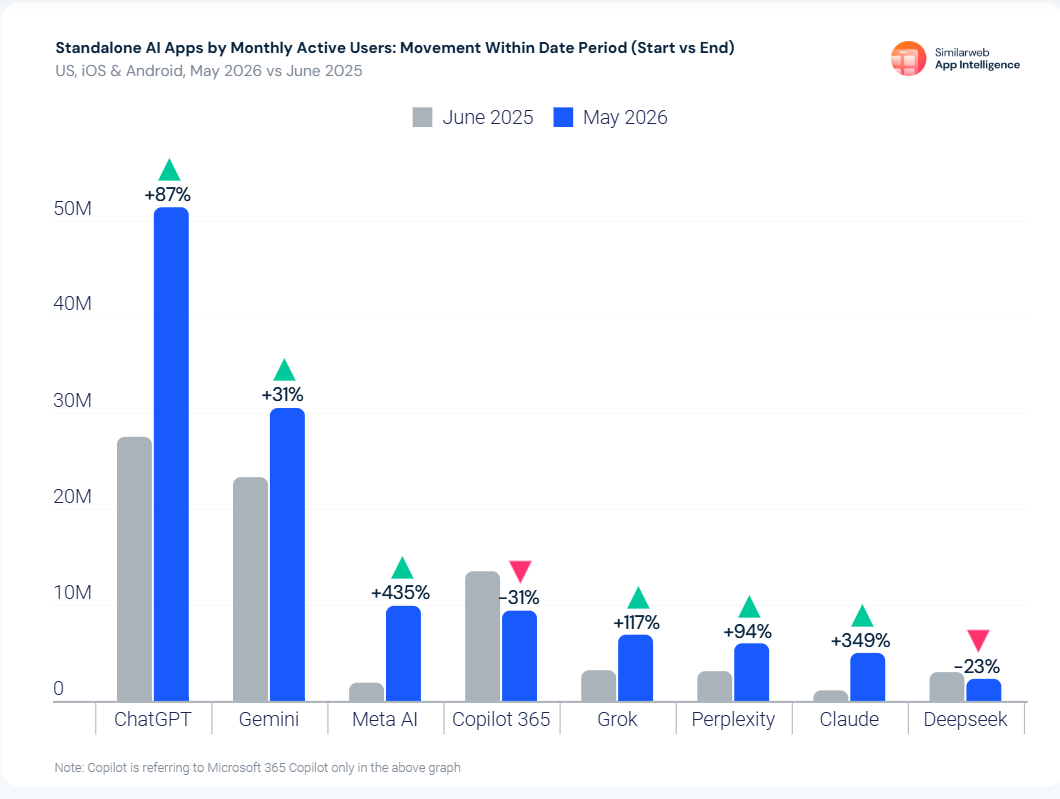
Your prompt set needs to keep up with how buyers search. Buyer questions can change from one quarter to the next, and new competitors can start appearing in AI answers. Similarweb shows ChatGPT’s share of generative AI web traffic dropped from roughly 76% to around 53% in under a year. Gemini now holds over a quarter of all traffic. It's worth checking whether the engines you're tracking still reflect where your buyers search.
Source: The Similarweb’s May 2026 Generative AI Landscape Report
Every quarter, review your prompt set and check for:
- New buyer questions emerging from sales, support, and GSC data.
- Prompts where visibility has consistently declined across multiple engines.
- New competitors appearing in AI answers for your tracked queries.
- Previously relevant prompts that no longer return useful answers.
- New product features, use cases, or markets that need prompt coverage.
- Changes in which AI engines your target buyers use.
One thing to be careful about is updating your prompts without disrupting historical data. Keep a stable core set for tracking long-term trends and a separate exploratory set for testing new questions. After collecting a full quarter of data, you can move relevant exploratory prompts into your core set.
If you retire a core prompt, archive its historical results rather than deleting them. This way, you can still compare past performance without mixing old and new tracking data.
For teams in fast-moving categories, launching new products, or entering new markets, a monthly review makes sense. Otherwise, quarterly reviews are enough. The goal is choosing prompts to track for AEO that stay relevant as your market moves.
Start Tracking: Build Your First 20 Prompts This Week
You don't need hundreds of prompts to get started. Begin with your last 10 sales calls and note the questions prospects asked before buying. Turn those questions into conversational prompts with relevant buyer context, then organize them into the four buying-stage buckets. Test them on ChatGPT and Google AI Mode, and review the results after two weeks.
Twenty prompts based on real buyer conversations can give you a clearer picture of your AI visibility than 200 prompts pulled straight from a keyword tool.
If you'd prefer help setting everything up, RevvGrowth’s AEO team can build your prompt set, track its performance, and turn the results into reports you can act on.