Introduction
The goal of search optimization has always been to help people find the right information. But what happens when people get that information directly from an AI-generated answer instead of clicking through to a website?
This raises an important question about how businesses approach search visibility.
SEO (search engine optimization) helps people find your content through organic search. AEO (answer engine optimization) focuses on improving how your content and brand appear in AI-generated responses. They share many of the same foundations, but the way we approach content for each can differ.
So, should businesses rethink their SEO strategy or build something entirely new?
In this guide, we'll explore AEO vs. SEO, compare their optimization approaches, and explain how to bring both together into one effective search strategy.
AEO vs SEO: What are the differences?
The main difference between AEO and SEO is how they help people discover your content. SEO focuses on improving visibility in organic search results, while AEO aims to make your content and brand more visible in AI-generated answers.
Both matter because people are using search differently. According to Pew Research Center's 2026 survey, 60% of US adults say they read AI-generated summaries in search results. This means businesses need to consider not only where their content ranks but also how their brand is represented in the answers users read.
Here's how the two approaches compare:
However, these differences don't mean businesses should treat AEO and SEO as competing strategies.
In fact, Google's 2026 guidance confirms that SEO best practices remain relevant to its generative AI search features. However, marketers discussing AEO adoption highlight two practical challenges: allocating limited budgets between SEO and AEO and measuring AI visibility when attribution remains unreliable. Several recommend incorporating AEO-specific tasks into existing SEO workflows while tracking AI citations and brand mentions separately.
The two approaches share important foundations, even though their optimization priorities differ. We've explored this relationship further in our AEO strategy framework.
But the difference isn't limited to where your content appears. It also affects how potential customers discover and evaluate businesses.
How do AEO and SEO influence the buyer journey?
Think about how someone researches a software product. They might start with a Google search, ask ChatGPT to compare options, then return to Google to visit a specific brand's website.
SEO and AEO can influence different moments in that journey, including when users never click through from an AI-generated answer.
Here's how both approaches can support each stage:
Consider someone researching an account-based marketing agency.
They may find a comparison article through Google, ask an AI assistant which agency fits their requirements, and then visit a shortlisted vendor's pricing page.
The important distinction is that the first interaction with a brand doesn't always lead directly to a website visit. AEO can build awareness and consideration in AI-generated answers, while SEO helps businesses stay discoverable as buyers continue their research through search engines.
Neither approach is limited to a particular stage of the journey. Businesses benefit from making accurate, useful information available wherever potential customers choose to research.
That brings us to the content itself. How should we optimize a page that needs to serve both traditional search and AI-assisted discovery?
How does content optimization change between AEO and SEO?
The difference becomes clearer when we look at how content is researched, structured, and supported with evidence. From the questions we target to how we structure answers and support claims, AEO adds new considerations to the existing SEO process.
1. Keyword research vs conversational queries
SEO research typically starts with keywords, search volume, competition, and intent. AEO extends this research to conversational prompts and the follow-up questions people ask AI assistants.
Take our AI SEO pricing guide, for example. Someone might search Google for "AI SEO pricing" but ask ChatGPT, "How much should a B2B SaaS company budget for AI SEO, and what services should be included?" Both queries relate to pricing, but the second asks for more context around budgeting and service scope.
A 2026 study of 158,099 AI-generated answers found that pages whose titles and paragraphs closely matched users' questions were more likely to receive citations. This supports researching the specific problems behind search queries, not just keyword variations.
2. Content depth vs answer clarity
SEO content needs sufficient depth to satisfy search intent. AEO also benefits from clear explanations that answer specific questions without requiring readers to search through several paragraphs.
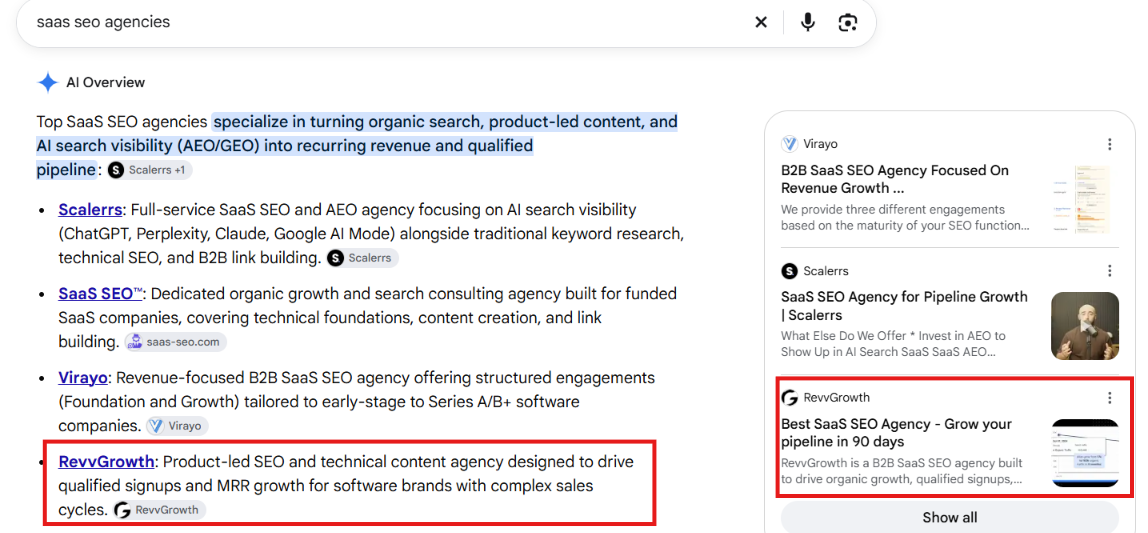
We've applied this approach at Revv Growth. We restructured content around direct answers and question-based headings. Several articles subsequently appeared in Google AI Overviews, showing how content optimized for AI Overviews can gain visibility alongside traditional search results.
3. Authority signals and supporting evidence
Both approaches benefit from credible information, but AEO makes accurate representation particularly important.
We can strengthen content with original research, expert insights, product data, and verifiable sources. These additions help distinguish meaningful information from generic explanations.
For instance, a product comparison supported by actual specifications and documented use cases offers more value than one relying on unsupported claims.
However, neither backlinks nor expert quotes guarantee inclusion in AI-generated answers.
4. Technical SEO and content accessibility
SEO relies on crawlable pages, indexable content, internal links, and a logical site structure. These foundations also support visibility in AI-powered search experiences.
For AEO, we should additionally check whether important information is clearly expressed in accessible page content.
Structured data can help search engines interpret eligible content, but Google doesn't require special AI-specific schema for AI Overviews.
Content improvements are only part of the picture, though. We also need to measure whether increased visibility in organic search and AI-generated answers translates into relevant website traffic, qualified leads, and conversions.
How do you measure AEO and SEO performance?
A page ranking in Google's top results and a brand appearing in ChatGPT might both indicate strong visibility. But they don't necessarily tell us the same thing about user engagement or business results.
That's why we need to evaluate SEO and AEO using a combination of visibility, engagement, and conversion metrics.
What should we track for SEO?
Traditional SEO measurement provides established indicators of search performance. Google Search Console helps us monitor impressions, clicks, search queries, and average positions. GA4 adds information about website engagement and conversions.
Together, these metrics help us understand whether organic visibility is attracting visitors who take meaningful actions.
What should we track for AEO?
AEO measurement requires us to look beyond conventional keyword rankings. We can monitor how often a brand appears in relevant AI answers, whether its content is cited, which competitors appear alongside it, and whether AI platforms send identifiable referral traffic.
Why attribution remains challenging
An AI mention doesn't always result in a click. Someone may discover a brand in ChatGPT, research it elsewhere, and convert through a direct or branded search visit. Similarly, a citation captured during one prompt test may not appear consistently for every user.
We should therefore distinguish measurable referrals and conversions from estimated AI influence, rather than assigning revenue to every observed brand mention.
Once we understand what we're measuring, we can use those findings to decide where SEO and AEO improvements should happen first.
How can you make AEO and SEO work together?
You don't need to rebuild your SEO strategy to accommodate AI search. At Revv Growth, we integrate AEO into our clients' existing search strategies through shared keyword research, content optimization, authority building, and performance tracking.
Here's how we approach it, using our engagement with Atlan, an enterprise data management platform, as an example.
Step 1. Audit your existing search and AI visibility
Start by comparing your organic search performance with your presence in AI-generated answers.
- Use Google Search Console to identify high-impression queries, top-performing pages, and declining rankings.
- Check GA4 for organic conversions and identifiable referrals from AI platforms.
- Use tools like Semrush or Ahrefs to identify queries triggering AI Overviews.
- Test relevant prompts in ChatGPT and Perplexity to see whether your brand appears, gets cited, or is missing.
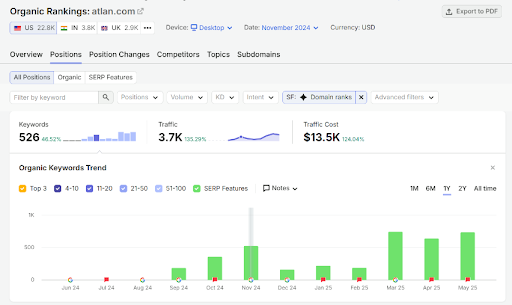
When we began working with Atlan, its competitors and review platforms dominated commercially relevant search results. Atlan received fewer than 10,000 monthly organic sessions and had no recorded AI citations. These gaps informed our content and search optimization priorities.
Step 2. Identify opportunities across the buyer journey
Map existing content to informational, comparison, and purchase-intent queries. Extend keyword research to include conversational questions buyers ask AI assistants.
Before creating new content, check whether existing pages can address those questions without introducing keyword cannibalization.
For Atlan, we initially prioritized high-intent keywords closely aligned with its product offerings. As organic visibility improved, we expanded into comparison queries and broader data governance topics. This helped Atlan reach buyers researching technical concepts, evaluating alternatives, and selecting enterprise data management solutions.
Step 3. Strengthen content and brand visibility
Once you've identified priority pages, focus on improvements that add genuine value.
- Update outdated information and address unanswered buyer questions.
- Include original research, expert perspectives, and relevant examples.
- Strengthen contextual internal links between informational and commercial pages.
- Build authority through credible backlinks and relevant third-party brand mentions.
For Atlan, we combined AI-assisted content production with human research, subject-matter expertise, and editorial reviews. We supported content production with on-page SEO, internal linking, link building, and ongoing content optimization.
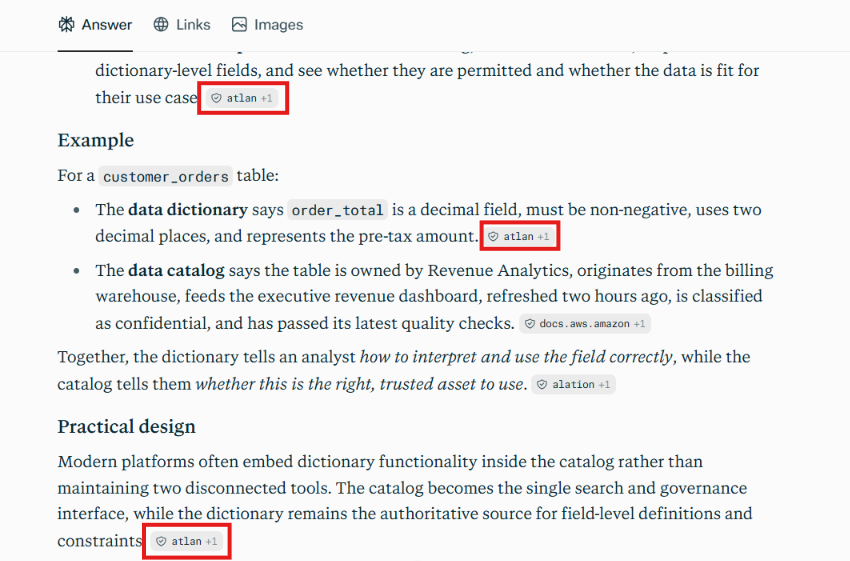
This approach helped Atlan scale to over 100 blogs per month while securing citations across Google AI Overviews and Perplexity.
Step 4. Track performance and refine your strategy
Evaluate SEO and AEO together while maintaining channel-specific performance metrics. This helps you assess their combined contribution to lead generation and identify where further optimization is needed.
Track organic rankings, clicks, and conversions alongside AI citations, brand mentions, and identifiable referral traffic. Use consistent prompt sets and AEO tracking tools to monitor citation trends, competitor mentions, and changes in brand visibility over time.
For Atlan, we monitored organic search performance alongside AI visibility. The following snapshots demonstrate its organic search growth and presence in AI-generated answers.
Read more: How our AEO approach helped Atlan win 6,500+ citations
Use these performance insights to prioritize next optimization efforts, whether that means refreshing declining pages, closing citation gaps, or expanding coverage of commercially relevant buyer questions.
Build a search strategy that goes beyond rankings
SEO helps your business get discovered in search results. AEO extends that visibility to AI-generated answers. Together, they create more opportunities to reach potential customers as they research, compare, and evaluate solutions.
At Revv Growth, we help businesses connect both approaches through AI-driven content strategies, technical optimization, and ongoing visibility tracking. Our focus is on improving discoverability across search platforms and turning that visibility into meaningful business opportunities.
Want your brand to be found in both search results and AI-generated answers? Explore our AEO services and let's build a search strategy that works across both.