
About
A collaboration platform for modern data teams
Atlan is a SaaS-based data collaboration platform built for data teams, the way GitHub was built for engineers. It gives data professionals a central place to discover, govern, and collaborate on data, and it's been one of the fastest-growing names in the DataOps space since its founding in 2018.
They had the product. They had the market. What they needed was organic visibility to match.
The Challenge
Ranking well in a competitive, technical niche
Atlan's challenge wasn't an unusual one for a B2B SaaS company. Their blog existed, but it wasn't pulling the organic traffic their growth targets needed. Their top-3 keyword rankings stood at 778, and organic traffic was at around 54,000 monthly sessions, decent, but far short of their potential.
The bigger problem was positioning. Atlan needed to become the authoritative voice on topics their ideal buyers cared about: data quality, data lineage, data catalogs, governance, without sounding like a product brochure. That's harder than it looks in a space where every major vendor is fighting for the same search real estate.
The goal was clear: rank in the top 3 of the SERP for high-intent, high-volume keywords in the data space, secure featured snippets, and turn Atlan's blog into a traffic machine that consistently attracts qualified readers.
Our Approach
An AI-powered content engine with a human editorial layer
We didn't just start writing blogs and hoping for the best. We built a repeatable system, one that could produce high-quality, SEO-optimized content at scale without sacrificing depth or accuracy.
The strategy came down to two things: topic authority and execution velocity. For topic selection, we mapped keywords adjacent to Atlan's core product using a pillar-cluster model.
A term like "cloud data migration" isn't a feature Atlan sells, but it's high-intent traffic from exactly the right buyers. Ranking for these adjacent keywords builds topical authority across the broader data space, which feeds PageRank and relevance signals directly into Atlan's core product pages.
01. Intent Mapping
Before writing a word, we studied the true search intent behind each keyword. What is someone actually trying to learn or do when they type this query? That determined the structure, depth, and angle of every piece.
02. Structured Outlines
We reverse-engineered the top-ranking pages for each keyword and built outlines that matched what Google was already rewarding. No guesswork, no padding.
03. AI-Assisted Drafting
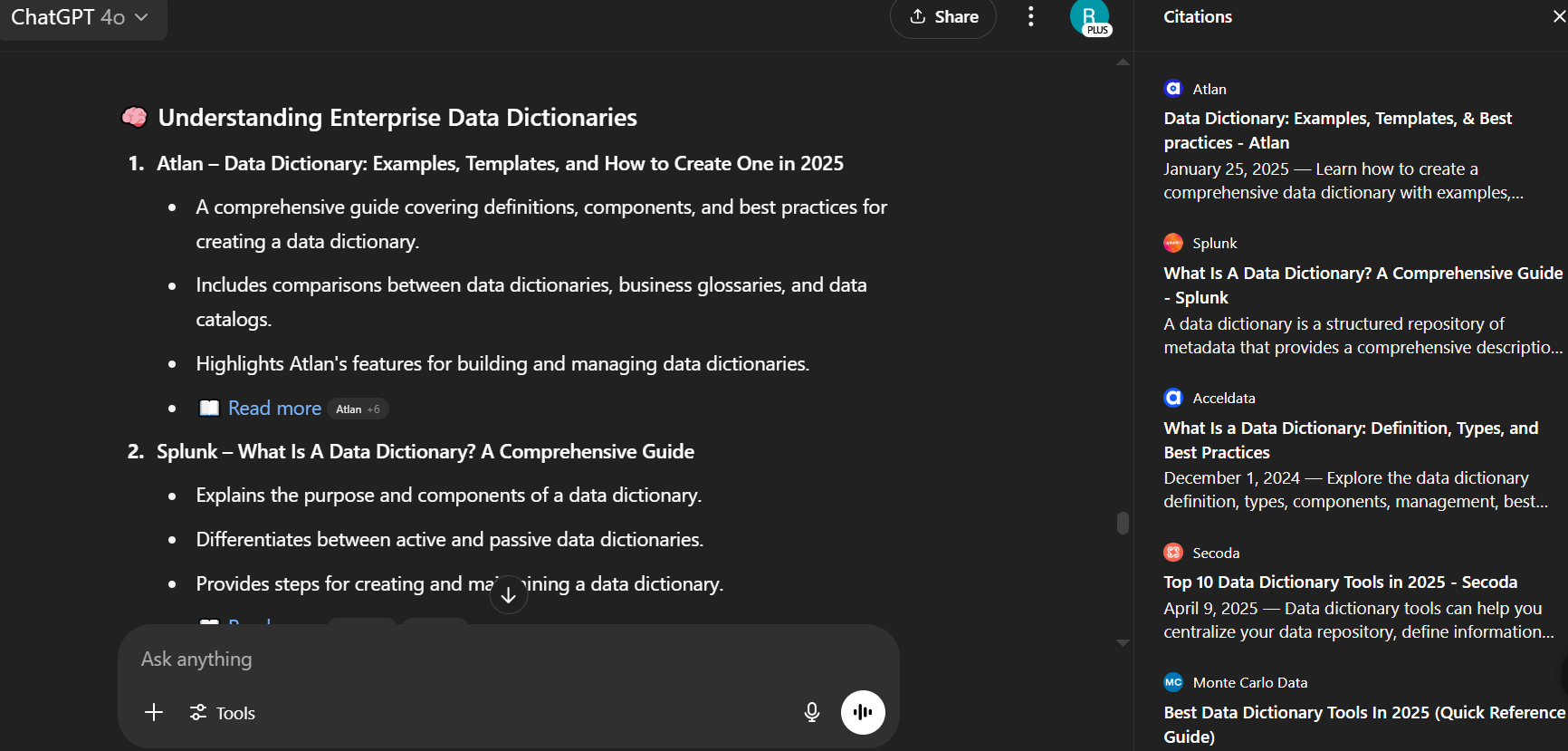
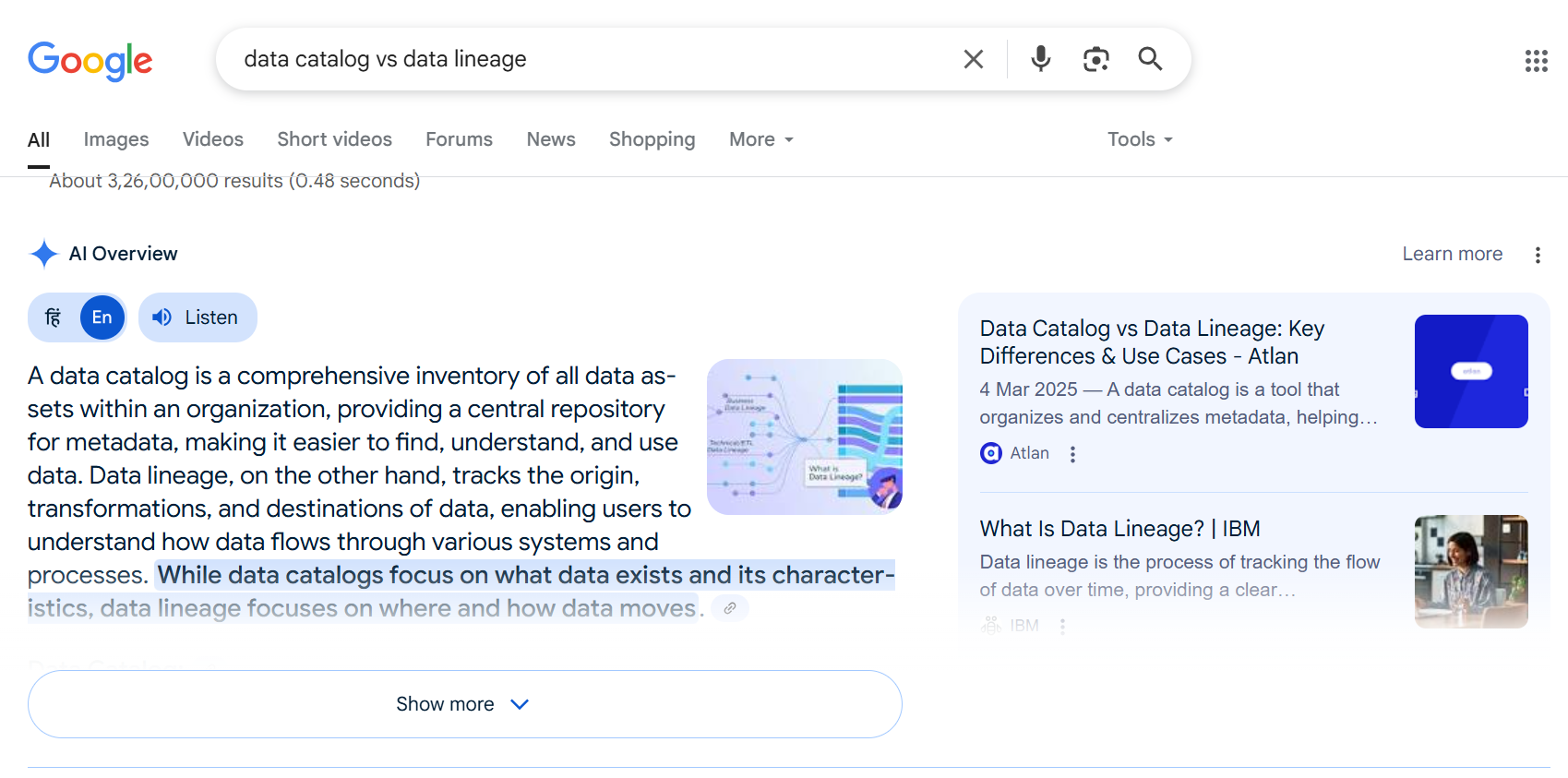
ChatGPT, Claude, Perplexity, and Frase handled first drafts, calibrated for featured snippet capture: tight definitions, structured lists, direct comparison paragraphs. That's how we scaled to 130+ long-form blogs a month without a large team.
04. Expert Editorial Review
Every piece went through at least two rounds of human review. Editors checked for accuracy, brand tone, contextual depth, and E-E-A-T signals, the things AI can't reliably get right on its own.
05. Pillar-Cluster Interlinking
Each cluster blog linked back to its pillar page in the first paragraph, passing link equity upward and giving crawlers a clear topical map. Sub-topics like "Data Catalog vs. Data Dictionary" fed directly into the "What is a Data Catalog" pillar, compounding its authority over time.
06. On-Page SEO Optimization
Every blog was optimized for meta titles, meta descriptions, H1/H2/H3 structure, transition words, and featured snippet formatting. Nothing was left to chance.
07. Automated Editorial Workflow
The entire pipeline from brief to publish was integrated with Notion and Atlan's CMS (CloudCannon), cutting production time without sacrificing consistency across 130+ monthly articles.
Results
From a strong blog to a search dominance machine
The numbers tell a straightforward story. In the period after we started working together, Atlan's organic presence roughly doubled across every meaningful metric.


.webp)