


.png)
A few months ago, I noticed a pattern in my day. I kept asking simple questions. How many proposals were sent? Which deals were closed last month? What meetings were scheduled today? None of this information was new. It already lived across Google Sheets, ClickUp, Google Calendar, Google Ads, Gmail, and Slack.
The problem was access. Every answer required switching tools or asking someone else to check. Individually, these interruptions felt small. Together, they created constant context switching and slowed down decision-making.
We had already experimented with a basic version of Revv GPT, but it only returned generic answers and could not interact with live systems. It did not reduce effort. It added another layer. That was the turning point. If the data already existed, there was no reason answers could not come from a single conversation.
That realization led us to rebuild Revv GPT as an internal assistant designed around one idea: ask questions naturally in one chat window and get clear, real answers without friction.
The Real Problem: Friction, Not Information
Revv Growth already had all the right tools in place—Google Sheets for proposals, ClickUp for tasks, Google Calendar for meetings, Gmail and Slack for communication, Google Ads dashboards for performance, and internal documents for context. From the outside, everything looked well organized.
The problem showed up in day-to-day work. Simple questions like how many proposals were sent, which campaigns were live, what meetings were scheduled, or what was pending with the team required switching between tools or asking someone else. The information already existed, but reaching it took effort. That constant friction, not a lack of data, was the real inefficiency slowing things down.
The Shift: One Chat, One Question, Everything Else Automated
Traditional dashboards and early AI tools didn’t solve this. They either returned generic answers, couldn’t access live systems, or required users to think about prompts and tools. That missed the point. The experience needed to feel as natural as asking a teammate a question.
The breakthrough came by flipping the model entirely. Instead of making users choose tools or write prompts, all responsibility was moved to the AI agent. Users ask a question in plain language through a single chat interface. The AI understands intent, selects the right system, pulls the relevant data, and delivers a clear, human-readable answer. The philosophy behind Revv GPT is simple: the user does one thing—ask a question. The system handles the rest.
How Revv GPT Actually Works
Step 1: One Chat Interface
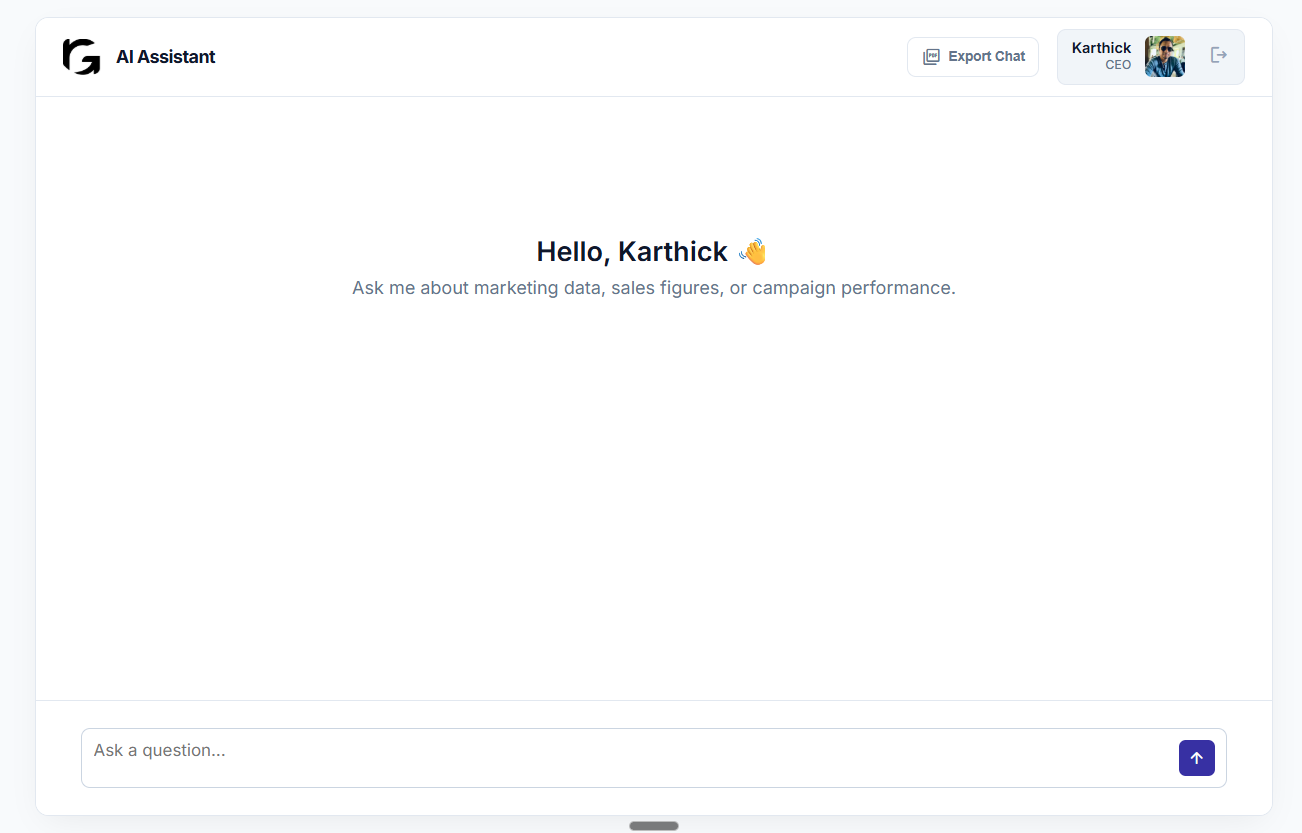
Revv GPT starts with a single chat interface. A user types a question in plain language, without selecting tools or routing the request manually.
Step 2: The System Receives the Query
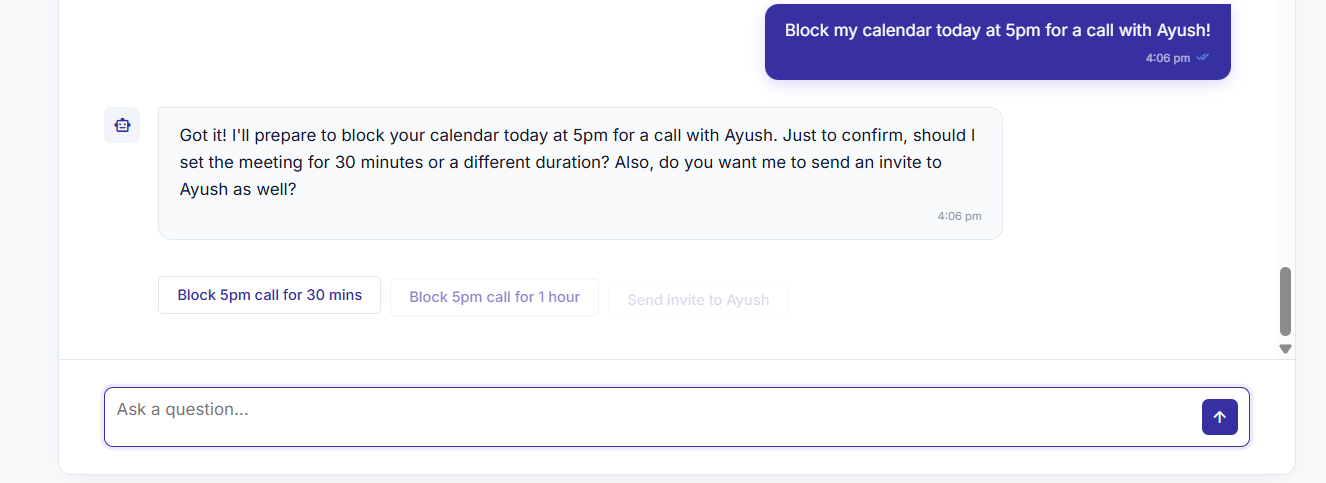
Once a question is submitted, the system captures three things: the message itself, the user’s identity, and the session context. This allows the system to understand both the question and who is asking it.
Step 3: User-Based Access Control
Access is controlled based on the user. Founders have full visibility across data sources, while role-specific users—such as a PPC lead—only see data relevant to their function, like Google Ads. The same system applies different permissions to ensure data safety and relevance.
Step 4: The AI Agent Chooses the Right Tool
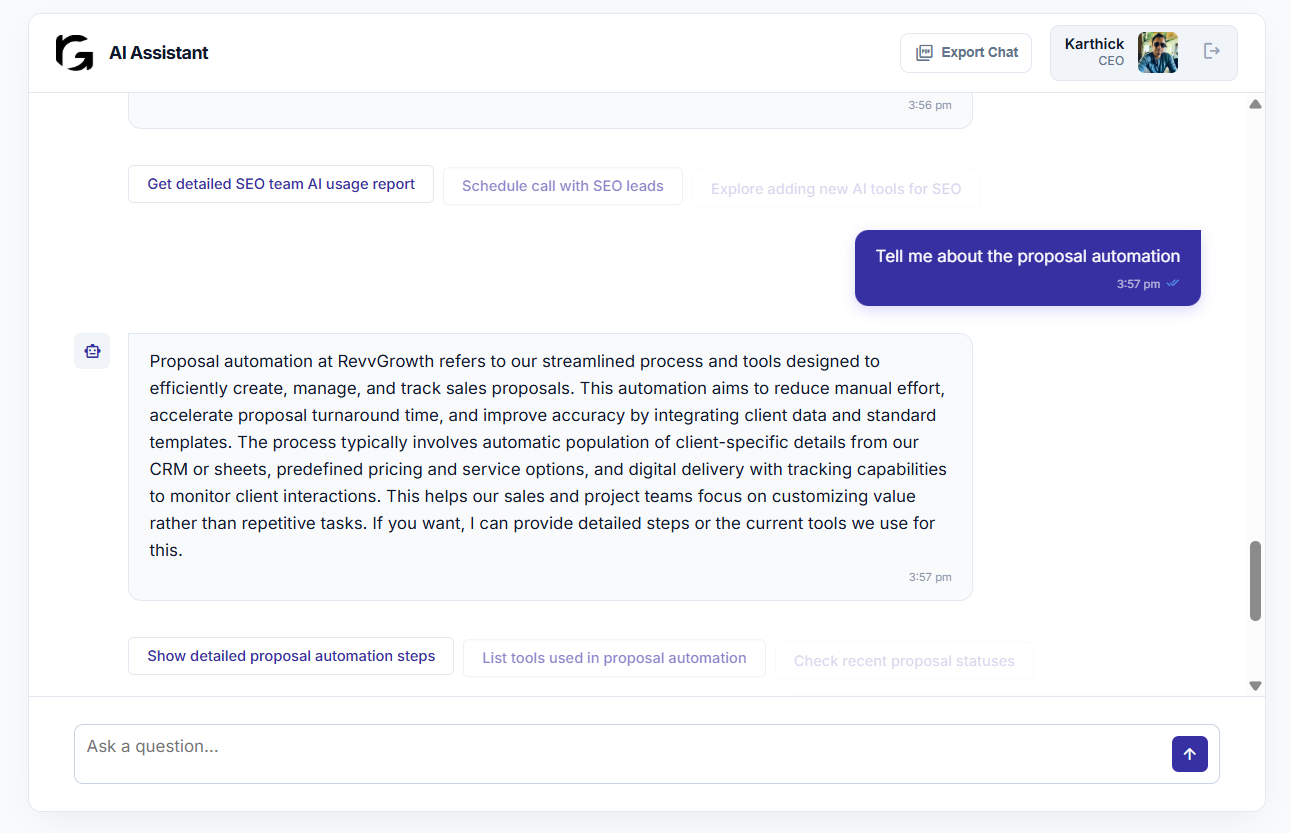
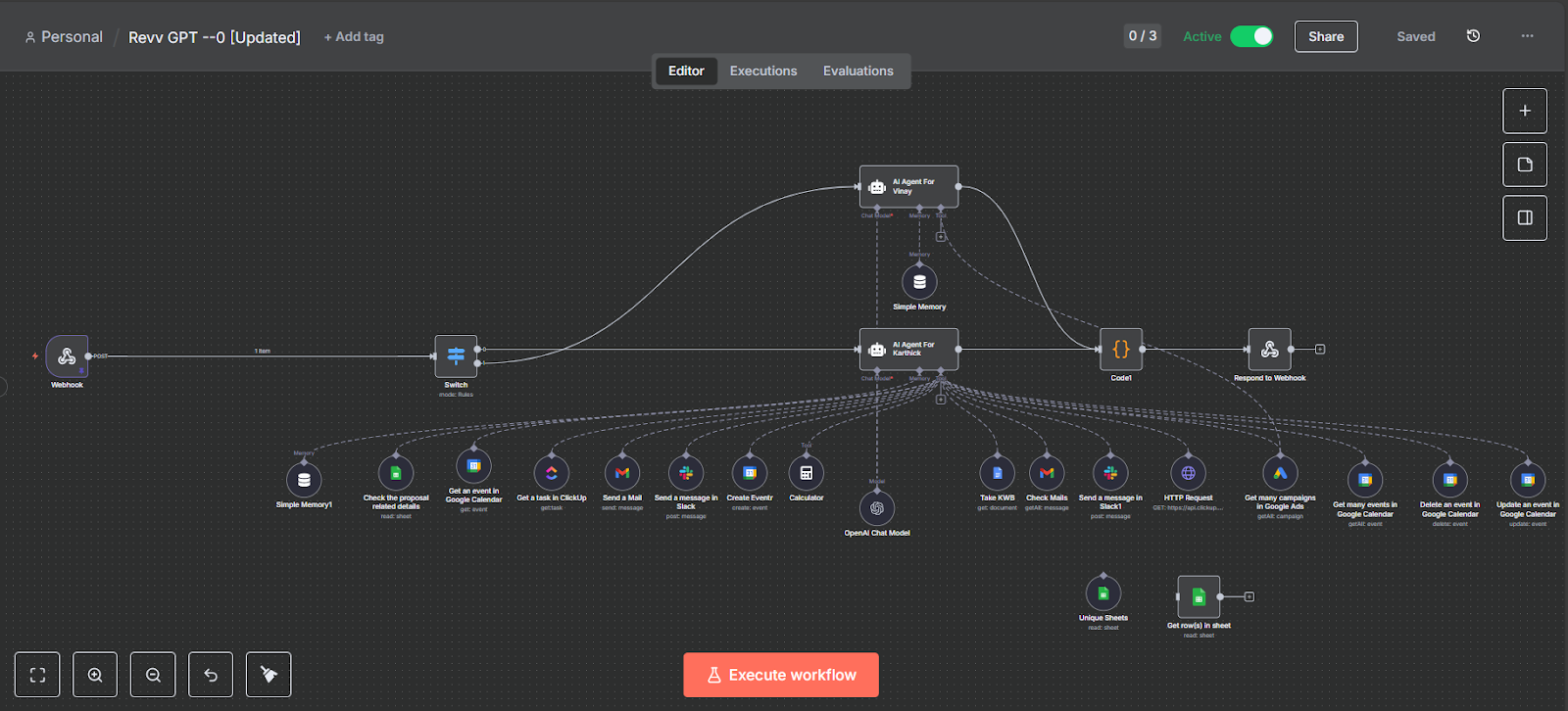
This is the core of Revv GPT. The AI agent reads the question, understands the intent, and automatically selects the correct internal tool. Proposal-related queries go to proposal sheets, meeting questions check calendars, campaign queries pull from Google Ads, and task updates come from ClickUp. No tagging or manual routing is required—the AI handles tool selection, context, tone, and the final response.
Step 5: Data Is Returned as a Human-Readable Answer
Instead of returning raw numbers or dashboard exports, Revv GPT delivers responses in a clear, conversational format. When asked about active campaigns, it explains which campaigns are running, their status, and relevant metrics, making the answer actionable and easy to understand.
Designing an AI That Takes Responsibility
One of the biggest lessons from building Revv GPT was simple: prompt design is not about clever wording. It is about responsibility. Instead of juggling multiple prompts, we defined a single, comprehensive instruction set that clearly established what the AI owns. It behaves like a Revv Growth employee, stays within our context, avoids generic advice, and responds in clear, human language. Even small details, like addressing people by name, were intentional to make interactions feel natural.
Just as important was how the system handles uncertainty. When information is not available, Revv GPT does not guess or fabricate. It states the gap clearly and offers to help by drafting a message to the right person. That shift, from pretending to know to helping move work forward, changed everything.
Final Thoughts
Revv GPT was built to reduce dependency and protect focus. By removing constant context switching and dashboard hopping, it brings answers into one conversation where decisions can happen faster and with less effort. The real takeaway is not about AI adoption. It is about designing workflows that reduce thinking instead of adding complexity.
Still jumping between tools to get basic answers from your own systems?
We replaced dashboards, follow-ups, and context switching with a single internal assistant that surfaces real answers in one conversation.
If you are thinking about simplifying internal workflows or building AI systems that actually remove friction, connect with me on LinkedIn. I am happy to share what worked for us, what did not, and how you can apply the same thinking inside your team.
— Karthick Raajha
Founder, Revv Growth
FAQs
.svg)


.webp)
.avif)