


.png)
A few months ago, our hiring process started to feel heavier than it should have. Not because we were hiring too much, and not because we had the wrong people, but because every new role added more manual work for our HR team.
A single job post could turn into hundreds of emails within days. Each resume had to be opened, read, understood, compared with the role, evaluated, recorded, and answered. None of this was difficult work, but it was constant and time-consuming. The problem was not the complexity of hiring. It was the volume and repetition around it. Every resume had to be checked against the job description. Every candidate needed a decision. Every decision needed a reason. Every eligible candidate triggered follow-up emails. Every reply had to be reviewed again for location, salary expectations, and availability.
Each step felt manageable on its own. Together, they became a slow and tiring loop that took up hours of focused human attention, not on judgment, but on filtering. We were not failing to hire well. We were failing to protect our team’s time and mental energy while doing it. That realization changed how we looked at the entire process.
The Real Problem Was Not Hiring. It Was Friction
The issue became clear during an internal discussion. The moment a role goes live, dozens or even hundreds of resumes arrive at once, and HR has to pause everything else to go through them. Not because they want to, but because the process leaves no other choice. Hiring becomes reactive, and decisions are made quickly not because people are careless, but because the system forces speed instead of thought.
What stood out was that none of this work was strategic or required deep human thinking. It was mostly mechanical work like reading resumes, comparing them to the role, writing summaries, sorting candidates, and sending replies. The important parts of hiring, such as judging fit, noticing nuance, and having real conversations, were getting pushed aside.
That was the real inefficiency. We were not short on talent. We were short on attention. And in a growing company, attention is the most valuable resource there is.
Why Traditional ATS Did Not Solve It and What We Built Instead
It was natural to ask whether this was what ATS systems were meant to solve. In theory, yes. In practice, they did not address our real problem. Most ATS tools rely on internal scoring and keyword matching. They rank candidates as high or low, but they rarely explain why in a way that maps clearly to the role. They optimize for speed and volume, not for understanding.
What we needed was not a ranking engine. We needed a reasoning layer. We needed something that could take a resume, take the job description, compare the two, and explain the alignment or mismatch in plain language. Not “this candidate scored 72,” but “this candidate does not have B2B SaaS writing experience, which is required for this role.” That kind of explanation supports human decisions instead of replacing them.
So the first workflow we built was a resume evaluation system designed to automate repetitive thinking so people could focus on meaningful thinking. Instead of HR opening and reading every resume manually, the system reads each one, creates a concise professional summary, compares it to the role, and makes an eligibility decision with a clear written justification. The justification is specific to both the resume and the role, which makes decisions transparent and easy to trust.
For example, when a candidate with strong general copywriting experience applied for a B2B SaaS content role, the system did not simply reject them. It explained that while the candidate had solid digital writing experience, they lacked demonstrated B2B SaaS background, which was a core requirement for the role. That level of clarity changed how hiring felt internally. HR was no longer starting from chaos. They were starting from clarity.
How the System Works (Step by Step)
Once we agreed that the goal was not to replace human judgment but to remove repetitive work, the next question was practical. What does this look like in reality? How does a resume move through the system and turn into a hiring decision? We designed the process as a simple set of steps, where each step removes a specific bottleneck and keeps humans in control of the final outcome.
Step 1: The job description defines what “fit” means
HR first defines the job description inside the system. This includes not just the role title, but the required skills, experience, and domain context. This becomes the single reference point used to evaluate every resume, so candidates are judged consistently against the same criteria.
Step 2: Relevant resumes are collected automatically
The system filters incoming applications based on role-related keywords. For example, if the role is for an AI or ML engineer, only resumes related to that role are collected. This keeps the process focused and avoids clutter from unrelated applications.
Step 3: Resumes are analyzed and given a verdict
Each resume is read by the system and summarized. It is then compared to the job description and given a verdict: Yes, No, or Maybe, along with a clear explanation for that decision.
This explanation shows how the candidate matches or does not match the role, using plain language that is easy to understand.
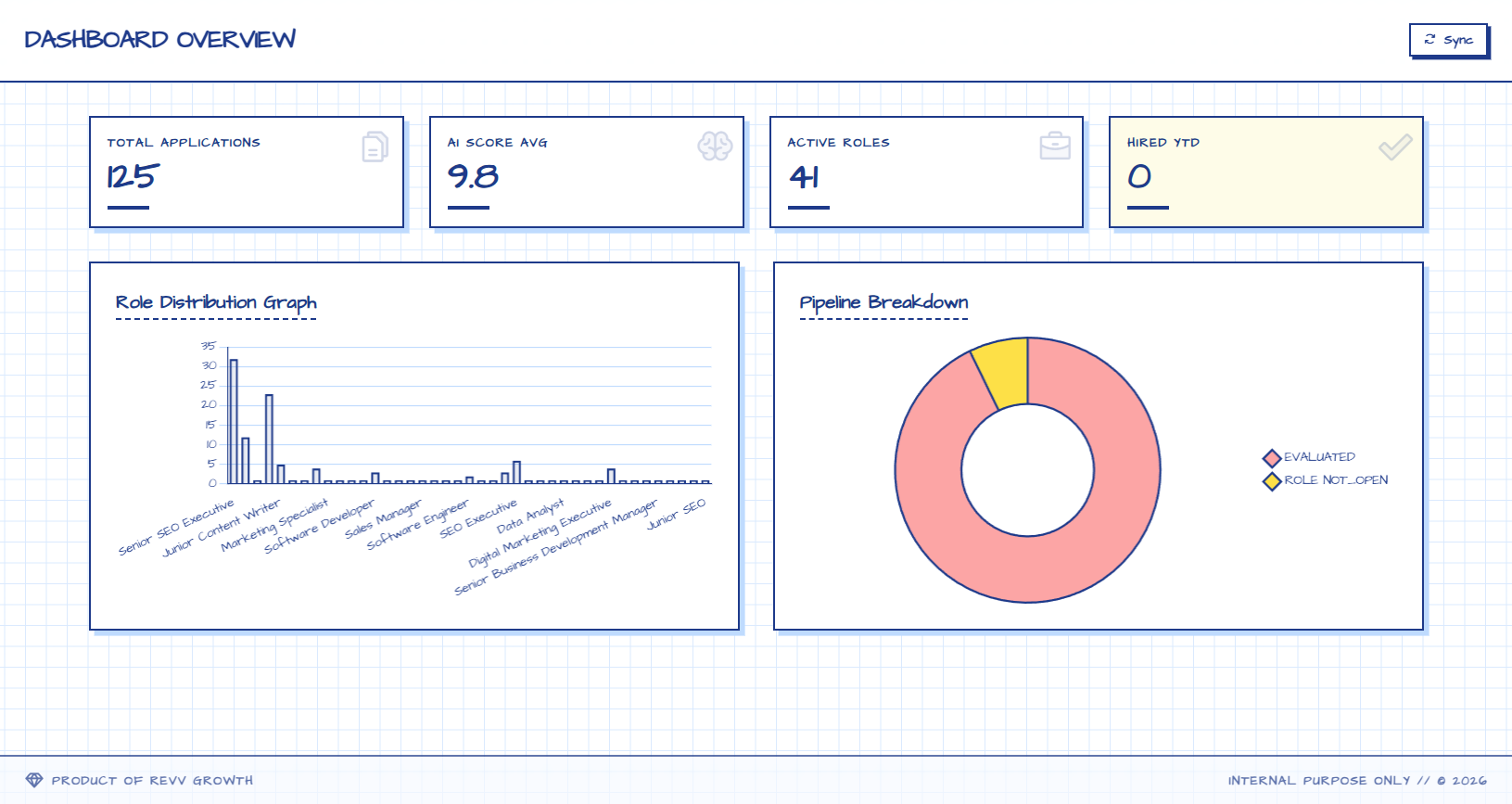
Step 4: Results are saved in one central view
All candidate data is stored in a structured sheet. This includes the candidate name, summary, verdict, and reasoning. This gives HR and the team a clean, organized view of the full applicant pool.
Step 5: The team reviews and votes
Team members can review candidates and vote Yes or No. These votes do not trigger actions automatically. Instead, they are sent as notifications to HR, who remains responsible for the final decision.
Step 6: HR makes the final decision and schedules interviews
HR reviews the system verdict, the team votes, and the reasoning. Based on this, HR decides whether to move the candidate forward and schedule an interview. Nothing is scheduled automatically without HR approval.
Step 7: Communication is fully controlled by HR
No follow-up emails are sent automatically. If HR chooses to reach out to a candidate, emails are sent manually through admin access. This ensures full human control over candidate communication.
Step 8: Interviews are summarized into structured reports
After interviews, transcripts are analyzed and turned into structured reports. These reports highlight strengths, gaps, and areas to explore further. HR and leadership receive clear summaries instead of raw transcripts.
Step 9: HR and leadership receive insight, not raw data
All information is presented as structured insight that supports thoughtful decisions. The system handles reading, organizing, and summarizing, while humans handle judgment and responsibility.
Why This Structure Matters
What this step-by-step structure does is quietly shift hiring from a reactive process into a deliberate one. Each step removes a specific form of friction: inbox overload, manual reading, copy-pasting, chasing responses, coordinating feedback. None of these activities made us better at hiring. They only made us busier.
By separating mechanical work from judgment, the system gives human decision-makers more space to think, reflect, and choose well — which is what hiring should be about in the first place.
From Resumes to Decisions: Removing Friction From Hiring
Once resume evaluation was structured, the same friction appeared across the rest of the hiring process. Follow-ups for location and compensation still had to be sent, responses still had to be read and checked, and interview transcripts still had to be reviewed and summarized. None of this required judgment, but all of it consumed human attention.
So we extended the system end to end. Eligible candidates receive structured follow-ups, responses are extracted and evaluated automatically, and only aligned candidates move forward. After interviews, transcripts are converted into clear, structured reports that highlight strengths, gaps, and what to explore next. Instead of inbox monitoring, copy-pasting, and transcript skimming, the team receives insight.
The boundary remains intentional. The system handles reading, extracting, comparing, and organizing information. Humans retain ownership of judgment and final decisions. If information is missing, the system flags it instead of guessing, preserving trust.
What changed was not just speed, but quality. Hiring became calmer and more deliberate. HR felt less overwhelmed, candidates received clearer responses, and attention returned to where it belonged, conversations, not filtering. We did not hire faster because we rushed. We hired faster because friction disappeared.
Final Thoughts
This was never about building “AI hiring.” It was about protecting human attention. By removing inbox monitoring, manual filtering, and transcript skimming, we created space for the work that actually matters: judgment, conversation, and thoughtful decisions. The real takeaway is not AI adoption. It is designing workflows that reduce cognitive load instead of adding another system to manage. Hiring works best when people are allowed to think, not rush.
Still spending hours filtering resumes, chasing replies, or turning interviews into decisions?
We replaced manual follow-ups, resume screening, and transcript review with a system that removes friction and surfaces clarity, while keeping humans fully in control. If you are exploring AI workflows that respect human time instead of replacing human judgment, connect with me on LinkedIn. I’m happy to share what worked for us, what didn’t, and how the same principles can be applied inside your team.
— Karthick Raajha
Founder, Revv Growth
FAQs
.svg)


.webp)
.avif)