
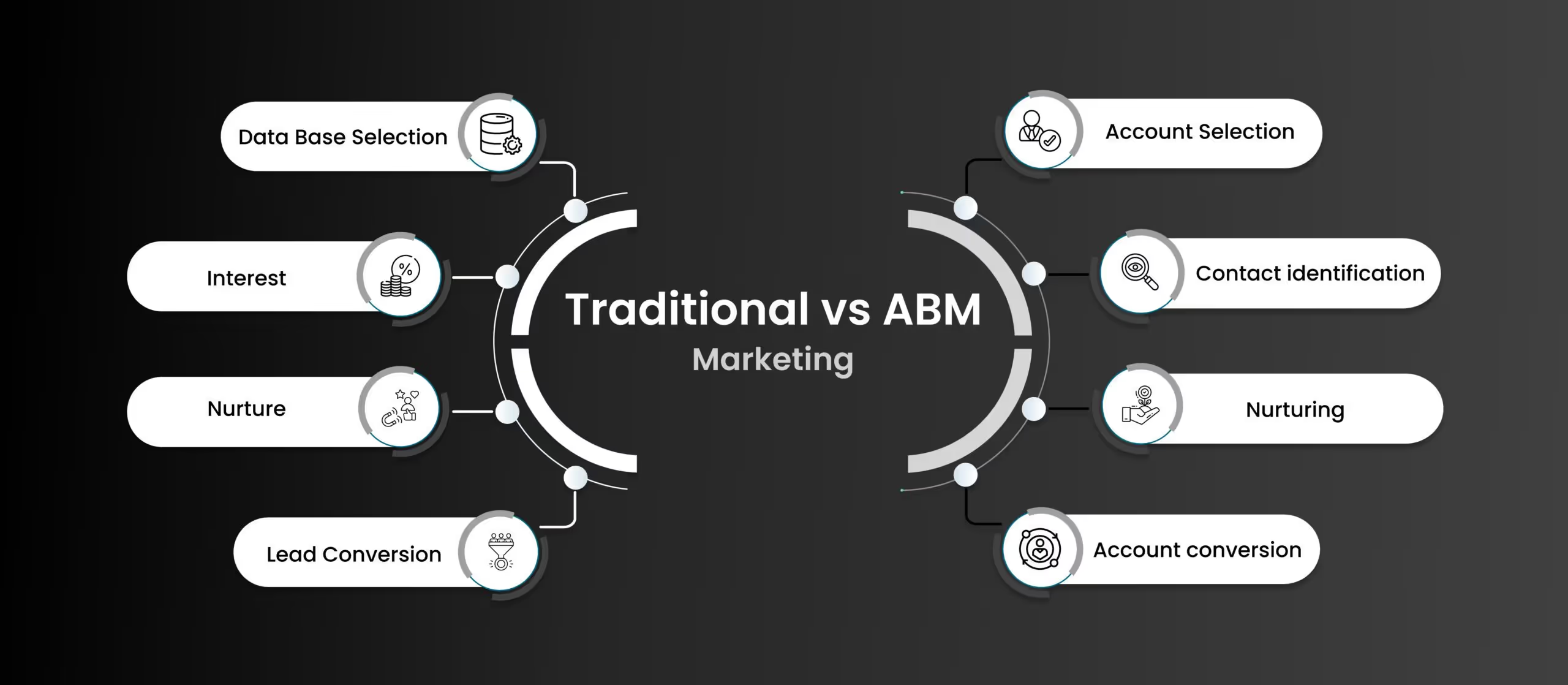
In the ever-evolving landscape of B2B marketing, two distinct approaches have emerged as powerful strategies to drive growth and revenue: Account-Based Marketing (ABM) and Traditional Marketing.
As businesses strive to connect with their target audience and maximize their marketing efforts, understanding the differences between these two methodologies becomes crucial.
The numbers tell a compelling story. According to ITSMA research, 87% of marketers report that ABM delivers higher ROI than traditional marketing strategies. Even more striking, companies implementing ABM see a 224% increase in revenue compared to those using traditional methods.
But here's what matters most: choosing the right approach isn't about which strategy is objectively "better." It's about which aligns with your specific business goals, target audience, and available resources.
In this comprehensive comparison guide, we delve into the intricacies of ABM and Traditional Marketing. We explore their unique characteristics, benefits, and how they align with the needs of B2B marketers in 2025.
Whether you're seeking to refine your existing marketing strategies or looking to make a significant shift, this guide will equip you with the knowledge and insights necessary to make informed decisions.
The State of ABM in 2025
Account-Based Marketing has evolved from an experimental strategy to a revenue-driving necessity in the B2B landscape. The adoption rates and results speak for themselves.
Market Growth and Explosive Adoption
The ABM market is experiencing explosive growth. The global ABM market is projected to surpass $1.6 billion by 2027, according to industry analysts.
This isn't just about market size. It's about proven effectiveness in driving adoption.
Forrester research reveals that ABM programs generate 21% to 350% higher ROI than traditional marketing approaches. That's not a marginal improvement—that's transformational.
Here's a stunning statistic: 94% of B2B marketers now employ ABM strategies. This nearly universal adoption demonstrates ABM's effectiveness and prominence as a fundamental strategy in engaging and converting high-value accounts.
But it gets even more interesting. 67% of brands have incorporated ABM into their marketing mix, highlighting its widespread acceptance beyond just B2B tech companies.
Investment Continues Growing
The momentum continues building. In 2023, 95% of technology marketers anticipated increasing their Account-Based Marketing budgets over the following year. This reflects a commitment to expanding ABM programs and their perceived value in driving business results.
Even during the pandemic, 44% of organizations kept their ABM budgets unchanged. This demonstrates ABM's enduring strategic value and crucial role in enabling targeted engagement even under challenging conditions.
More than one year of ABM implementation is reported by 57% of marketers. This demonstrates maturity among the majority of ABM users, suggesting that sustained ABM efforts are considered valuable and integral to long-term marketing strategies.
AI Transforms ABM Execution
Technology is reshaping how companies execute ABM strategies. By 2025, 84% of marketers report leveraging AI and intent data to enhance personalization within their ABM campaigns, according to LinkedIn's B2B Institute.
AI enables marketers to identify buying signals earlier. It automates personalization at scale. It predicts which accounts are most likely to convert.
This technological advancement makes ABM more accessible to companies of all sizes. You no longer need massive teams to execute sophisticated ABM programs.
Hybrid Approaches Gain Traction
Here's an important evolution: 58% of organizations now blend ABM strategies with traditional demand generation. This marks a strategic evolution toward a unified marketing approach that capitalizes on the combined strengths of both methodologies.
The most successful B2B companies aren't choosing between ABM and traditional marketing. They're strategically combining both to maximize effectiveness.
The Results Justify the Investment
Let's talk about what really matters: outcomes.
Mature ABM programs contribute to 79% of all sales opportunities. This figure emphasizes ABM's dominance in generating and converting high-value accounts, surpassing traditional inbound and outbound marketing methods in effectiveness.
Companies with complete ABM programs report impressive returns. 63% report at least a 25% return on investment. Even more impressive, 46% see returns of at least 50%.
According to research, 91% of companies using ABM increase their average deal size. What's even more remarkable, 25% report increases of over 50%.
These aren't projections or hopes. These are actual results from companies that have fully implemented ABM strategies.
Understanding the Basics: ABM vs Traditional Marketing
To navigate the B2B marketing landscape effectively, it's essential to grasp the fundamental differences between Account-Based Marketing and Traditional Marketing.
These two distinct approaches form the cornerstone of modern marketing strategies. Each has its own unique characteristics and methodologies.
What is Account-Based Marketing (ABM)?
Account-Based Marketing is a strategic approach that focuses on targeting specific high-value accounts with personalized marketing efforts.
Think of it this way: instead of casting a wide net hoping to catch any fish, ABM is like spear fishing. You identify exactly which accounts you want and go after them with precision.
ABM aims to align sales and marketing efforts to engage and convert key accounts. According to research, 82% of B2B marketers acknowledge that ABM significantly boosts marketing and sales alignment within their organizations.
This collaboration is one of ABM's fundamental advantages. Both teams work together from the start, identifying target accounts and creating coordinated campaigns.
There are four main types of ABM, each suited to different business needs and resources:
One-to-One ABM: This approach involves creating highly customized marketing campaigns and experiences tailored to individual accounts.
It requires significant personalization and typically suits organizations with a small number of high-value accounts. Think enterprise deals worth $500,000 to millions annually.
One-to-Few ABM: Here, marketing efforts are personalized for a small cluster of accounts (typically 5-15) that share similar characteristics or needs.
While not as individualized as one-to-one, this approach still requires a high level of customization.
One-to-Many ABM: Also known as "ABM Lite," this approach involves targeting a larger set of accounts (50-500) that have similar characteristics.
It involves personalization at scale, utilizing technology and automation to deliver relevant messaging and content.
Programmatic ABM: This type combines the principles of ABM with programmatic advertising. It uses data and technology to automate the delivery of targeted ads to specific accounts or account segments. Platforms like Demandbase and 6sense enable this approach.
What is Traditional Marketing?
Traditional marketing refers to the conventional marketing methods used to reach a broad audience. It involves mass marketing tactics that are not personalized to individual accounts.
The goal is to reach as many potential customers as possible and nurture them through the sales funnel. Traditional marketing encompasses various types, including:
Broadcast Marketing: This type involves reaching a wide audience through mass media channels like television, radio, and podcasts. Broadcast marketing aims to create brand awareness and engage a large number of potential customers simultaneously.
Print Marketing: Print marketing includes advertisements in newspapers, magazines, brochures, flyers, and direct mail campaigns. It allows businesses to target specific geographic areas or publications to reach their intended audience.
Outdoor Marketing: Also known as out-of-home (OOH) advertising, this type involves marketing through billboards, transit ads, signage, and other physical media. Outdoor marketing aims to capture the attention of people in public spaces.
Digital Marketing: Digital marketing encompasses a wide range of online tactics, including search engine marketing (SEM), social media marketing, email marketing, display advertising, content marketing, and influencer marketing. According to Gartner research, 73% of B2B buyers prefer to research independently online before engaging with sales.
The Fundamental Difference
Here's the core distinction: Traditional marketing optimizes for reach and volume. ABM optimizes for precision and value.
Traditional marketing says, "Let's get our message in front of as many people as possible." ABM say,s "Let's identify the 100 companies that would benefit most from our solution and create campaigns specifically for them."
Neither approach is inherently better. They serve different purposes and work for different business models.
It's worth noting that traditional marketing types are often used in conjunction with each other to create a comprehensive marketing strategy. The choice between ABM and traditional marketing depends on your organization's goals, target audience, and available resources.
Why Businesses Are Switching from Traditional to ABM
The shift from traditional marketing to account-based marketing has been driven by several factors that have influenced the way businesses approach their marketing strategies.
Here are the key reasons why there has been a switch from traditional marketing to account-based marketing:
1. Personalization and Targeting
Traditional marketing methods often involve casting a wide net and reaching out to a broad audience. However, with the rise of digital marketing and data-driven insights, businesses have realized the value of personalized and targeted marketing efforts.
Here's what changed: buyers now expect personalization. According to Salesforce research, 73% of customers expect companies to understand their unique needs and expectations.
ABM allows companies to focus on specific high-value accounts and tailor their marketing messages to the unique needs and pain points of those accounts. This personalized approach helps in building stronger relationships with key decision-makers and increases the likelihood of converting them into customers.
The results speak for themselves. Companies using ABM see 60% higher win rates compared to traditional marketing approaches, according to industry surveys.
2. Alignment of Sales and Marketing
ABM emphasizes the alignment of sales and marketing teams, encouraging them to work together towards common goals.
Traditional marketing approaches often generate leads and hand them off to the sales team. This can lead to misalignment and a lack of synergy.
You've probably heard sales complain: "These leads are of terrible quality." Meanwhile, marketing says, "We're generating hundreds of leads. It's not our fault sales can't close them."
ABM solves this problem through collaboration. It involves close collaboration between sales and marketing teams from the beginning. By jointly identifying target accounts, defining ideal customer profiles, and creating personalized campaigns, ABM ensures that marketing efforts are closely aligned with sales objectives.
The impact is measurable. 82% of B2B marketers report that ABM significantly improves marketing and sales alignment within their organizations. Even better, 61% of marketers have observed a significant enhancement in marketing and sales alignment at their companies due to ABM.
3. ROI and Efficiency
Traditional marketing methods, such as mass advertising, can be expensive and yield low conversion rates.
Let's look at the numbers. Traditional B2B marketing delivers an average 2.3% open rate for non-targeted email campaigns. Generic content marketing sees engagement times under 30 seconds. Mass advertising generates high costs per lead with conversion rates averaging just 1% to 3%.
ABM, with its targeted approach, helps optimize marketing spend by focusing resources on accounts with the highest potential for revenue generation.
By identifying and targeting key accounts, companies can allocate their budget and resources more efficiently. This results in higher return on investment and better use of marketing resources.
How much better? According to ITSMA, 87% of marketers say ABM delivers a higher ROI than other marketing strategies. Forrester research found that ABM programs generate 21% to 350% higher ROI than traditional marketing approaches.
4. Customer-Centric Approach
ABM places a strong emphasis on understanding the needs and preferences of individual accounts. By focusing on personalized interactions and delivering highly relevant content and messaging, companies can create a more customer-centric approach.
This approach builds trust, enhances the customer experience, and increases the likelihood of success in engaging and converting target accounts.
Companies using ABM report an 84% improvement in reputation and 80% improvement in customer relationships, according to industry studies.
But here's what really matters: modern B2B buyers demand this level of attention. According to research from Gartner, 77% of B2B buyers state that their latest purchase was very complex or difficult.
They're dealing with multiple stakeholders, long evaluation periods, and high-stakes decisions. Generic marketing doesn't help them navigate this complexity. Personalized, account-specific content that addresses their unique situation does.
5. Technology Advancements
The availability of advanced marketing technologies and tools has also played a significant role in the shift towards ABM.
Ten years ago, executing personalized campaigns for hundreds of accounts required massive teams and budgets. Today, technology enables sophisticated ABM at reasonable costs.
Platforms like Demandbase, 6sense, and Terminus provide the infrastructure for ABM execution.
ZoomInfo and similar platforms provide the account intelligence and contact data needed for targeting.
LinkedIn Sales Navigator enables account-level advertising and engagement.
These technologies enable the execution and management of complex ABM campaigns, making it easier for businesses to adopt and implement ABM strategies.
Overall, the switch from traditional marketing to account-based marketing is driven by the need for more personalized, targeted, and efficient marketing efforts.
ABM allows companies to focus on their most valuable accounts, align sales and marketing teams, and leverage technology to deliver highly tailored experiences, ultimately resulting in improved ROI and customer satisfaction.
When to Choose ABM vs Traditional Marketing
Here's the truth: neither ABM nor traditional marketing is universally "better." The right choice depends on your specific business situation.
Let's break down exactly when each approach makes sense.
Choose ABM When:
Your Average Contract Value Exceeds $25,000: ABM requires investment in personalization and targeted campaigns. This investment only makes sense when the potential return justifies it. If your average deal is $25,000 or more, the cost of personalized ABM campaigns gets absorbed into healthy unit economics.
You have 50 to 500 Identifiable Target Accounts: ABM works best when you can clearly identify your ideal customers. If your total addressable market consists of 50 to 500 companies that fit your ICP perfectly, ABM is ideal.
Sales Cycles Are 3+ Months: When deals take three to twelve months to close, you need sustained engagement throughout the buying journey. ABM provides the framework for nurturing accounts over extended periods. Research shows that ad-influenced accounts progress through the sales pipeline 234% faster than non-influenced accounts.
Multiple Stakeholders (6-10) Involved: B2B purchases now involve an average of 6 to 10 decision-makers, according to Gartner research. ABM excels at engaging buying committees by creating role-specific content for different stakeholders simultaneously.
High Lifetime Value Customers: When customers stay for years and expand their spend over time, the cost of ABM acquisition gets amortized beautifully. If your average customer lifetime value is $500,000 or more, investing heavily in acquisition through ABM campaigns makes economic sense.
Complex B2B Solutions: The more complex your solution, the more education and trust-building required. ABM provides the personalized approach needed for complex sales.
Choose Traditional Marketing When:
Lower Price Point Products (Under $10,000): When your average deal value is under $10,000, the economics of ABM often don't work. You can't justify spending $3,000 to $5,000 on personalized campaigns for each account when deals are only worth $5,000.
Large Addressable Market (Thousands): If your total addressable market includes 10,000+ potential customers, traditional marketing's broad reach becomes essential. You can't personally target 10,000 accounts with ABM-level personalization.
Short Sales Cycles (Under 30 Days): When prospects move from awareness to purchase in days or weeks, you don't need the sustained engagement ABM provides. Traditional marketing's ability to generate immediate interest and fast conversions works better.
Single Decision-Maker Purchases: If one person can make the buying decision without committee approval, the multi-stakeholder engagement ABM provides isn't necessary.
Early Stage Brand Building: When you're a new company or entering a new market, you often need awareness before you can be selective about targeting. Traditional marketing's broad reach helps establish market presence.
Need High Volume Leads Quickly: Sometimes you need lead volume fast. Traditional marketing's ability to generate hundreds or thousands of leads quickly serves this need better than ABM.
Use a Hybrid Approach When:
Many successful B2B companies combine both approaches strategically.
Mid-Market SaaS ($10K-$50K ACV): This is the sweet spot for hybrid strategies. Deal sizes justify some personalization, but you need volume too. Use traditional marketing to generate broad awareness and inbound leads. Implement ABM for your top 100-200 target accounts.
Multiple Product Lines: If you sell both to SMBs and enterprises, or have products at different price points, a hybrid approach makes sense. Use traditional marketing for lower-tier offerings and reserve ABM for premium, high-value products.
Want Brand + Precision: Brand awareness matters even when doing ABM. A hybrid approach builds broad market recognition while focusing personalized efforts on target accounts.
Comparing KPI Templates
As B2B marketers navigate the dynamic landscape of modern marketing, the need for effective measurement and evaluation becomes paramount. Key Performance Indicators play a crucial role in gauging the success and impact of marketing initiatives.
ABM (Account-Based Marketing) Template
An effective ABM marketing template is a strategic approach that focuses on targeting specific accounts rather than a broad audience. It involves creating personalized marketing campaigns tailored to the needs and preferences of individual accounts.
The template typically includes the following elements:
Account Identification: The first step is to identify and prioritize high-value target accounts. This is usually done by collaborating with sales teams to identify accounts that are most likely to convert into customers. Research shows that companies with aligned sales and marketing teams experience 32% higher revenue growth and 36% higher customer retention.
Personalized Messaging: ABM templates emphasize crafting personalized messages for each target account. The content is tailored to address the specific pain points, challenges, and goals of the account, making it more relevant and engaging. According to research, 73% of customers expect companies to understand their unique needs and expectations.
Multi-Channel Approach: ABM templates leverage multiple channels to reach target accounts. This can include personalized emails, social media campaigns, direct mail, and even one-on-one interactions. The goal is to create a cohesive and consistent experience across all touchpoints.
Account-Specific Content: ABM templates involve creating content that resonates with the target account. This can include case studies, industry-specific reports, and custom-made collateral that directly addresses the account's needs and concerns.
Metrics and Measurement: An effective ABM template includes metrics to measure the success of the campaign. This can include account engagement, conversion rates, pipeline acceleration, and revenue generated from target accounts. The most mature ABM programs are 30% more likely to measure ROI effectively.
Traditional Marketing Template
A traditional marketing template is a more broad-based approach that targets a larger audience without focusing on individual accounts.
Market Segmentation: Traditional marketing templates segment the market based on demographic, geographic, or psychographic factors to identify target groups. The focus is on reaching a broad audience rather than specific accounts.
Mass Communication: Traditional marketing templates often rely on mass communication channels such as television, radio, print media, and online advertising to reach a wide range of potential customers. The messaging tends to be more generic and less personalized.
Campaign Consistency: Traditional marketing templates aim for consistent messaging across various channels to build brand awareness and reach as many people as possible. The content is designed to appeal to a broad audience rather than addressing individual account needs.
Lead Generation: Traditional marketing templates often prioritize lead generation by capturing contact information from potential customers through forms, landing pages, or call-to-action. The focus is on quantity rather than quality of leads.
ROI Measurement: Traditional marketing templates typically measure success through metrics like website traffic, click-through rates, and conversions. The emphasis is on generating a positive return on investment from the overall campaign.
How ABM Templates Are Better
ABM templates offer several advantages over traditional marketing templates:
Increased Relevance: ABM templates enable personalized and tailored messaging, which results in higher relevance for target accounts. This increases the chances of engagement and conversion compared to generic messaging.
Higher Conversion Rates: By focusing efforts on high-value accounts, ABM templates have the potential to deliver higher conversion rates. Research shows that 91% of companies using ABM increase their average deal size, with 25% reporting increases of over 50%.
Stronger Customer Relationships: ABM templates prioritize building strong relationships with target accounts. Companies using ABM report an 84% improvement in reputation and 80% improvement in customer relationships.
Better Alignment with Sales: ABM templates foster closer collaboration between marketing and sales teams. 82% of B2B marketers acknowledge that ABM significantly boosts marketing and sales alignment.
Measurable ROI: ABM templates enable more accurate measurement of ROI by focusing on specific target accounts. According to ITSMA, 87% of marketers say ABM delivers higher ROI than other marketing strategies.
Key Performance Indicators: Examples and Benchmarks
In the context of traditional vs account-based marketing, Key Performance Indicators are metrics used to measure the effectiveness and success of marketing efforts.
Here are examples of KPIs commonly used in each approach:
Traditional Marketing KPIs:
Reach: This measures the total number of people who have been exposed to a marketing campaign or message. It can be tracked through metrics like website traffic, social media followers, or impressions on advertising platforms.
Conversion Rate: This tracks the percentage of website visitors or leads who take a desired action, such as making a purchase or filling out a contact form. Traditional B2B marketing sees an average landing page conversion rate of around 2.3%.
Cost Per Acquisition (CPA): CPA measures the average cost of acquiring a new customer or lead. According to HubSpot research, cost per lead varies dramatically by channel, from $31 for SEO to $200-$800 for LinkedIn ads.
Return on Investment (ROI): ROI measures the profitability of a marketing campaign by comparing the revenue generated to the amount spent on marketing efforts.
Customer Lifetime Value (CLTV): CLTV is the predicted net profit a company can expect to earn from a customer over the entire duration of their relationship. It helps assess the long-term value of acquiring and retaining customers.
Account-Based Marketing (ABM) KPIs:
Target Account Engagement: ABM focuses on specific target accounts, so tracking the level of engagement from those accounts is crucial. This measures the number of interactions, such as website visits, content downloads, or email opens, from the target accounts.
Account Conversion Rate: ABM aims to convert target accounts into customers. This measures the percentage of target accounts that have progressed through the sales funnel and become paying customers. Research shows that 91% of companies using ABM increase their average deal size.
Pipeline Velocity: Pipeline velocity measures the speed at which target accounts move through the sales pipeline. Ad-influenced accounts progress 234% faster through the sales pipeline than non-influenced accounts.
Account Retention Rate: ABM not only focuses on acquiring new accounts but also on retaining and expanding existing ones. This measures the percentage of target accounts that have remained as customers over a specific period.
Revenue from Target Accounts: This tracks the revenue generated from target accounts specifically. Mature ABM programs contribute to 79% of all sales opportunities.
Real Company Success Stories
Theory is helpful, but nothing beats seeing how real companies have used these approaches to drive actual business results.
ABM Success: Payscale's 500% Traffic Increase
Payscale, a compensation software company, needed to accelerate its marketing efforts and overall growth. They were using traditional digital marketing but struggling to engage high-value enterprise accounts effectively.
They implemented a focused ABM strategy targeting their ideal customer profile. They identified 200 high-value target accounts and created personalized campaigns for each.
Within just seven months, Payscale saw transformational results:
- 500% increase in target account traffic to their website
- 6X increase in ROI from their marketing efforts
- Significant improvement in sales and marketing alignment
- Higher quality pipeline focused on ideal customer accounts
This example demonstrates ABM's power when executed well. By focusing resources on the right accounts with personalized campaigns, Payscale achieved results that would have been impossible with traditional broad-based marketing.
Creative ABM: Invidea's Billboard Campaign
Invidea, a web product and services company, wanted to win the global advertising agency Ogilvy & Mather as a client. Traditional marketing approaches had failed to get their attention in a crowded marketplace.
Invidea took a bold, creative approach. They installed a billboard directly across the street from Ogilvy's office with the message: "Ogle this, Ogilvy."
The campaign successfully captured Ogilvy's attention, and Invidea won them as a client. More importantly, this campaign generated significant PR and industry buzz, creating additional brand awareness.
This example shows how creative ABM execution can break through noise in ways traditional marketing cannot. When you focus on one high-value account, you can create campaigns so personalized and bold that they're impossible to ignore.
Traditional Marketing Success: Small Business SaaS
A project management SaaS company targeting small businesses and freelancers needed rapid growth. Their product sold for $49 per month with a self-serve model. ABM economics didn't make sense at this price point.
They invested heavily in inbound marketing and traditional digital tactics, including SEO and content marketing,a freemium model driving viral adoption, paid advertising on Google and Facebook, and automated email marketing.
Over 18 months, they generated 50,000+ trial signups through organic and paid channels, achieved a 15% trial-to-paid conversion rate, grew to 7,500 paying customers, and maintained a customer acquisition cost of just $75.
When you're targeting a large market with a lower-priced product, traditional marketing's ability to reach thousands cost-effectively is unbeatable. ABM would have been too expensive and too slow for this business model.
ABM vs Inbound Marketing: Key Differences
ABM and inbound marketing are two distinct approaches. While they can work together, understanding their differences helps you deploy each effectively.
1. Targeting
ABM focuses on targeting specific high-value accounts or companies. It involves identifying and prioritizing key accounts that align with the company's ideal customer profile.
In contrast, inbound marketing focuses on attracting a broader audience by creating valuable content and optimizing for search engines, aiming to generate leads from various sources.
2. Personalization
ABM emphasizes personalization and customization for each targeted account. It tailors marketing messages, content, and campaigns to address the specific needs and pain points of individual accounts.
In contrast, inbound marketing takes a more generalized approach, creating content and campaigns that appeal to a wider audience based on their shared interests or challenges.
3. Outreach Strategy
ABM typically employs a proactive outreach strategy that involves direct communication and engagement with the targeted accounts. It can include personalized emails, social media interactions, targeted advertising, and one-on-one meetings.
Inbound marketing, on the other hand, relies on creating valuable content and optimizing online channels to attract potential customers organically. It focuses on capturing leads through forms, landing pages, and calls-to-action on the company's website.
4. Scale
ABM is often considered a more focused and resource-intensive approach. It is well-suited for companies with a limited number of high-value accounts or those operating in niche markets.
Inbound marketing, on the other hand, has the potential to reach a broader audience and scale more easily as it appeals to a larger segment of the market.
5. Sales and Marketing Alignment
ABM promotes closer collaboration between sales and marketing teams. Both teams work together to identify target accounts, develop account-specific strategies, and execute personalized campaigns.
Inbound marketing, while also benefiting from sales and marketing alignment, is typically more marketing-driven, with a focus on creating content that attracts and engages potential customers.
Overall, ABM is a highly targeted and personalized approach that concentrates efforts on specific high-value accounts. It is ideal for companies with a limited number of key accounts and complex sales cycles.
In contrast, inbound marketing aims to attract a wider audience through valuable content and is well-suited for companies with a larger customer base and a focus on lead generation at scale.
Common Mistakes to Avoid
Whether you're implementing ABM or traditional marketing, certain mistakes can undermine your results.
ABM Mistakes:
Targeting Too Many Accounts: Companies try to do ABM for 1,000+ accounts, which dilutes personalization and makes true account-based marketing impossible. Start with 50-200 accounts maximum.
Insufficient Personalization: Calling something "ABM" while sending the same generic content to all target accounts. True ABM requires meaningful personalization.
Lack of Sales-Marketing Alignment: Marketing runs ABM campaigns without sales involvement. ABM requires tight collaboration from day one.
Giving Up Too Early: ABM takes 3-6 months to show initial results and 12+ months for mature programs. Don't judge ABM by traditional marketing timelines.
Wrong Metrics: Tracking traditional metrics like total leads generated instead of account-level engagement and conversion.
Traditional Marketing Mistakes:
Spray and Pray Approach: Blasting messages to everyone without proper segmentation or targeting.
Ignoring Data and Personalization: Not using available data to at least segment audiences and personalize messaging at scale.
Not Segmenting Audiences: Treating all prospects the same when even traditional marketing benefits from segmentation.
Focusing on Vanity Metrics: Celebrating social media followers and page views while the pipeline and revenue decline.
Poor Lead Qualification: Generating thousands of leads without proper qualification, overwhelming sales with unqualified prospects.
Conclusion
ABM offers a personalized, targeted, and highly effective approach that aligns sales and marketing teams, maximizes ROI, and puts the customer at the forefront.
While Traditional Marketing has its merits and can reach a broader audience, the shift towards ABM is driven by the desire for greater personalization, efficiency, and measurable results.
As you navigate the complex landscape of B2B marketing, remember that both ABM and Traditional Marketing have their place. It's essential to consider your specific business objectives, target audience, and industry landscape when determining the most suitable approach.
The key is understanding when each approach excels:
- ABM for high-value, complex B2B sales with identifiable target accounts
- Traditional marketing for broader reach, brand building, and lower-priced offerings
- Hybrid approaches for mid-market companies wanting both precision and scale
Embrace the power of ABM or leverage the strengths of Traditional Marketing, or even explore a combination of both to create a comprehensive and effective marketing strategy that drives results.
Good luck on your journey to achieving marketing excellence, and may your efforts lead to remarkable success in the world of B2B marketing!
FAQs

.svg)

.webp)