


Introduction
Your ABM dashboard looks busy, but when leadership asks whether the results are actually good, the answer isn’t clear. Engagement is up, pipeline exists, yet there’s no reliable way to prove if performance meets the bar or just feels acceptable.
This is exactly why account-based marketing benchmarks matter. Benchmarks turn isolated metrics into context. They show whether your pipeline contribution, deal size, conversion rates, and ROI align with enterprise standards, and signal gaps that need fixing before you scale or invest further.
This urgency isn’t hypothetical because recent benchmarks show that 64% of B2B marketing teams now run an account-based or target-account strategy, making benchmarked performance the baseline expectation rather than a competitive advantage.
In this guide, we’ll break down the ABM benchmarks buyers rely on at the BOFU stage, explain how high-performing teams interpret them, and show how to use benchmarks to validate performance, justify investment, and make confident scale-or-optimize decisions.
Why ABM Benchmarks Matter at the BOFU Stage
Account-based marketing benchmarks define the standard metrics used to evaluate ABM performance across industries, company sizes, and program maturity. These benchmarks measure engagement, pipeline contribution, revenue impact, and ROI at the account level.
Teams use comparative data to assess whether ABM campaigns outperform traditional demand generation. SaaS and B2B marketers rely on these benchmarks to validate investment, align sales and marketing, and optimize targeting strategies. Updated benchmarks reflect shifts toward revenue-focused metrics, buying group engagement, and account-level attribution.
Once buyers reach the BOFU stage, the conversation changes tone. The question is no longer whether ABM works in theory; it becomes whether your ABM program performs well enough to justify continued investment and expansion.
As B2B marketing veteran Fred Isbell notes, “ABM has risen in parallel with key concepts and practices including Thought Leadership, Marketing Analytics and Data, Marketing Technology, and Marketing Transformation… competencies that all B2B marketers and organizations seeking to be leaders must now invest in.” This reinforces why modern ABM leaders must invest in measurable outcomes, not just activity.
Benchmarks matter here because they replace assumptions with evidence. They give revenue leaders a reference point to evaluate performance objectively, rather than relying on internal trends or isolated wins. When benchmarks are clear, decision-making becomes faster and far less political.
Forrester reported that most ABM programs report 21%–50% higher ROI compared to non-ABM approaches, reinforcing why leadership teams increasingly expect benchmarked proof before approving spend.
They also play different roles for different stakeholders:
- Revenue leaders use benchmarks to reduce risk before approving spend on ABM platforms, agencies, or headcount.
- Marketing teams rely on benchmarks to defend budgets with pipeline and revenue data instead of engagement-heavy narratives.
- Sales leaders look to benchmarks to confirm whether ABM actually improves deal quality, win rates, and velocity.
Benchmarks also act as a scaling filter. Expanding ABM to new segments, regions, or account tiers without benchmark validation often leads to overextension and skepticism. Strong benchmark performance, on the other hand, creates confidence that the model works and can be replicated.
Most importantly, benchmarks create shared language across teams. When marketing, sales, and leadership evaluate ABM against the same performance standards, alignment improves, and ABM decisions shift from opinion-driven debates to data-backed conclusions.
Core ABM Performance Metrics Buyers Benchmark First
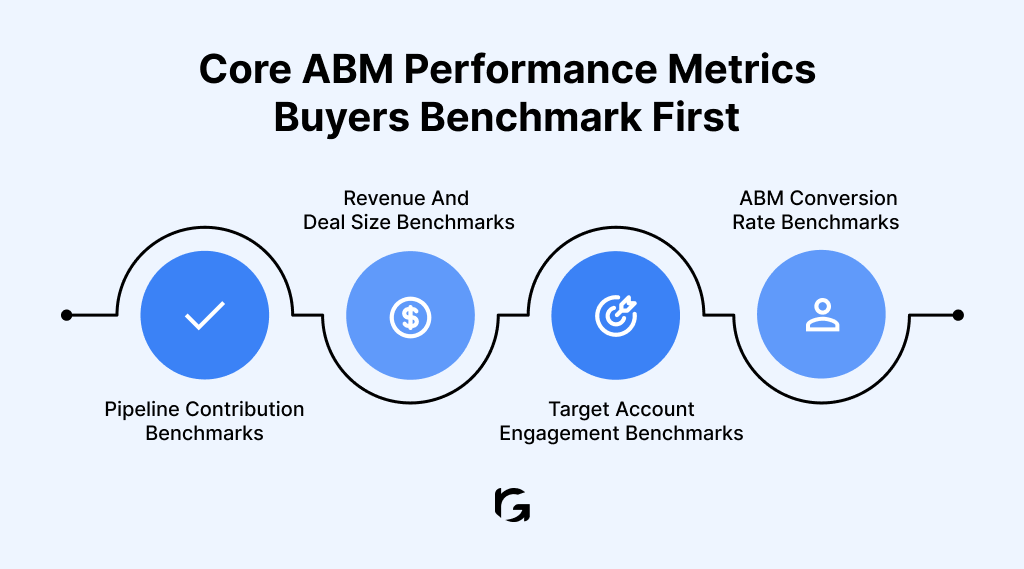
When buyers evaluate ABM at the BOFU stage, they start with a small set of performance signals that directly answer one question: “Is ABM moving revenue in a meaningful, repeatable way?”
These benchmarks shape confidence, budget decisions, and scale readiness.
1. Pipeline Contribution Benchmarks
Pipeline influence is usually the first metric that leadership reviews because it connects ABM directly to revenue potential. Buyers look at what percentage of the total pipeline comes from target accounts and how that compares to non-ABM motion.
Pipeline value per target account also matters. A smaller number of accounts generating meaningful pipeline often signals better targeting and stronger sales alignment than broad account coverage with thin results.
At this stage, attribution needs discipline. Account-level and multi-touch attribution help teams capture ABM’s real influence across long sales cycles without inflating impact or oversimplifying contribution.
2. Revenue and Deal Size Benchmarks
Revenue benchmarks focus on outcomes that leadership cares about most. Buyers compare average deal size and win rates between ABM and non-ABM opportunities to understand whether personalization actually changes deal economics.
In practice, this shows up clearly in outcomes. Recent benchmark data indicates ABM accounts often generate 11%–50% larger average deal sizes, depending on region and segment, compared to non-ABM accounts.
In mature ABM programs, named accounts often show larger deal sizes and stronger expansion potential. These benchmarks help teams determine whether ABM is driving higher-value deals or simply redistributing revenue that would have closed anyway.
3. Target Account Engagement Benchmarks
Engagement benchmarks still matter, but only when they connect to pipeline movement. Buyers increasingly evaluate engagement at the buying-group level rather than tracking activity from individual contacts.
High-performing teams look closely at:
- Stakeholder coverage across decision roles
- Engagement consistency throughout the account
- Engagement patterns that reliably precede opportunity creation
Without a clear link to pipeline progression, engagement metrics lose credibility quickly at the BOFU stage.
4. ABM Conversion Rate Benchmarks
Conversion benchmarks answer the most direct question buyers ask: “Does engagement turn into revenue?” Teams track how often target accounts convert into opportunities and how efficiently those opportunities close.
Velocity between stages also plays a key role. Faster movement through qualification and proposal stages often signals tighter sales and marketing alignment and more effective account orchestration.
Taken together, these benchmarks create a clear performance narrative from early engagement to closed revenue. In the next section, we’ll look at how high-performing teams interpret these numbers correctly and avoid the misreads that derail otherwise strong ABM programs.
Also read → 6 ABM Best Practices to Close High-Value Deals in 2025
How High-Performing Teams Interpret ABM Benchmarks Correctly
High-performing teams don’t use benchmarks as a verdict on whether ABM is “working” or “failing.” They use them as diagnostic signals that explain why performance looks the way it does and what needs attention next. Context always comes before comparison.
One of the biggest mistakes teams make is treating benchmarks as universal standards. In reality, what “good” looks like changes based on several factors:
- Segment and deal size, since enterprise deals behave very differently from mid-market ones.
- Sales cycle length, which directly impacts pipeline velocity and conversion timing.
- ABM maturity, because early-stage programs rarely match the benchmarks of long-running ones.
Strong teams also focus on direction, not just distance, because absolute benchmark gaps matter less than whether performance is moving in the right direction over time. A program that shows steady improvement quarter over quarter often signals healthier fundamentals than one that briefly hits a benchmark and stalls.
Another common misread is abandoning ABM too early. When early benchmarks lag, the issue is rarely the strategy itself. More often, it’s misaligned targeting, inconsistent sales execution, or incomplete attribution. Teams that understand this use benchmarks to fine-tune execution, not to pull the plug prematurely.
Interpreted correctly, benchmarks clarify whether a program needs optimization, patience, or scale, and prevent reactive decisions based on incomplete signals.
ABM ROI Benchmarks Buyers Use To Justify Investment
At the BOFU stage, ROI benchmarks carry the most weight in decision-making, because buyers are looking for proof that ABM delivers returns strong enough to justify continued and expanded investment.
Cost-Per-Account vs Pipeline Return Benchmarks
Buyers evaluate ABM ROI by weighing cost per target account against pipeline and revenue return. Higher upfront costs are expected in ABM, but leadership looks for clear evidence that those costs translate into a higher-quality pipeline and stronger revenue efficiency.
Benchmark data support this trade-off. In fact, top-performing ABM programs report ROI levels up to 81% higher than traditional approaches, when targeting discipline and sales alignment are in place.
The focus here is balance. When the cost per account rises without a corresponding lift in pipeline contribution or deal value, confidence erodes quickly. Strong ROI benchmarks show that spend scales in proportion to revenue impact, not ahead of it.
Sales Velocity and Cycle-Time Benchmarks
Velocity benchmarks assess whether ABM improves how quickly deals move through the funnel. Buyers compare sales cycle length and stage progression for ABM-driven opportunities against historical baselines.
Enterprise programs tend to see more incremental improvements due to deal complexity, while mid-market ABM often shows clearer gains from tighter coordination and consistent buying-group engagement. Even small reductions in cycle time can significantly improve revenue predictability at scale.
Marketers often point out that ABM delivers ROI for high-value, enterprise deals, but the economics break for lower-ticket offers, reinforcing why deal size and lifetime value must factor into any serious ABM benchmark evaluation.
Marketing-Sourced vs Influenced Revenue Benchmarks
At the BOFU stage, influenced revenue benchmarks matter more than sourced revenue. Buyers understand that ABM rarely operates as a single-touch motion. Its value lies in shaping opportunity progression, deal size, and expansion.
Blended attribution helps teams assess ABM’s real contribution without oversimplifying impact or forcing credit into narrow categories.
Together, these ROI benchmarks help teams determine whether ABM spend is defensible and sustainable. Once you understand that, it’s important to identify benchmark gaps that signal when an ABM program needs fixing before scaling further.
Benchmark Gaps That Signal Your ABM Program Needs Fixing
At the BOFU stage, benchmarks stop being performance reports and start acting like warning signals. Certain patterns show up again and again when an ABM program looks active on the surface but fails to deliver revenue impact underneath.
For instance, teams often see rising engagement across target accounts while pipeline contribution remains flat, which is an early sign that activity isn’t translating into revenue movement.
Using Benchmarks To Decide Whether To Scale Or Optimize ABM
Benchmarks make one thing clear quickly: whether your ABM program is ready to scale, or needs fixing first. Some gaps point to execution issues that require optimization:
- High engagement but weak pipeline contribution usually indicates targeting problems or poor sales handoff. Accounts engage, but conversations fail to progress into real opportunities.
- A growing pipeline without win-rate improvement often signals qualification gaps or inconsistent sales execution. Deals enter the funnel but stall or close poorly.
- Rising ABM costs with flat ROI typically appear when personalization and tooling increase faster than revenue impact, eroding confidence in the program.
Other benchmark patterns suggest scale may be justified. Consistent improvement in pipeline contribution, conversion rates, and ROI signals that the model works and can be replicated across more accounts or regions.
When benchmarks flatten or move in the wrong direction, optimization should come first, because buyers rely on benchmark trends to decide whether expansion will reduce risk or amplify it.
In fact, practitioners discussing ABM execution often recommend starting small, testing lead-gen forms against landing pages, and scaling spend only after conversion metrics improve, highlighting a core benchmark principle: don’t scale ABM costs until conversions and pipeline returns prove out.
How Buyers Use ABM Benchmarks To Evaluate Vendors And Agencies
By the time buyers evaluate vendors or agencies, benchmarks become the filter that separates confidence from caution. Promises alone don’t carry much weight at this stage, because buyers want to know whether a partner understands what realistic performance looks like for their business.
Strong ABM partners earn trust by how they talk about benchmarks:
- They anchor expectations in credible benchmark ranges, not best-case scenarios.
- They explain how benchmarks change by segment, deal size, and sales motion.
- They connect benchmarks to execution decisions, not just reporting outputs.
Buyers also pay close attention to how vendors model performance. For instance, a partner that jumps straight to projections without understanding current benchmark gaps often signals risk rather than expertise.
At RevvGrowth, benchmark-led planning replaces one-size-fits-all ABM playbooks. The focus stays on transparency, context, and performance modeling grounded in real business constraints.
If you’re evaluating partners right now, a practical next step is to benchmark your current ABM performance. Book a free consultation with RevvGrowth to see where you stand and what realistic improvement looks like.
A Practical ABM Benchmark Scorecard Template For Internal Reviews
By this point, the goal has changed from learning about benchmarks to using them. A simple ABM benchmark scorecard helps turn scattered metrics into a shared decision-making tool that leadership, sales, and marketing can align around.
A practical scorecard needs to answer a few clear questions consistently:
- Pipeline influence: How much of the total pipeline comes from target accounts, and how does it compare to benchmark ranges?
- Revenue impact: Are ABM deals larger, higher quality, or expanding faster than non-ABM deals?
- Target account engagement: Are the right stakeholders engaging in ways that reliably precede opportunity creation?
- Conversion rates: How efficiently do target accounts move from engagement to opportunity and from opportunity to close?
- ROI efficiency: Does the pipeline and revenue return justify the current cost per account?
For each metric, teams should track three simple reference points: current performance, internal targets, and relevant benchmark ranges. When metrics consistently improve and sit within benchmark expectations, scale becomes a confident decision, and in case gaps persist, optimization becomes the priority.
Used well, this scorecard becomes the framework teams rely on to defend budgets, guide strategy shifts, and make ABM decisions with clarity instead of guesswork. When everyone reviews ABM performance through the same scorecard, conversations shift from defending activity to making confident decisions about what comes next.
Also read → How to Choose the Best ABM Agency for Your Organization
Conclusion & Next Steps
At this stage, the risk is running ABM without knowing whether it’s actually working. When performance isn’t anchored to clear benchmarks, decisions around budget, scale, and partners turn reactive instead of strategic.
This is why the next step is clarity. High-performing teams move forward by grounding ABM decisions in benchmarked performance across pipeline, revenue, and ROI, so leadership discussions shift from justification to execution.
If you decide to work with RevvGrowth, the next steps focus on turning benchmarks into action:
- Reviewing your current ABM performance against relevant benchmark ranges.
- Identifying where gaps signal optimization versus scale readiness.
- Aligning marketing and sales on realistic performance targets.
- Building a clear, benchmark-led roadmap tied to revenue outcomes.
If you want to understand where your ABM program truly stands and what it would take to improve it with confidence, schedule a free consultation with RevvGrowth. It’s a practical starting point for replacing guesswork with data-backed decisions.
.svg)


.webp)
.avif)