


Introduction
Most ABM programs fail because the platform was bought too early, too late, or for the wrong stage of maturity.
In a global study of B2B teams, 64% of marketers reported using an account-based marketing approach, yet most organizations remain uneven in execution maturity and readiness.
That gap is exactly what the ABM maturity model is designed to solve. It gives revenue teams a clear way to understand how advanced their ABM execution really is across strategy, data, tooling, and measurement, before committing to platforms or agencies that introduce more complexity than value.
At RevvGrowth, we see this mismatch constantly. Teams invest in powerful ABM tools but lack the operational readiness to use them, while others outgrow basic platforms long before leadership realizes it. In both cases, growth stalls not because ABM is broken, but because maturity and tooling are misaligned.
This post breaks down the five ABM maturity levels through a buyer’s lens. You’ll learn how to assess your current stage, compare maturity and readiness models, map capabilities to tools and services, and choose an ABM platform that fits where you are and where you’re going.
ABM Maturity Models Explained For B2B Revenue Teams
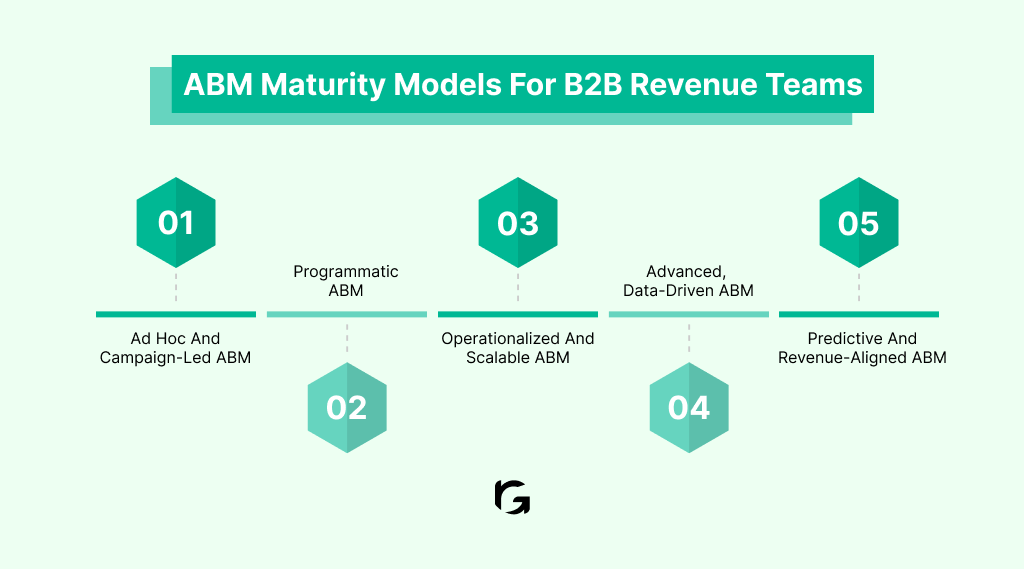
An ABM maturity model defines how account-based marketing evolves across structured stages, from ad hoc campaigns to predictive, revenue-aligned execution. The model helps B2B teams assess alignment, data readiness, technology integration, and process maturity.
Each stage maps required capabilities across marketing, sales, and revenue operations. The model supports objective maturity assessment, scalable execution, and measurable pipeline impact. Organizations use the ABM maturity model to benchmark progress, identify gaps, and choose ABM platforms that match current and future growth needs.
Research shows that organizations practicing ABM report 21%–50% higher ROI compared to non-ABM marketing, with nearly a quarter seeing ROI gains above 50%.
For revenue teams evaluating platforms, vendors, or managed services, it provides practical clarity in areas that are often overlooked. It helps teams:
- Avoid overbuying ABM platforms that assume advanced data, orchestration, or analytics readiness
- Identify capability gaps early, before execution issues surface in the pipeline and revenue
- Match tools and services to maturity, instead of choosing vendors based on feature lists
- Reduce adoption risk by aligning technology decisions with operational reality
The sections below break down the five ABM maturity levels with a buyer’s mindset. Each stage explains how ABM actually shows up inside revenue teams and why certain tools, services, or vendors fit at one stage and fail at another.
Stage 1: Ad Hoc and Campaign-Led ABM
At this stage, ABM usually starts as a test. Teams run one-off campaigns against a small set of strategic accounts. Account selection relies heavily on sales judgment, and personalization stays light because execution is manual and time-consuming.
Tooling remains basic, as most teams operate with a CRM and email, sometimes layered with simple campaign reporting. The biggest risk here is jumping straight to advanced ABM platforms. Without a clear strategy or repeatable processes, those platforms add complexity without delivering meaningful returns.
Stage 2: Programmatic ABM
Programmatic ABM brings structure and consistency. Teams define ICPs, tier accounts, and reuse campaign frameworks. Firmographic data and early intent signals start shaping targeting decisions instead of gut instinct alone.
Buying-group behavior is the reason this shift matters. Forrester reports that an average of 13 people are involved in a B2B purchasing decision, and 89% of purchases involve two or more departments, which makes tiering, shared signals, and repeatable plays non-negotiable even at Stage 2.
At this stage, ABM tools should reduce manual work and improve repeatability. The goal is scale, not sophistication. Platforms that demand heavy orchestration, deep integrations, or advanced analytics often slow teams down instead of helping them move faster.
Stage 3: Operationalized and Scalable ABM
This is the point where ABM maturity starts to directly influence vendor success. Sales and marketing alignment improves, systems integrate more tightly, and teams track account engagement across channels and begin connecting activity to pipeline movement.
Platform fit becomes critical here, as tools must support scale without breaking workflows or creating reporting chaos. When platforms outgrow the team or teams outgrow the platform, the cost shows up quickly in stalled execution and internal friction.
Stage 4: Advanced, Data-Driven ABM
Advanced ABM adds real-time intent, behavioral signals, and dynamic account prioritization. Campaigns evolve into coordinated experiences across ads, email, SDR outreach, and content, leading to a shift in decisions from static planning to continuous optimization.
This is where the performance gap opens up. In its 2024 benchmark, Demandbase highlights that top B2B marketers achieve 81% higher ROI with account-based marketing, which aligns with what Stage 4 teams discover fast: orchestration only pays off when data, process, and execution maturity can keep up.
Many teams hit an unexpected wall because execution complexity increases faster than internal capacity. While tooling enables possibility, expertise is what determines whether those capabilities translate into performance.
Stage 5: Predictive and Revenue-Aligned ABM
At the highest level, ABM becomes part of revenue strategy, not just marketing execution. Predictive scoring, forecasting, and closed-loop attribution guide planning and investment decisions. ABM informs where to focus, not just how to engage.
Reaching this stage requires a mature data infrastructure, governance, and disciplined execution. Software supports outcomes, but sustained performance depends on how well strategy, operations, and expertise work together.
Together, these five stages show why ABM success depends less on ambition and more on readiness. Each level builds on the one before it, and skipping stages almost always introduces execution risk rather than faster results.
Before comparing platforms or models, the next step is understanding where your organization actually sits today. That clarity comes from a structured ABM maturity assessment, which we’ll walk through next.
Also read → How to Choose the Best ABM Agency for Your Organization
ABM Maturity Assessment: How To Determine Your Current Stage
One of the biggest mistakes revenue teams make is assuming maturity based on intent rather than execution. Running ABM campaigns or owning ABM software does not automatically mean your organization is ready for advanced ABM.
In fact, only 29% of marketers said they are very successful at using attribution to achieve strategic objectives, and only 31% reported being extremely confident in attribution accuracy.
That gap is exactly why maturity assessments need to test what teams can prove, not what they believe. For instance, a strong ABM maturity assessment looks past surface-level activity and focuses on how well strategy, data, technology, and teams actually work together in practice.
1. Strategic Alignment Signals
ABM maturity starts with shared ownership. Sales and marketing need to agree on what qualifies as an account, how accounts are prioritized, and how success is measured. When ABM performance ties directly to pipeline and revenue outcomes, maturity accelerates naturally.
Misalignment at this level creates friction fast. Even the most capable ABM platforms struggle when teams disagree on fundamentals.
2. Data, Technology, And Integration Readiness
Data readiness defines what ABM platforms can realistically deliver. CRM hygiene, enrichment coverage, and intent data availability shape targeting, personalization, and orchestration. Integration depth matters more than the number of tools in your stack.
Disconnected systems slow execution, dilute insights, and often expose maturity gaps only after platforms fail to meet expectations.
3. Process Maturity And Team Capability Indicators
Scalable ABM depends on repeatable workflows, consistent measurement, and clear attribution. When execution relies on a handful of individuals or undocumented processes, programs become fragile as they grow. At higher maturity levels, process discipline carries as much weight as technology investment.
Taken together, these signals provide a grounded view of where your ABM program truly stands. With that clarity, teams can move beyond guesswork and make more confident decisions about frameworks, platforms, and external support.
ABM Framework Comparison: Maturity Model vs Readiness Model
ABM conversations often get confusing because teams use different frameworks to answer different questions. One model helps you decide whether you should invest in ABM at all. Another helps you decide how far you can realistically take it and what tools make sense along the way.
That distinction matters most when you are evaluating platforms or external partners. Using the wrong framework at the wrong time often leads to premature purchases or stalled execution. The table below clarifies how ABM maturity models and ABM readiness models serve different purposes.
Maturity models work best once ABM is already in motion, and teams need to evaluate platforms, agencies, or services that align with their current and future capabilities. Readiness models are more useful earlier, when organizations are deciding whether ABM adoption makes sense in the first place.
For vendor selection, maturity models provide clearer guidance. They map tools and services to capability depth, helping teams choose platforms that fit where they are today without limiting where they want to go next.
Also read → How to Build a SaaS ABM Strategy: 1:1, 1:Few & Beyond
ABM Capability Matrix: Mapping Maturity Levels To Tools And Services
The ABM capability matrix translates maturity theory into execution reality. It shows what teams actually need to run ABM effectively at each stage and where technology alone stops being enough.
This is where maturity models become practical, especially for buyers trying to decide which tools to adopt, which capabilities to build internally, and when outside expertise becomes necessary.
Core Capabilities Required At Each ABM Maturity Level
As ABM matures, the required capabilities expand in both scope and coordination.
- Targeting evolves from static account lists to dynamic, signal-driven prioritization.
- Personalization moves from light message variations to buying-group-level orchestration across channels.
- Measurement shifts from engagement metrics to pipeline and revenue attribution.
- Orchestration grows from isolated campaigns to coordinated execution across marketing, sales, and RevOps.
Each capability compounds complexity, and what feels manageable at early stages becomes difficult to sustain without stronger processes and ownership as maturity increases.
Tool Categories That Support Each Stage
Different maturity levels demand different categories of tools, not just more features. In fact, professionals often discuss how teams can run lighter 1:many ABM with strong ICP discipline and a few core systems, but bigger ABM platforms feel useless without strategy and alignment in place.
That matches what the ABM capability matrix is designed to prevent: buying orchestration software before your workflows, data, and measurement can sustain it.
- Early stages benefit most from CRM and marketing automation platforms that emphasize ease of use and speed to value.
- Mid-stage teams need ABM platforms that integrate tightly with existing systems and provide clear account engagement visibility.
- Advanced stages rely on intent data, analytics, and orchestration tools that adapt in real time and support continuous optimization.
A critical distinction emerges here. While enablement tools help teams run ABM, optimization tools help teams improve performance. Confusing the two often leads to bloated stacks and underwhelming results.
Signals That ABM Scale Requires External Expertise
Scalability limits typically surface at Stage 3 and above, when execution complexity outpaces internal capacity. Common signals include:
- Complex data environments that slow execution despite having the “right” tools.
- Multiple ABM or intent platforms are in place with limited performance improvement.
- Attribution disputes between marketing, sales, and RevOps as programs expand.
- Advanced capabilities like orchestration or predictive scoring remain underused.
- Overreliance on a small group of individuals to keep ABM running.
- Breakdowns in governance, measurement consistency, or process discipline.
This is not just a tooling problem. In a 2024 attribution study, marketers named limited resources (46%) and complexity (46%) as the top blockers to implementing attribution effectively.
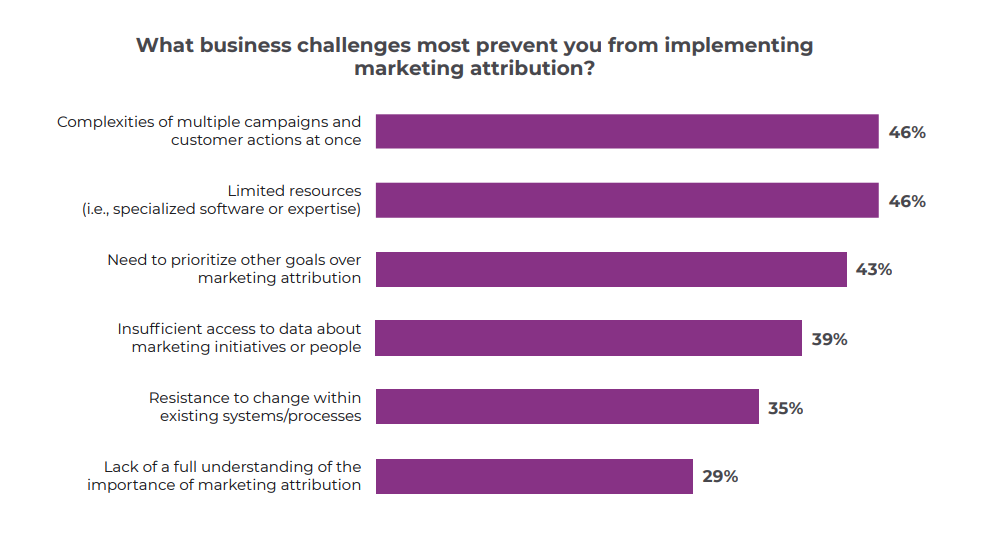
That’s the same story you see in scaled ABM: more channels, more stakeholders, more systems, and fewer people who can hold it all together.
At this point, external ABM expertise acts as a risk-reduction and scale-stabilization mechanism. It does not replace internal teams or shortcut maturity, but helps organizations operationalize their tools, maintain discipline, and translate higher maturity into measurable revenue impact.
Choosing The Right ABM Platform Based On Your Maturity Level
Most ABM platform evaluations break down because teams start with feature comparisons instead of readiness. Powerful platforms get shortlisted early, expectations rise, and adoption stalls when the organization cannot support the complexity that those tools assume.
This matters even more because ABM is scaling fast as a category. Grand View Research estimated the global ABM market at $1,410.5 million in 2024, projecting growth to $3,811.4 million by 2030 at a 17.9% CAGR. More spend usually means more vendor noise, and maturity fit becomes the only way to avoid expensive misalignment.
The right ABM platform should align with your current maturity while supporting the next stage of growth, because what matters most changes as ABM evolves.
For early-stage teams, the priority is momentum:
- Platforms should be easy to use, quick to onboard, and light on operational overhead.
- Speed to value matters more than advanced orchestration or analytics.
- Teams need clear account visibility and simple workflows that help them build confidence before adding complexity.
As ABM scales, platform expectations shift. Teams need deeper integrations across CRM, marketing automation, and data systems. Orchestration must work across channels without breaking processes, and analytics and attribution become critical for connecting ABM activity to pipeline and revenue. At this stage, platforms must adapt to evolving maturity instead of locking teams into rigid workflows.
Additionally, certain vendor red flags tend to appear regardless of maturity level:
- AI-driven promises without clear data readiness requirements
- Over-complex platforms sold to immature teams
- Feature-heavy demos with limited focus on adoption or enablement
- Little guidance beyond initial implementation
This is where partners like RevvGrowth fit naturally. RevvGrowth helps teams align ABM strategy and maturity with platform selection and execution. The focus is not on replacing software, but ensuring tools match readiness, reducing adoption risk, and helping organizations operationalize ABM beyond features.
If you are evaluating ABM platforms or unsure whether your current stack fits your ABM maturity level, you can schedule a demo with RevvGrowth to walk through your current setup, assess maturity gaps, and see how the right mix of tools and execution support can accelerate results without overcomplicating your ABM program.
Conclusion
Most ABM investments fail because maturity gets ignored. The way forward is not another feature comparison, but clear visibility into where your ABM program actually stands and what it can realistically support next.
A practical next step looks like this:
- Run an objective ABM maturity assessment to surface gaps across strategy, data, execution, and measurement
- Validate platform fit against your current and next-stage maturity, not aspirational roadmaps
- Prioritize capabilities over features to avoid overbuying or under-investing
- Identify where internal execution ends and where external expertise reduces risk
When teams work with RevvGrowth, the process starts with maturity, not software. From there, the focus shifts to platform evaluation, capability mapping, and operational guidance that helps ABM investments translate into pipeline and revenue impact, especially at mid to advanced maturity stages.
If you want clarity before committing to your next ABM decision, book a demo with RevvGrowth to review your maturity, assess your current stack, and map a path forward that fits how your organization actually operates today.
.svg)


.webp)
.avif)