


Introduction
ABM rarely fails because of strategy. It fails because the wrong agency is running it.
Most B2B teams reach this point after months of activity that looks impressive but delivers an uneven pipeline, weak sales alignment, and reporting that never quite ties back to revenue. At that stage, the question is no longer whether ABM works. The question is how to choose an ABM agency that can execute, align with sales, and drive measurable outcomes.
The right partner accelerates pipeline, sharpens focus on high-value accounts, and aligns sales and marketing around outcomes. The wrong one creates activity without momentum.
This guide breaks down how to choose an ABM agency with clarity and confidence. I’ll cover the evaluation criteria that matter, how to assess different ABM strategy models, what strong case studies really prove, how pricing and ROI should be evaluated, and the red flags to avoid before signing a contract.
How to Choose the Best ABM Agency for Your Organization
An ABM agency is a specialized B2B partner that designs and runs account-based marketing programs for high-value target accounts. It identifies ideal customer profiles, prioritizes in-market accounts, and aligns sales and marketing around shared revenue goals.
These agencies personalize messaging, activate multi-channel campaigns, and measure account engagement, pipeline, and revenue impact. Businesses use an ABM agency to improve deal quality, shorten sales cycles, and drive predictable growth from strategic accounts.
Once you understand what an ABM agency does, the real challenge becomes choosing the right one. This is not a branding or vendor decision, but a revenue one. Let’s break down how to evaluate ABM agencies with clarity, confidence, and a focus on outcomes.
Define Your ABM Goals Before Evaluating Agencies
Most ABM engagements struggle because the goals are fuzzy from the start, since agencies can only optimize based on what you ask them to optimize. When success is undefined, results drift, and expectations break down quickly.
Clear ABM goals anchor every decision that follows and shape how an agency designs strategy, allocates resources, and measures success. Common ABM goals usually fall into one of these buckets:
- Accelerating the enterprise pipeline from a defined list of target accounts
- Expanding revenue within existing customers through cross-sell or upsell
- Entering new markets or verticals with strategic logos
- Improving win rates on late-stage or high-value deals already in flight
Before you evaluate agencies, get specific about what success looks like for your business. For instance, improving win rates is one of the most practical and measurable ABM objectives. An industry study found that 80% of marketers report higher win rates on accounts engaged through ABM, which underscores why outcome clarity matters before choosing an agency.
Keep in mind that a strong ABM agency will challenge vague objectives, pressure-test your priorities, and translate goals into a focused execution plan instead of simply agreeing to broad outcomes.
ABM Agency Selection Criteria That Actually Matter
Many agencies talk about ABM strategy, but far fewer can execute ABM in a way that consistently ties activity to revenue. The difference shows up quickly once programs go live.
This focus on execution and measurement is not just a preference. Forrester reports that ABM decision-makers most commonly see 21% to 50% higher ROI versus non-ABM marketing, and 23% report ABM ROI is 51% to 200% higher. That kind of uplift only shows up when execution connects cleanly to revenue.
When evaluating an ABM agency, focus on criteria that reflect execution maturity instead of presentation polish:
- Proven ABM execution with real case studies
- Ability to align with your sales process and ICP
- Clear measurement and reporting tied to the pipeline
- Experience working with complex B2B buying committees
- A revenue impact mindset instead of vanity metrics
These factors separate agencies that generate engagement from those that generate deals. Use them as a filter in every conversation, demo, and proposal review.
Questions to Ask Before You Choose an ABM Agency
Strong ABM agencies welcome direct questions, and weak ones avoid specifics. As you evaluate partners, listen closely to how clearly they answer questions like:
- How do you define ABM success beyond engagement?: This helps you understand whether they focus on revenue or surface metrics.
- Which ABM model do you recommend for our business and why?: You can test their strategic thinking and business alignment.
- How do you collaborate with sales teams on a weekly basis?: This question helps you assess real sales and marketing alignment.
- What do the first 90 days of an engagement actually look like?: This is perfect for setting expectations in terms of execution speed and structure.
- How is ROI tracked and reported to leadership?: This will explain how they validate accountability and executive reporting.
The quality of these answers tells you far more than any slide deck. The main objective of these questions is to evaluate which ABM agency fits into your operating rhythm instead of forcing you into theirs.
ABM Strategy Options Agencies Use and How to Choose the Right One
Most ABM agencies use three core models: 1:1 ABM, 1:few ABM, and 1:many ABM. The difference between success and frustration often comes down to choosing the one that fits your deal size, account volume, and growth stage. There is no universally “best” ABM strategy; it simply depends on where your business stands today.
ABM strategy choices matter more now because budgets are moving in this direction. Grand View Research projects the global ABM market to reach about USD 3.81 billion by 2030. More spending usually means more vendors and more noise, so model selection becomes the first real filter.
A strong ABM agency will help you make this decision early instead of forcing every client into the same model.
1:1 ABM Strategy
1:1 ABM focuses on a small number of high-value, strategic accounts. Each account receives deep personalization across messaging, content, outreach, and sales coordination.
This approach works best when deal sizes are large, sales cycles are long, and buying committees are complex. Personalization may run deep, but so does the required investment. Teams using 1:1 ABM should expect close collaboration between sales and marketing, longer planning cycles, and a heavy focus on account-specific insights.
Best fit when:
- Deal sizes are large and justify deep personalization
- Sales cycles involve multiple stakeholders
- Winning or expanding a single account materially impacts revenue
1:Few ABM Strategy
1:few ABM strategy groups accounts with similar characteristics, such as industry, use case, or buying challenge. Personalization happens at the segment level rather than for each individual account.
This model strikes a balance between relevance and scale. It works well for teams targeting specific verticals or running multiple strategic plays at once. Compared to 1:1 ABM, it requires fewer resources while still delivering tailored messaging that resonates with decision-makers.
Best fit when:
- Accounts share common pain points or industries
- Deal sizes support targeted but repeatable plays
- Teams want scalability without losing relevance
1:Many ABM Strategy
1:many ABM uses broader targeting combined with intent signals to engage larger account lists. Personalization is lighter, but reach and efficiency increase.
This ABM strategy supports early pipeline acceleration and market coverage. It is often used by teams that want to identify in-market accounts quickly and prioritize sales outreach based on engagement signals rather than static lists.
Best fit when:
- Account lists are large and dynamic
- Pipeline growth is an early or top priority
- Teams need speed and coverage more than deep customization
Matching ABM Strategy to Deal Size, Sales Cycle, and Growth Stage
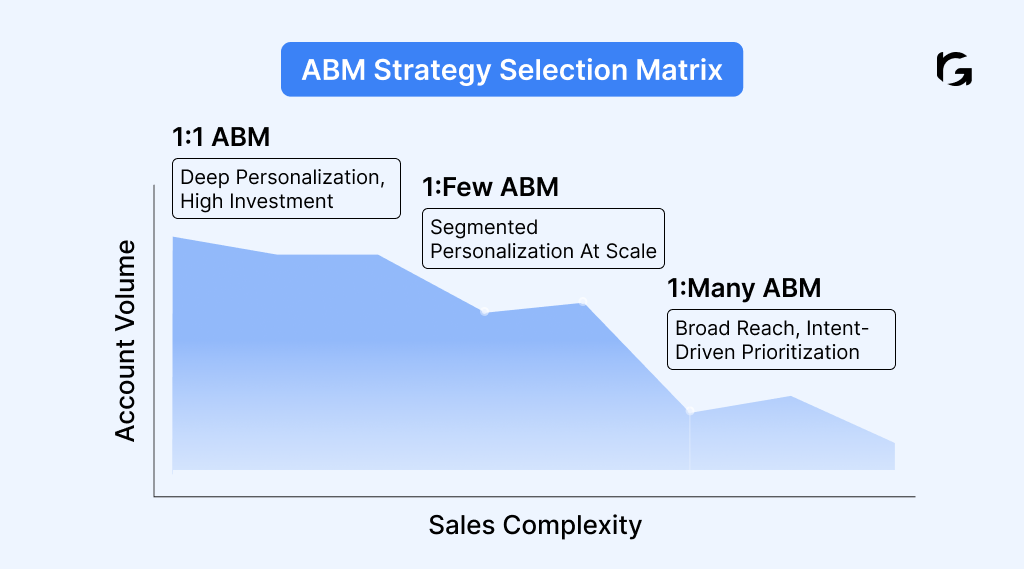
Choosing the wrong ABM model creates friction, wasted effort, and misaligned expectations. A simple decision framework can help you self-qualify before engaging an agency:
- High ACV and long sales cycles usually favor 1:1 ABM: Large deal sizes and complex buying committees justify deeper personalization and tighter sales and marketing coordination at the individual account level.
- Mid-range ACV with vertical or use case focus often favors 1:few ABM: Grouping similar accounts allows teams to run targeted plays efficiently while maintaining relevance across shared industries or challenges.
- Large account lists and early pipeline goals typically favor 1:many ABM: Broader reach, combined with intent signals, helps identify in-market accounts quickly and prioritize sales outreach at scale.
Practitioners often point out that ABM economics only work when deal values justify the extra personalization and coordination. That’s why strategy selection should start with ACV and sales complexity.
An effective ABM agency will walk you through this decision openly. If an agency pushes a single model without considering your sales motion, that is usually a signal to pause and reassess.
Also read → ABM Maturity Model: How to Evaluate Vendors and Choose the Right ABM Platform
Why RevvGrowth Is Different as an ABM Agency
Most agencies talk about specialization. RevvGrowth focuses on what actually matters once ABM goes live: revenue movement. Instead of treating ABM as a collection of disconnected campaigns, RevvGrowth treats it as a growth system.
Strategy and execution are designed together from the start, not handed off between teams. Sales and marketing stay tightly orchestrated around shared account priorities, and success is measured by pipeline progression, deal quality, and revenue impact rather than impressions or surface-level engagement.
Every engagement begins with a clear understanding of how the business sells, who the real buying committee is, and where deals tend to slow down or stall. That context shapes the ABM model, messaging approach, and execution plan before any campaigns are launched.
RevvGrowth’s ABM programs are built around a few core principles:
- Tight alignment with existing sales workflows and account plans
- Clear ownership across marketing, sales, and revenue operations
- Measurement frameworks that connect account activity directly to the pipeline and closed revenue
This approach keeps ABM practical and accountable, especially for B2B and SaaS teams that cannot afford long ramp times, unclear attribution, or activity that fails to translate into deals.
SaaS relevance is not niche here. Mordor Intelligence notes that IT and Telecommunications represented 26% of ABM market size in 2024, which helps explain why SaaS teams tend to compete on execution depth, not on whether ABM is ‘worth doing.’
Case Study: RevvGrowth’s Work With LeadSquared
One clear example of RevvGrowth’s execution style is its engagement with LeadSquared, a CRM-focused SaaS company with growth goals that required a heavier influence on the pipeline and improved conversion outcomes.
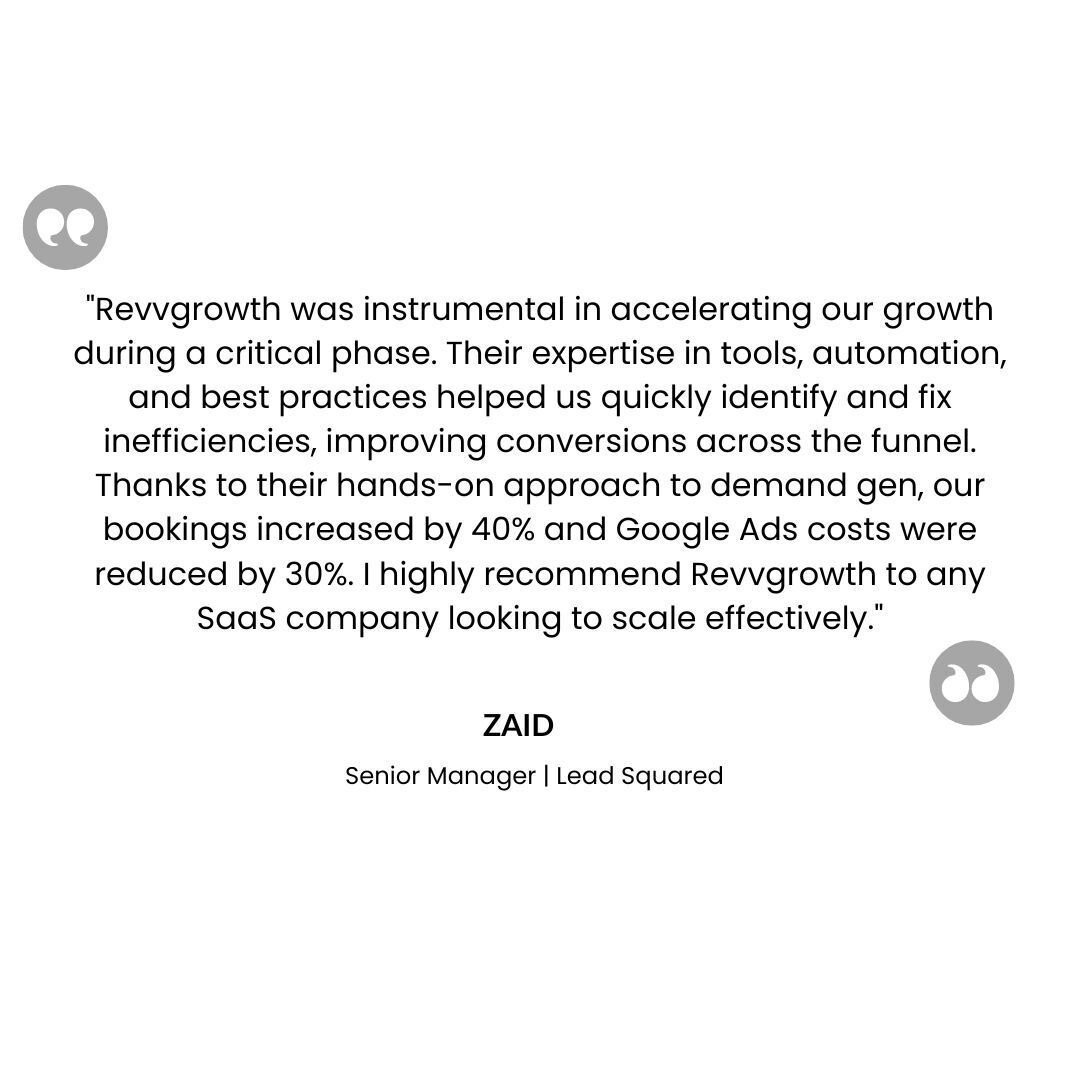
LeadSquared faced challenges with a stagnant website conversion rate (25%) and an underperforming ad return on spend (ROAS) that was below break-even. RevvGrowth redesigned the approach by optimizing conversion funnels and aligning paid media and organic efforts with intent signals and ICP priorities.
The results over the engagement period were meaningful and measurable:
- +42% increase in website leads and form fill rate
- +40% increase in bookings from target accounts
- 30% reduction in Google ads cost while improving lead quality
These improvements came not from generic volume tactics, but from targeted optimization and execution that focused on moving accounts through the funnel and improving engagement quality. The case demonstrates how an ABM-oriented approach, aligned closely with ICP data and sales priorities, produces impact beyond surface KPIs.
Read the full case study → How We Helped LeadSquared Increase Bookings by 40%
Across similar engagements, RevvGrowth consistently ties ABM execution to outcomes such as:
- Pipeline influenced by target accounts
- Higher win rates on key deals
- Increased deal size through deeper account penetration
- Improved timing and quality of sales conversations
This results-driven perspective helps buyers evaluate RevvGrowth not on broad claims, but on repeatable execution patterns that drive pipeline and revenue.
If you’re facing similar challenges with pipeline quality, conversion efficiency, or account engagement, the next step doesn’t have to be a full commitment. A focused conversation can quickly surface where execution is breaking down and what a revenue-driven ABM program could look like for your business.
Book a demo with RevvGrowth to explore how an execution-led ABM approach can turn target accounts into measurable pipeline and revenue.
ABM Agency Pricing, Costs, and ROI
Cost concerns around ABM are completely valid. An ABM agency is not a plug-and-play service. It is an investment that touches strategy, sales alignment, execution, and measurement.
Most ABM agencies price their services in a few common ways. Some work on monthly retainers tied to a defined scope. Others offer program-based pricing around specific ABM initiatives. More complex engagements are often custom-priced based on business goals and execution depth.
Teams often run into a budgeting mismatch where finance expects cost-per-lead logic. ABM needs a different business case, grounded in deal size, win rate, and speed to close.
Pricing typically changes based on:
- Number of target accounts involved
- Level of personalization required
- Complexity of the ABM strategy and model
- Degree of sales involvement and coordination
Understanding these drivers helps set realistic expectations before conversations turn to numbers.
Pro Tip: Evaluate ABM ROI Before You Sign a Contract
ROI evaluation should start before execution, not after results are expected.
For instance, strong ABM agencies align on what success looks like upfront and how it will be measured. Leading indicators usually include account engagement, sales activity, and buying committee interaction. Lagging indicators focus on pipeline created, deal velocity, and closed revenue.
Vendor benchmarks also point in the same direction. Demandbase reports ‘top B2B marketers’ achieving 81% higher ROI with ABM, based on insights from 300+ global marketers, so it’s worth treating ROI planning as part of the agency selection process.
Agreeing on attribution models, benchmarks, and reporting cadence early reduces friction later. It also ensures both teams stay focused on outcomes that matter to the business, not just activity levels.
ABM Agency Evaluation Checklist
Before you make a final decision, it helps to pause and run a quick validation check. This is less about overanalyzing and more about confirming that the agency in front of you truly fits how your business grows and sells.
A strong ABM agency should check these boxes:
- Strategy aligns with revenue goals: The agency understands what success means for your business and builds ABM around outcomes, not activity.
- ABM model fits deal size and growth stage: The recommended approach makes sense for your sales cycle, account volume, and revenue targets.
- Revenue measurement is clearly defined: There is shared clarity on how account engagement connects to pipeline and closed deals.
- Proof of execution exists through real case studies: The agency can show how similar programs have worked in practice, not just in theory.
- Pricing and scope are transparent: You know what is included, what is not, and how costs scale as the program evolves.
Used correctly, this checklist brings confidence to the decision without forcing urgency. If most boxes are checked, you are likely looking at a partner that understands both ABM and your business.
Red Flags to Watch When Evaluating an ABM Agency
Even strong conversations can hide warning signs. A few signals are worth taking seriously before moving forward:
- One-size-fits-all ABM promises that ignore your sales motion
- No clear revenue attribution model beyond engagement metrics
- ‘Tool first, strategy second’ thinking that leads with platforms instead of outcomes
- Minimal sales involvement in planning or execution
These red flags often show up early and tend to surface later as missed expectations. Spotting them now helps protect both budget and momentum.
Also read → 6 ABM Best Practices to Close High-Value Deals
Conclusion
Most ABM programs fail because execution never fully connects to revenue. When the agency driving your ABM motion doesn’t understand how your business actually sells, even strong strategies stall before they create real pipeline impact.
When teams reach out to RevvGrowth, the process starts with clarity. The first step is a focused conversation around your revenue goals, target accounts, and sales motion. From there, RevvGrowth helps identify the right ABM model, uncover where pipeline friction exists, and outline a realistic, results-driven ABM program built for your organization.
If you’re ready to move from ABM activity to measurable revenue impact, the next step is simple. Schedule a call with RevvGrowth and see what execution-led ABM looks like when it’s designed around how your business grows.
FAQs
.svg)


.webp)
.avif)