Your SEO report shows rising traffic, better rankings, and consistent content output. Yet at your quarterly budget review, there may not be a clear answer when leadership asks how much qualified pipeline SEO generated. Low-intent traffic and weak conversion paths can limit pipeline generation, while longer sales cycles and incomplete attribution can make SEO's contribution difficult to measure.
So, is SEO worth it in 2027? With AI Overviews changing how buyers discover solutions and paid campaigns delivering faster lead generation, SEO investment for another quarter needs a clear business case.
Across our work with 50+ B2B SaaS brands, we've seen why some SEO programs generate strong returns while others struggle to justify their cost. To determine whether SEO deserves a share of your next marketing budget, assess its cost, expected payback period, and potential for compounding returns.
Is SEO worth it for B2B SaaS in 2027?
SEO remains a valuable acquisition channel for B2B SaaS because it connects vendors with buyers already researching business problems and evaluating solutions. Its role extends beyond website discovery and helps SaaS companies build credibility across buying journeys that now span Google, AI answer engines, and peer communities.
That said, recent changes in search have brought this question into sharper focus. Zero-click searches are increasing, AI Overviews answer informational queries without sending users to a website, and tools like ChatGPT compress vendor research into a single prompt. These shifts have prompted a need to re-evaluate whether organic will keep generating pipeline at the same rate. SEO remains valuable, though the ways it contributes to pipeline are evolving.
Despite these changes in buyer behavior, website, blog, and SEO remain the highest-ranked marketing channels for reported ROI. According to HubSpot's 2026 marketing channel research, 30.2% of B2B marketers identified this category as a top-performing channel, ahead of email marketing and paid social. The finding reflects their combined performance rather than SEO returns in isolation.
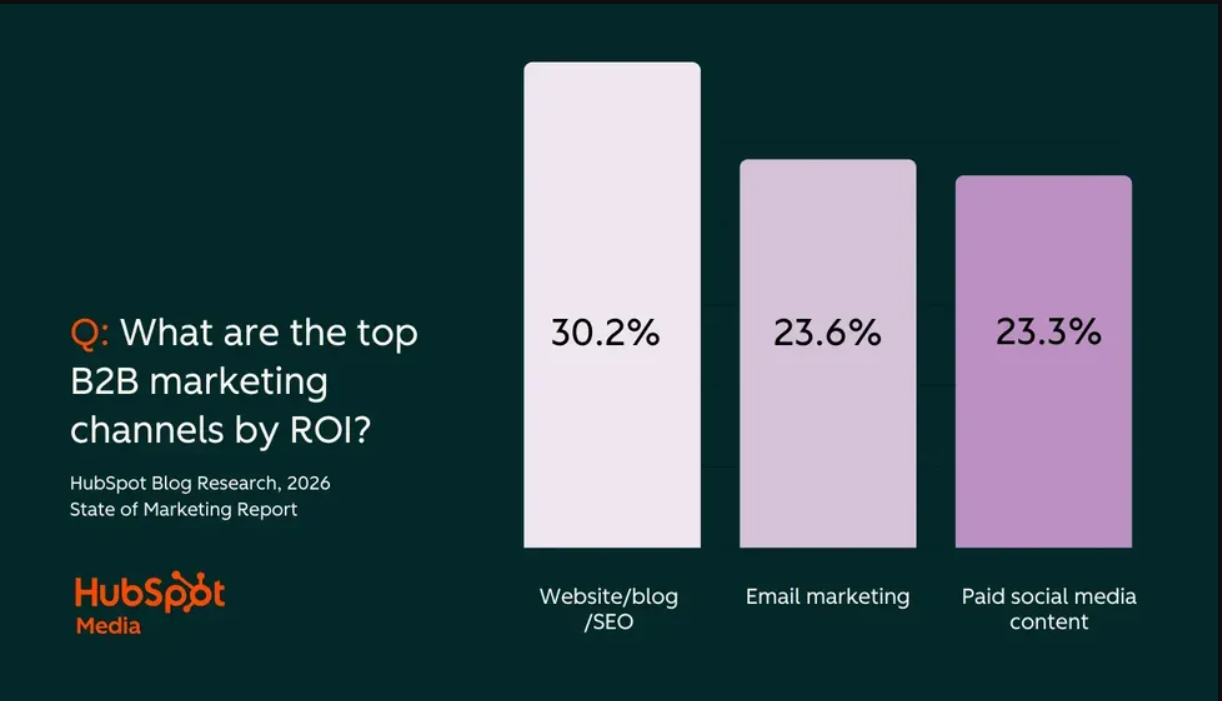
Source: The 2026 HubSpot Research
With fewer opportunities to convert informational searches into website visits, SaaS companies need to be more selective about which keywords and content assets receive investment. Prioritize searches where the buyer's problem aligns with the product's capabilities.
How much does SEO cost, and is paying for SEO worth it in 2027?
Use $3,000–$15,000 per month as an initial planning range for managed B2B SaaS SEO. Paying for SEO makes financial sense when the expected customer value justifies the investment. Your final budget depends on market competition, website complexity, content requirements, and the extent of AI search optimization required.
What goes into the total cost of a SaaS SEO program
The total cost of SEO includes both initial setup and recurring optimization. Technical audits and strategy development typically require more attention in the initial months, while content production, authority building, and maintenance continue throughout the engagement.
- Content production: Develop middle-of-funnel (MOFU) and bottom-of-funnel (BOFU) content that helps buyers evaluate solutions, compare vendors, and understand product fit.
- Technical SEO: Improve crawlability, indexing, site architecture, and page experience so search engines can discover content and visitors can navigate it efficiently.
- Link building and digital PR: Earn relevant backlinks and third-party mentions that strengthen content credibility and discoverability.
- AAI search optimization: Improve answer structure, brand entity clarity, and source credibility to support inclusion in AI-generated responses.
- Strategy, reporting, and performance reviews: Tracking qualified leads, pipeline contribution, and acquisition costs to identify which SEO activities justify continued investment.
In-house vs. agency vs. hybrid: which model fits
An in-house SEO team offers greater control over execution, while an agency provides access to specialized expertise without additional permanent hires. A hybrid model shares responsibilities between both teams, which can be useful when product knowledge resides internally but execution capacity is limited.
Before choosing a model, establish who will own technical fixes, product reviews, and pipeline reporting. These responsibilities can significantly affect the actual cost of an SEO engagement. Compare and choose among in-house teams, agencies, and freelancers after you understand the trade-offs and their alignment with the goals you are looking to achieve.
We often work as an extension of the client's marketing team. Our team handles SEO strategy, content execution, and optimization, while internal stakeholders contribute product expertise and customer insights. This hybrid approach helped us deliver results while reducing hiring needs for the companies and retaining the product context essential for accurate SaaS content.
Is SEO more cost-effective than paid ads for B2B SaaS?
SEO can become more cost-effective than paid advertising over time because established pages can continue acquiring customers without a proportional increase in spending. Paid campaigns offer greater control over acquisition and volume but require ongoing media investment. The financial advantage depends on how efficiently each channel converts its total investment into paying customers.
For many SaaS companies, combining both channels makes economic sense. Paid acquisition captures existing demand while SEO builds visibility around buying-stage queries.
The decision should follow actual performance rather than an assumed timeline. Once organic starts delivering consistent demos, the budget ratio can shift because each additional dollar of SEO spend stretches further than the same dollar in paid. The companies that treat this as a sequencing question get the most from both channels.
How long does SEO take to generate ROI?
Plan for 6–12 months to evaluate the commercial returns of a B2B SaaS SEO investment, although high-intent pages can produce leads earlier. Results depend on existing domain authority, competition, technical health, and content quality.
Google Search Central notes that some search improvements can take effect within days, while others require several months. Allow additional time for SaaS prospects to progress through evaluation and purchasing before assessing financial returns.
The timeline follows a predictable pattern:
- Months 1-3. Groundwork: Technical fixes, keyword strategy, first content published. No meaningful pipeline yet. This is where most companies lose patience and pull budget.
- Months 3-6. Early traction: Target pages start ranking. First organic-sourced leads appear. The volume is small, but the signal is real.
- Months 6-12. Acceleration: Earlier content earns backlinks and authority organically. Newer content ranks faster because the domain is stronger. Demo volume becomes predictable enough to forecast.
- Month 12 onward. Compounding returns: Established pages can continue generating demos with ongoing maintenance. Stronger topical coverage and accumulated authority can also help new content gain visibility faster, reducing the effort required to generate additional qualified demand.
These stages are planning estimates rather than fixed milestones. If progress stalls at any stage, identify the underlying constraint before extending the timeline. Poor indexing, weak rankings, and low conversion rates require different interventions.
Is SEO still worth it with AI Overviews, ChatGPT, and zero-click search?
SEO remains relevant even as AI searches dominate because discoverability now extends beyond traditional website visits. Google AI Overviews, ChatGPT, and Perplexity can introduce buyers to vendors before they visit a website. This makes visibility during product research valuable even when search behavior produces fewer direct clicks.
RevvGrowth’s AI SEO team can help you identify gaps in this visibility through competitive citation audits that reveal which buyer questions surface competing vendors but leave your brand out.
Why the same content now ranks in search and gets cited by AI
Well-structured content can perform in both traditional search and AI-generated answers because both share the same foundation. Search engines and AI systems can draw from the same published content when it directly addresses a user's question and provides reliable supporting evidence. Clear headings, accurate product information, original research, and relevant examples make individual passages easier to interpret and reference.
However, ranking on Google does not guarantee a citation in ChatGPT or Perplexity. AI-generated recommendations can also draw from review platforms, industry publications, and independent discussions. Building credibility across these sources complements the information available on your website.
In G2’s 2026 research involving more than 1,000 B2B software buyers, 51% reported starting research with an AI chatbot more often than Google. Another 85% said they think more highly of vendors cited in AI answers. This suggests AI visibility can influence vendor consideration and decisions even before buyers visit a website. For example, a brand named in an AI-generated answer when a buyer asks “which tools are best for X” reaches the buyer before they start with their product research. That visibility shapes the shortlist even when no click happens.

Content that ranks in AI Overviews wins those citations. But it is not limited to pages with the highest organic rankings. In fact, new SaaS products can contend with existing well-known market leaders having a content repository and ranking well.
How SEO, AEO, and GEO drive pipeline together
SEO, AEO, and GEO support different parts of organic discovery.
- Search engine optimization (SEO) builds the technical and content foundations needed to earn organic rankings and traffic.
- Answer engine optimization (AEO) improves answer clarity and structure, making content easier for search and AI systems to extract and reference.
- Generative engine optimization (GEO) strengthens brand visibility, mentions, and citations across generative search platforms such as ChatGPT, Perplexity, and Gemini.
A well-developed content asset can support all three, although each platform evaluates sources differently. At RevvGrowth, we connect these efforts through shared content research, editorial standards, and performance measurement. The investment becomes more efficient when teams understand which to prioritize among AI SEO vs AEO vs GEO based on their existing search visibility and buyer behavior.
A September 2026 Conductor study, analyzing nearly 168 million Google AI Overview citations across industries, found that 57% came from pages outside the organic top 10. The research covered U.S. searches and shows why SEO rankings and AI citation visibility need separate measurement. Together, these signals provide a broader view of where content earns exposure.
When SEO is not worth the investment
SEO is not the best investment for every SaaS company. It becomes harder to justify when immediate pipeline is the priority, relevant search demand is limited, or the team cannot support ongoing optimization. Delaying a full SEO program can be financially sensible when other channels better address your immediate needs. These are the most common scenarios where the investment stalls.
When you need pipeline in under 90 days: SEO generates results over months. If you need demos next quarter and the organic channel is starting from zero, paid or outbound will get there faster.
When your category has limited search demand: If buyers are unfamiliar with your solution, category-specific keywords may offer little immediate opportunity. Research adjacent problems, existing alternatives, and use-case searches before ruling out SEO. If relevant demand is still limited, prioritize demand creation through events, PR, and content distribution.
When you cannot support ongoing optimization: Publishing consistently helps build topical coverage, but maintaining existing content matters too. If your team cannot support content updates, technical fixes, and performance reviews, a large SEO program may be difficult to justify.

How to make SEO worth the investment in 2027
An effective SEO investment starts with matching search opportunities to the products, customer segments, and use cases that matter commercially. We evaluate each opportunity against its potential business contribution before deciding how much content to produce or which existing pages require improvement.
Start with bottom-of-funnel keywords: Comparison pages, “best X for Y,” and “X vs. Y” queries generate pipeline faster than top-of-funnel educational content. Build the revenue layer first, then expand upward.
Fix technical SEO and conversion paths before scaling content: Slow pages, broken indexation, and weak CTAs limit what even the best pages can do. A site that ranks but doesn’t convert wastes the production budget.
Review performance every 90 days and adjust based on pipeline contribution: Identify which keywords, pages, and content formats attract qualified leads. Improve or deprioritize content with weak conversion performance, and invest further in topics demonstrating commercial intent.
We used this pipeline-focused SEO approach with Atlan, prioritizing high-intent topics and scaling content production. Monthly organic leads grew from fewer than 50 to over 400. Atlan also reported that 90% of closed-won deals had engaged with content we produced.
How to measure SEO ROI and pipeline impact
Measure SEO ROI by comparing the gross profit attributable to organic customer acquisition with total SEO spending over a defined period. Customer acquisition cost, payback period, and pipeline attribution provide additional context about acquisition efficiency, investment recovery, and future revenue potential.
Organic CAC and payback period
Include agency fees, allocated salaries, production expenses, software costs, and relevant sales acquisition expenses. Use comparable cost allocations when evaluating paid acquisition.
CAC payback period measures how many months of gross profit from a customer are needed to recover the acquisition cost.
A shorter payback period generally indicates more efficient acquisition. However, the right target depends on contract value, gross margin, retention, and the company's cash position.
Pipeline attribution and AI search influence
B2B buying journeys rarely begin and end with the same marketing channel. Attribution helps identify where organic search originated an opportunity, where it supported an existing opportunity, and where AI discovery contributed visibility that may be difficult to connect directly to a deal.
- Organic-sourced pipeline: Qualified leads and opportunities originating from unpaid search. Use GA4 channel data, landing-page tracking, and CRM first-touch attribution to identify these conversions.
- Organic-assisted pipeline: Opportunities where organic content contributed during the buying journey, even when another channel generated the initial lead. Review CRM touchpoints and multi-touch attribution where available.
- AI search influence: Use GA4's AI Assistant channel to track recognized chatbot referrals and Google Search Console's generative AI performance report to monitor visibility in AI Overviews and AI Mode. Supplement these reports with buyer-prompt monitoring.
Google introduced dedicated AI Assistant traffic measurement in GA4 in May 2026. Its generative AI performance report in Search Console provides impression data across supported Google AI search features. Including these capabilities makes the section more current and actionable.
According to Forrester's 2026 research, 94% of business buyers report using AI during purchasing. To capture interactions that referral tracking misses, include an open-ended discovery question on demo forms or during sales conversations. Treat these self-reported responses as supplementary attribution evidence.
The real test comes when these metrics inform your next budget decision. If you can identify which organic efforts contribute to qualified pipeline, you have a stronger basis for deciding where to invest, what to improve, and what to stop funding.
The companies that get the most from SEO treat it as a pipeline investment from day one, measure it the same way they measure paid, and capture AI search visibility before their competitors do. The decision is whether to start now or wait until organic becomes the more expensive channel to enter.