


Paid search has outgrown manual management. Bids, budgets, creative, and targeting now move faster than any team can adjust by hand. Fall behind, and you get rising spend with flat results.
AI in PPC management solves that by automating the mechanics. Bidding, budgets, targeting, and ad creation run in real time. Your team spends its hours on strategy, not spreadsheets.
This guide covers how AI works in SaaS PPC, the tools that matter in 2026, how we run it for clients, and how to get started.
How does AI work in PPC campaigns?
AI in PPC management works across five parts of a campaign: keyword targeting, bidding, creative, budget, and reporting.
Keyword targeting
AI reads millions of signals, like search queries, intent, behavior, and past performance. It surfaces the terms most likely to convert and prioritizes intent over search volume. It also clusters keywords into awareness, consideration, and decision buckets. Google's Performance Max and AI Max for Search both expand targeting beyond your exact keyword list.
Smart bidding
Smart Bidding in Google Ads is an AI-powered subset of automated bidding strategies where machine learning does the heavy lifting. Google's strategies, like Target CPA and Target ROAS, predict how likely each search is to convert, then set the bid for that auction. The models weigh dozens of signals, from device to time of day, and learn from every conversion.
Google reports more than 80% of its advertisers now use automated bidding. Your job shifts to feeding the model better inputs.
Ad creative
Generative AI produces dozens of headline and description variations in seconds. Google's Responsive Search Ads then test combinations of up to 15 headlines and 4 descriptions, learning which land for which audience. Adding responsive search ads to an ad group can drive up to 10% more clicks and conversions.
Budget management
AI monitors CPC, CTR, CPA, and ROAS daily or hourly and optimizes bids inside each campaign. It can shift budget across campaigns through shared budgets or an automation layer, and its pacing keeps budgets from draining too early in the day or month.
Performance reporting
With Looker Studio, Supermetrics, or custom LLM workflows, AI acts as an on-demand analyst. It flags anomalies within hours and forecasts lead flow, CPL, and ROAS for the week ahead.
What are the benefits of using AI in PPC?
Those five jobs add up to five concrete gains. Here is what each looks like in practice.
Faster decisions with live data: AI acts on what is happening now, not last week's report. It raises a bid on a converting query, pauses an ad that stalled overnight, and moves budget the same day. For example, a sudden CPC spike on one ad group triggers an alert and a bid change before that day's budget burns.
Lower CPA and higher ROAS: AI keeps pushing spend toward the segments that convert. For example, Smart Bidding can pull spend off a broad, low-converting keyword overnight and put it behind a high-intent one, with no manual change. Google even reports advertisers using Performance Max see over 18% more conversions at a similar cost per action.
Sharper audience targeting: AI segments by intent, behavior, and context, not static demographics. A visitor who just compared your pricing pages gets a different bid than a cold lookalike.
Less manual work: Routine bid tweaks, A/B tests, and cross-channel budgeting run on their own. That frees your team for strategy, messaging, and creative.
Campaigns that scale cleanly: Pairing Smart Bidding with broad match can lift conversions by around 25% on Target CPA campaigns and value by about 12% on Target ROAS. The same automation holds quality steady as an account grows from a few campaigns to dozens.
How AI shapes our PPC strategy at RevvGrowth
Here is how we put those benefits to work on client accounts.
RevvGrowth is a SaaS-focused AI PPC agency. We run paid search and paid social for B2B SaaS companies, and we measure a campaign by the leads and revenue it brings in, not just its clicks and cost per click.
Every client account runs through the same six steps:
- Goal alignment and discovery: We set objectives with the client and audit existing campaigns.
- Keyword and intent strategy: We target high-intent, long-tail terms that match buyer stage.
- Campaign setup and structure: We build ad groups around the client's buyer personas.
- Landing page and conversion optimization: We design conversion-focused pages with tracking in place.
- Launch, monitoring, and optimization: We test and adjust through ongoing A/B testing.
- Reporting and scaling: We report transparently and scale what works.
The AI tools we built
What makes our process AI-led is the set of proprietary tools we built on top of it. Four of them do the heavy lifting on client accounts.
A campaign build agent: We built a custom agent on Claude Code for the manual build-and-launch work. It researches the client's product, builds the keyword strategy, writes the ad copy, and pushes campaigns into Google Ads. In one client run, it produced 121 keywords across several ad groups and 11 responsive search ads, all created paused for our team to review.
A build that once took a full day now takes one to two hours.
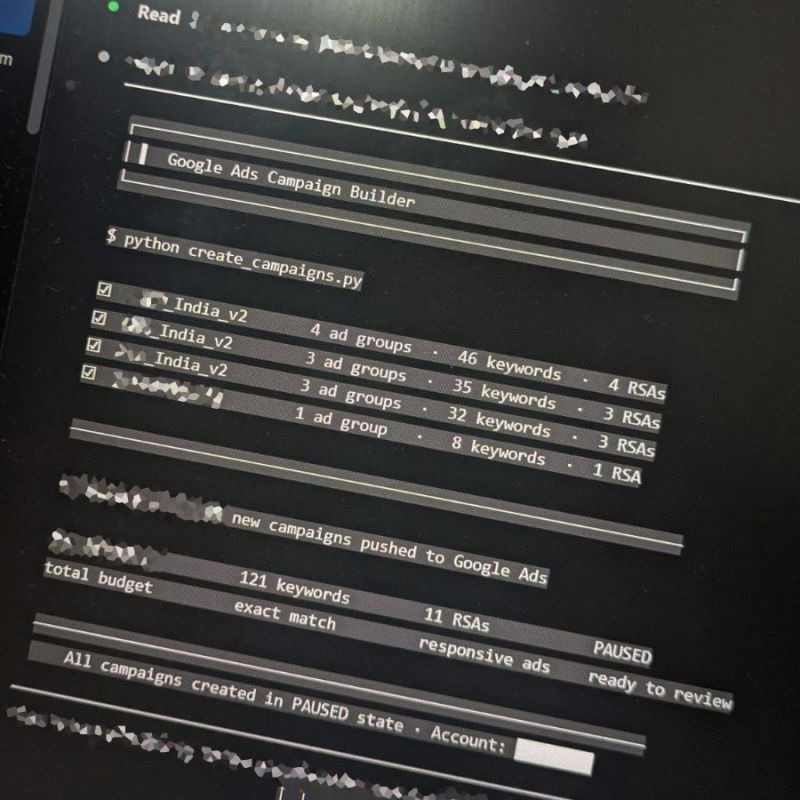
Google Ads campaign builder terminal — 121 keywords and 11 responsive search ads
Daily monitoring with alerts: Our monitoring tool track 10 to 12 parameters on each account daily, including CPC, cost per acquisition, CTR, conversion rate, and ROAS. An alert fires when any metric moves out of range, so a rising CPC or a conversion dip gets caught the same day, not at the end of a reporting cycle.
Search term cleanup: The system reviews which search queries are triggering the ads. It flags and negates the irrelevant ones automatically, so spend stops leaking to traffic that will never convert. It also surfaces daily optimization suggestions.
Predictive budget allocation: A forecasting layer reads three weeks of account history and projects the next week at roughly 70% to 80% accuracy. It flags a fading campaign early, so we can move the budget into stronger campaigns before losses build. We treat the forecast as a prompt to review, not an autopilot.
That is the difference. We do not just use AI PPC tools, we build the systems that run them, and we hold every campaign for human review before launch.
AI in PPC Management: Usage in action
Two examples showing AI PPC usage on real client accounts, kept anonymous.
A B2B SaaS platform: This client ran paid search and LinkedIn ads with heavy manual work. Campaign builds took a full day, and creative fatigue was caught only after performance dropped. We put our Google Ads build agent and a LinkedIn predictive layer on the account.
The build agent researched, wrote the copy, and pushed campaigns into Google Ads, all paused for review, cutting a full-day build to one to two hours. On LinkedIn, the predictive layer projected each campaign's next seven days and flagged creatives about to fatigue, so the team refreshed them before results dipped.
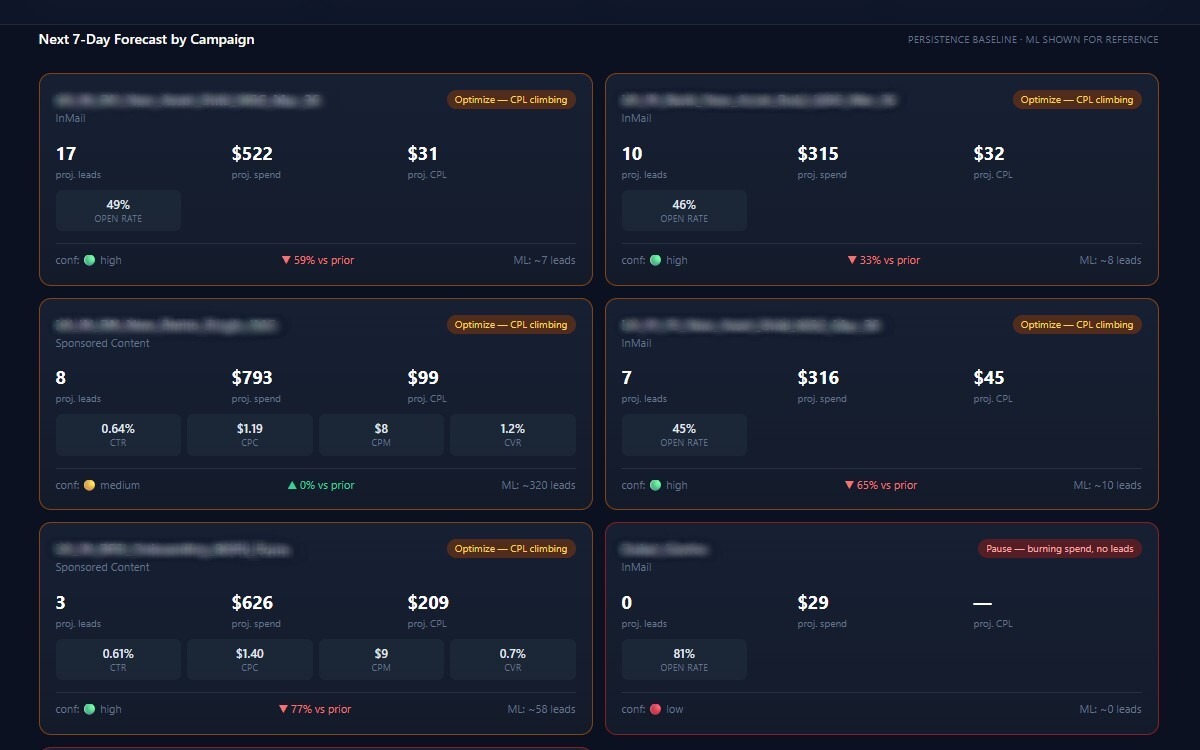
LinkedIn 7-day forecast dashboard showing projected leads, spend, and CPL per campaign with scale/optimize/pause calls
A financial services company: Their paid search leaked budget in familiar ways. A rising CPC ran for days before anyone noticed, and spend went to search terms that never convert. We put our monitoring, search term cleanup, and forecasting tools on the account.
Daily alerts flagged out-of-range metrics the same day, so problems got fixed in hours, not weeks. The search term cleanup negated irrelevant queries automatically, so spend stopped leaking to junk traffic. The forecast projected the next week, so budget moved out of fading campaigns before losses built.
Which AI PPC tools actually matter in 2026?
The system above runs on a specific stack including native Google AI first, with copy, campaign management, and workflow automation around it. Here is what matters and how we use each.
Native AI tools inside Google Ads
Google's own AI is the main bidding engine, and it does most of the optimization at scale. On top of Smart Bidding and Performance Max, 2025 and 2026 added two more layers. AI Max for Search widens targeting: it finds new queries and writes ad assets for them.
Smart Bidding Exploration bids on valuable searches you never added to your keyword list. Google is also upgrading Dynamic Search Ads to AI Max, with the automatic switchover pushed to February 2027.
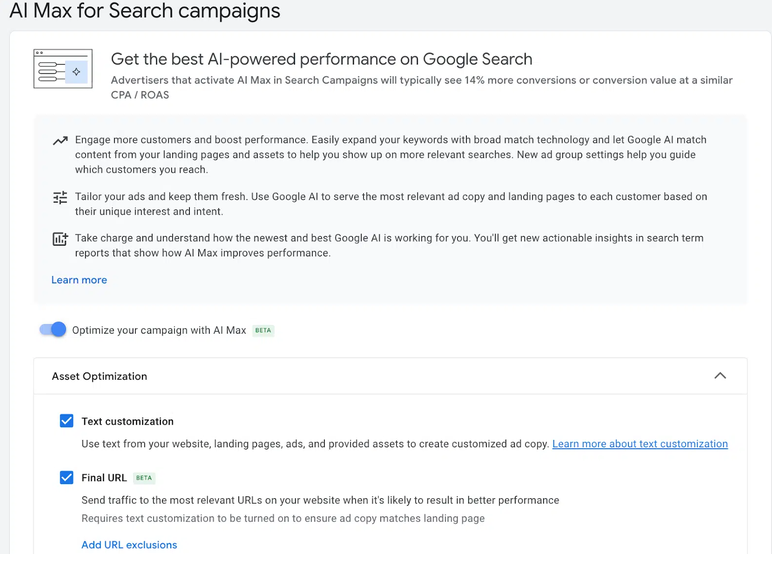
How we use it: Our agent sets up each campaign with a Target ROAS goal, conversion tracking, and a negative keyword list from day one. We use Search with tight match types for lead quality and Performance Max for extra reach.
Brand exclusions keep automation from spending on people already searching for the client by name. If you're evaluating outside help, our guide on the questions to ask a PPC agency explains what separates strategic PPC management from routine campaign execution.
AI copy tools
ChatGPT and Claude are what most PPC teams reach for now. In the State of PPC 2026 survey, 59% of professionals said they use ChatGPT for ad copy. Purpose-built writers like Jasper and Copy.ai still suit bigger content teams, but many marketers now directly use ChatGPT or Claude.
How we use it: We keep prompt templates tied to each client's messaging and funnel stage. We feed the tool brand context and past winners, then human-edit before Responsive Search Ads and Smart Bidding test it.
Campaign management and reporting
Some tools extend Google's built-in AI with extra guardrails, such as automated rules, alerts, and health checks that prevent campaigns from drifting off target. Optmyzr, Adalysis, and Opteo are some of the most popular tools for this.
Larger enterprise and retail teams tend to run Skai or Pacvue, which manage ads across many platforms at once. For reporting, Looker Studio and Supermetrics are the standard for dashboards and pulling numbers from different accounts into one view.
Workflow automation
Once campaigns are generating leads, the next step is automating everything that happens after the click. Workflow automation tools move leads into your CRM, notify sales teams, and validate data without manual work.
For most teams, three tools cover almost every workflow automation need. Make is best for visual workflows, n8n for AI-agent and high-volume automation, and Zapier for quick integrations. Pick the one that fits your team's needs.
How we use it: We route leads from ad forms and landing pages into CRMs like Zoho or HubSpot. We trigger Slack alerts on high-intent leads and validate contact details before anything hits the CRM.
Put together, the efficient 2026 setup is native Google AI on the bidding, a tool like Optmyzr for guardrails, and increasingly a custom agent owning build and optimization across channels. That agent approach is the biggest gain we have found, since it removes the day-long manual build entirely.
How do you get started with AI in PPC management?
You do not need to automate everything at once. Start here:
- Audit the account: Find where campaigns underperform and where conversion tracking or audience signals are missing.
- Automate the repetitive work first: Daily bid tweaks, pausing underperformers, budget pacing, reporting, and creative refreshes.
- Set your baselines: Record 30 days of CPA, ROAS, CTR, impressions, and conversions before you switch anything on.
- Pick tools that fit: Start with native platform AI, then add guardrails and automation as you need them.
- Pilot, then scale: Run one or two campaigns for two to four weeks before rolling out wider. AI is not set and forget, so step in when results stall.
One of the biggest advantages of AI is its ability to control wasted spend. If lowering click costs is your priority, read our guide on how to reduce CPC in Google Ads.
How is AI changing Google Search advertising in 2026?
Search itself is changing, and that shifts the stack again. Ads now appear in new places, not just a list of blue links: AI Overviews, AI Mode, and conversational, agent-driven queries. For advertisers, that changes the playbook in three ways.
First, targeting gets broader by design. AI Max and Smart Bidding Exploration are built to find converting queries you would never add to a list. Tight, exact-match-only accounts leave volume on the table.
Second, creative has to be machine-ready. When Google's AI assembles and rewrites assets for each query, the range and quality of your headlines, descriptions, and feeds matter more than any single ad.
Third, visibility depends on strong content and first-party data. AI systems pull from both to decide what to show, so structured, high-quality inputs win.
The takeaway is not that PPC managers disappear. Execution gets automated, while strategy, measurement, and creative direction become the edge. The teams that win in 2026 feed these systems better inputs than competitors.
Conclusion
AI in PPC management is changing how campaigns are built, optimized, and scaled. The biggest gains no longer come from simply enabling Google's automation, but from combining AI with clean data, custom workflows, and human oversight that keeps campaigns aligned with business goals.
Key takeaways:
- AI automates bidding, targeting, reporting, and creative testing, but human strategy still decides the outcome.
- First-party data and content quality now matter as much as keywords.
- AI Max and Smart Bidding are reshaping where search ads appear, including inside AI Overviews and AI Mode.
- Native Google AI handles much of the execution, while additional automation, monitoring, and human review keep campaigns performing over time.
- The edge goes to teams that build their own AI tools, like our campaign build agent and forecasting layer, and keep humans in the loop.
The companies that gain the most from AI treat it as an operating system for PPC, not a replacement for strategic decision-making.
.svg)


.webp)
.avif)