

Introduction
Choosing the wrong demand generation agency can cost your SaaS company 6-12 months and tens of thousands of dollars in wasted budget, only to end up with low-quality leads that don't convert.
With 300+ agencies claiming B2B SaaS expertise in 2026, how do you separate the real performers from those running generic playbooks?
The stakes are high: B2B buyers now consume 3-7 pieces of content before engaging with sales, and 70% of the buyer's journey happens before they speak to a rep. This means your agency partner needs to excel at creating demand, not just capturing it.
Here's what's changed in 2026:
- Traditional MQL-focused approaches are losing effectiveness
- Attribution has become more complex (third-party cookies declining, dark social rising)
- SaaS buyers expect personalized, multi-channel experiences
- Sales cycles are longer, requiring sophisticated nurturing strategies
- AI and automation are reshaping how demand generation works
According to the McKinsey Report 2022, companies with a strong demand generation strategy have 10% to 30% higher conversion rates than their competitors. And that's why many SaaS companies are now looking to hire a demand generation agency to build their brand awareness and attract high-quality leads.
"The key to scaling any SaaS business is finding a marketing partner who gets the nuances of your audience and can create meaningful engagement." —Robin Van Lieshout, the CEO of Insided
It's not just about launching new campaigns; it's about aligning your marketing strategies with your revenue goals. And the right demand gen agency understands this well.
This comprehensive guide walks you through the 7 non-negotiable criteria for choosing a demand gen agency that will become a true growth partner, plus the questions to ask, red flags to avoid, and a practical framework to structure your evaluation process.

Do You Need a Demand Generation Agency?
Before diving into how to choose an agency, let's determine if hiring one makes sense for your business right now.
Signs You Should Hire a Demand Generation Agency:
✅ Your sales team lacks a qualified pipeline – Reps are spending time on unqualified leads instead of closing deals
✅ Your marketing team is stretched too thin – Current team is juggling too many priorities with limited bandwidth
✅ You lack specific expertise – Missing critical skills in ABM, paid media, SEO, or marketing automation
✅ You need to scale quickly without hiring full-time – Want growth without the overhead of multiple full-time hires
✅ Your current demand gen efforts aren't data-driven – Flying blind without proper attribution or analytics
✅ You're entering new markets or launching new products – Need specialized expertise for new initiatives
✅ Your CAC is too high, and sales cycles are too long – Need optimization that requires specialized knowledge
When Building In-House Might Be Better:
❌ You have budget for 3+ experienced marketing hires with proven B2B SaaS track records
❌ You need 24/7 control and immediate pivots without agency coordination
❌ Your product requires extremely deep, ongoing domain expertise that's hard to transfer
❌ You already have robust marketing operations and proven demand gen processes
❌ You're pre-product-market fit and need constant experimentation and rapid pivots
The Hybrid Approach:
Many successful SaaS companies use a hybrid model partnering with an agency for specialized skills (paid media, ABM, SEO) while building in-house teams for content creation, product marketing, and day-to-day operations.
This gives you the best of both worlds: specialized expertise without the overhead of hiring niche specialists, combined with internal knowledge and control over core marketing functions.
Ready to explore agencies? Let's dive into how to choose the right partner.
Quick Checklist for Selecting Your SaaS Demand Gen Agency
These seven points serve as a quick reference checklist to ensure the agency you choose delivers measurable results:
- Experience in B2B SaaS – Knows SaaS cycles, CAC, MRR, churn, and has relevant case studies
- Data-driven decisions – Uses analytics, A/B tests, attribution models, and real-time insights
- Inbound expertise – SEO, content marketing, email nurturing, and lead scoring for SaaS
- Scalable strategies – Custom plans that adapt to your business growth stage
- Multichannel marketing – Runs inbound + outbound across appropriate channels
- High-quality leads – Delivers sales-ready, conversion-focused leads (not just MQLs)
- Clear reporting – Transparent updates on CAC, LTV, pipeline, conversions
Now, let's help you in demand creation and grow your business across the right channels by choosing the right demand-gen agency. Here are seven key features in detail to look for in an agency before you hire them for your demand-gen needs.
7 Key Features to Look at While Choosing a Demand Generation Agency for your SaaS
- Proven experience in B2B SaaS
- Strategic & data-driven decision-making
- Expertise in inbound marketing
- A customizable, scalable demand gen strategy
- Multichannel marketing expertise (outbound & inbound)
- Proven ability to generate high-quality leads
- Transparency and clear reporting
<div id="experience" style="margin-top:-150px; padding-top:150px;">
1. Proven experience in B2B SaaS
"With a well-structured demand generation engine, you can generate millions in revenue. An experienced agency can help build this engine from the ground up, ensuring consistent growth and scalability." –Alex Kracov, CEO and Co-Founder of Dock.
Demand generation for SaaS companies isn't one-size-fits-all. Your agency must have demonstrated experience in the B2B SaaS sector and understand unique sales cycles, SaaS metrics, and buyer personas.
What to look for?
Choose a demand generation agency with a proven track record and SaaS-specific case studies, proving they've successfully navigated challenges like:
- High customer acquisition costs (CAC)
- Monthly recurring revenue (MRR) growth
- Minimizing churn rates
- Long, complex sales cycles with multiple decision-makers
- Product-led growth (PLG) motions
- Freemium to paid conversions
Revv Growth, for example, has worked with notable clients like Atlan, Vymo, and Leadsquared. From optimizing ABM and demand generation campaigns to scaling lead generation, Revv Growth has worked closely with each of them to understand their problems and drive measurable results.

Read more→ Leadsquared increased their bookings by 40% and reduced their Google ads cost by 30%.
Critical Questions to Ask:
About Their SaaS Experience:
- "What percentage of your current client portfolio are B2B SaaS companies?"
- "Can you show me 3 case studies from companies in our industry vertical or at our revenue stage?"
- "What SaaS metrics have you successfully improved for clients (CAC payback, MRR growth, churn reduction)?"
- "How familiar are you with our sales cycle length and deal complexity?"
- "Have you worked with companies using our business model (PLG, sales-led, hybrid)?"
About Their Team:
- "Who on your team has direct B2B SaaS marketing experience?"
- "Will we work with senior strategists or junior account managers?"
- "How do you stay current with B2B SaaS marketing trends and best practices?"
What Good Looks Like:
✅ Strong indicators of SaaS expertise:
- 70%+ of the client portfolio is B2B SaaS companies
- Case studies showing specific SaaS metrics (not just generic "increased leads")
- Team members with previous in-house SaaS marketing experience
- Active thought leadership in SaaS marketing communities
- Understanding of your specific SaaS metrics and benchmarks
❌ Red flags:
- Generic B2B case studies without SaaS-specific results
- Team has e-commerce or B2C experience primarily
- Can't articulate the difference between CAC payback and LTV: CAC ratio
- One-size-fits-all approach regardless of the company stage
How can it help your business?
- No steep learning curve for the agency.
- Campaigns tailored for quick results.
- Higher customer retention rates.
- Speak your language with SaaS metrics and business models.
<div id="strategy" style="margin-top:-150px; padding-top:150px;">
2. Strategic & data-driven decision-making
A demand generation agency should base every action on data, not gut feelings or outdated playbooks. The agency you choose must show you real-time insights into campaign performance and make adjustments based on hard numbers not vanity metrics.
What to look for?
Look for agencies that offer advanced analytics, A/B testing methodologies, multi-touch attribution, and real-time reporting to give you insight into true campaign performance.
Vymo, for instance, aimed to enhance demand generation by leveraging LinkedIn ads to reach its ideal customer profile (ICP): businesses and IT leaders in banking, insurance, and multi-finance. They addressed customer pain points, such as sales growth visibility, by creating content around these challenges.
Through LinkedIn ads featuring webinars, testimonials, and content addressing key pain points, Revv Growth helped Vymo increase its MQL to SQL conversion rate from 4.5% to 18% in three months.
Show Image
So look for the right demand generation company that offers advanced analytics, A/B testing, and real-time reporting to give you insight into campaign performance.
Critical Questions to Ask:
About Their Analytics Approach:
- "What analytics tools and platforms do you use for tracking and attribution?"
- "How do you handle multi-touch attribution across long B2B sales cycles?"
- "Can you show me an example of a real-time dashboard you've built for a client?"
- "How often do you run A/B tests, and what's your framework for determining statistical significance?"
- "What leading indicators do you track before lag indicators like closed revenue?"
About Reporting & Optimization:
- "How frequently will we receive performance reports?"
- "What metrics do you prioritize, and why?"
- "Can you walk me through how you'd optimize an underperforming campaign?"
- "How do you separate correlation from causation in your analysis?"
What Good Looks Like:
✅ Strong data-driven indicators:
- Real-time dashboards customized to your business goals
- Clear A/B testing framework with documented learnings
- Multi-touch attribution models (not just last-click)
- Proactive recommendations based on data patterns
- Quarterly business reviews with strategic insights and forecasts
❌ What to avoid:
- Monthly PDF reports with only vanity metrics (impressions, clicks)
- No clear testing methodology
- Only tracks last-click attribution
- Reactive approach (only acts when you ask questions)

So look for the right demand generation company that offers advanced analytics, A/B testing, and real-time reporting to give you insight into campaign performance.
How can it help your business?
- Maximizes ROI by continuously optimizing campaigns.
- Adjusts marketing teams' spend based on lead quality and conversion rates.
- Identifies growth opportunities through metric analysis.
- Reduces wasted spend and improves overall efficiency.
<div id="marketing" style="margin-top:-150px; padding-top:150px;">
3. Expertise in inbound marketing
Inbound marketing remains one of the most effective strategies for SaaS companies. Your agency must excel at attracting and nurturing qualified leads through high-value content that speaks directly to the challenges of your ideal customer profile (ICP).
HubSpot states, "Inbound marketing is essential for B2B companies as it focuses on creating valuable content that educates and nurtures prospects throughout their buying journey."
What to look for?
The agency should have strong skills in inbound marketing, particularly content marketing, email campaigns, SEO, and nurturing strategies. Make sure the inbound marketing agency can develop SaaS-specific content such as blog posts, whitepapers, case studies, and webinars that speak to your target audience's pain points.
Critical Questions to Ask:
About Content Strategy:
- "Can you show examples of long-form content (2,000+ words) you've created for SaaS clients?"
- "How do you develop content that ranks organically while also converting?"
- "What's your process for understanding our ICP's pain points and search behavior?"
- "Do you have in-house content writers, or do you outsource?"
About SEO & Technical Execution:
- "What's your approach to SaaS SEO? How is it different from B2C or other B2B?"
- "Can you share examples of organic traffic and conversion growth you've driven?"
- "How do you balance SEO optimization with user experience and conversions?"
About Lead Nurturing:
- "How do you structure email nurture campaigns for different buyer personas?"
- "What's your philosophy on gated vs. ungated content?"
- "Can you share examples of email sequences that have driven high conversion rates?"
What Good Looks Like:
✅ Strong inbound indicators:
- Portfolio of high-quality, published content
- Demonstrated organic traffic growth (50%+ year-over-year)
- Sophisticated email nurture sequences with behavior-based triggers
- Clear content strategy aligned to each buyer journey stage
- Understanding of technical SEO and page speed optimization
❌ What to avoid:
- Generic, thin content (500-word blog posts)
- No demonstrated SEO results
- One-size-fits-all content approach
- Heavy reliance on gated content only
How can it help your business?
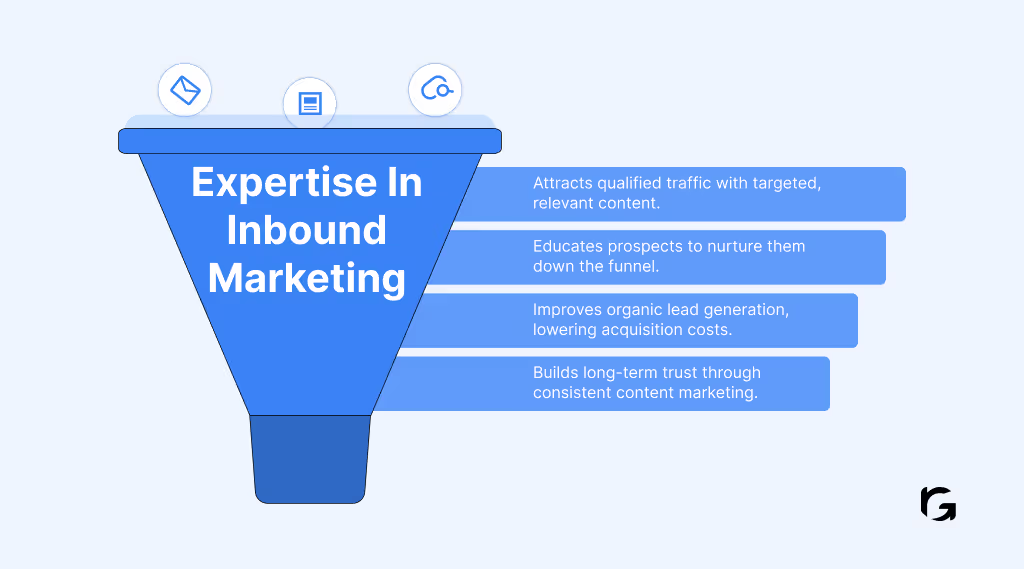
- Attracts qualified traffic with targeted, relevant content.
- Educates prospects to nurture them down the funnel.
- Improves organic lead generation, lowering acquisition costs.
- Builds long-term trust through consistent content marketing.
<div id="demand" style="margin-top:-150px; padding-top:150px;">
4. A customizable, scalable demand gen strategy
Your B2B demand generation agency must tailor growth strategies to your business stage, ICP, and market conditions, and help you scale those efforts as your business grows. Cookie-cutter approaches don't work in B2B SaaS.
What to look for?
Make sure your agency offers bespoke B2B demand generation services such as target market research, lead generation, and marketing automation that align with your specific KPIs, whether that's growing ARR, increasing conversion rates, or launching into new markets.
By developing a scalable demand strategy and continually adjusting the lead qualification process, Revv Growth helped Docsumo to 3X their lead conversions, while ensuring that the conversion strategy could be scaled as the business grew.
Read more → Docsumo increased its conversion rate by 300%
Critical Questions to Ask:
About Customization:
- "How do you tailor your approach based on our specific business stage and ICP?"
- "What research do you conduct before proposing a strategy?"
- "Can you walk me through how you'd build a custom strategy for our company?"
- "How do you balance proven playbooks with customization for our unique situation?"
About Scalability:
- "How do your strategies adapt as we grow from $5M to $20M ARR?"
- "What does a typical ramp-up timeline look like?"
- "Can you share examples of clients you've scaled with over 18+ months?"
What Good Looks Like:
✅ Strong customization indicators:
- Comprehensive discovery process before proposing solutions
- Custom strategy documents (not templated proposals)
- Flexible service offerings that can scale up or down
- Examples of long-term client relationships (12+ months)
- Clear framework for when to expand or contract services
❌ What to avoid:
- Identical proposals for every prospect
- Rigid packages that don't adapt
- No discovery process jumps straight to solutions
- Only offers month-to-month with no long-term vision
How can it help your business?
- Adapts seamlessly to business growth.
- Fuel growth without requiring new partnerships.
- Scales demand generation efforts as your product grows.
- Saves time, allowing focus on product development.
<div id="multichannel" style="margin-top:-150px; padding-top:150px;">
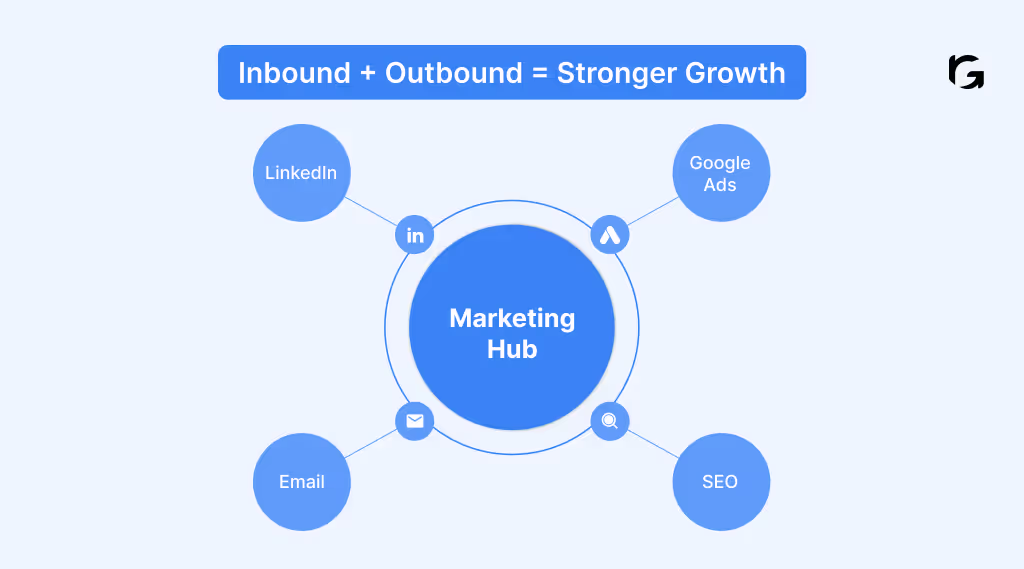
5. Multichannel marketing expertise (outbound & inbound)
Managing all B2B marketing efforts across different channels can feel overwhelming. From outbound strategies like cold email and paid ads to inbound efforts such as content marketing and SEO, coordinating these various approaches while ensuring consistency and efficiency can become overwhelming.
As observed by Jason Lemkin, founder of SaaStr, "Most SaaS businesses fail not because they didn't have a great product, but because they didn't have a scalable go-to-market strategy."
Many founders today face the same problem of building and scaling their B2B companies through a multichannel approach. So hiring a demand generation marketing agency for your B2B business can be a great option.
What to look for?
Look for an agency that runs omnichannel campaigns, with case studies showing success in running paid advertising campaigns (like Google Ads and LinkedIn), email marketing, SEO, and account-based marketing (ABM) strategies. Your agency should have a deep understanding of multi-channel funnels as well as how to optimize them for different stages of your buyer journey.
Critical Questions to Ask:
About Channel Strategy:
- "How do you determine the right channel mix for our specific ICP?"
- "Can you show examples of integrated multi-channel campaigns you've run?"
- "How do you balance inbound and outbound efforts?"
- "Which channels typically perform best for companies at our stage?"
About Channel Expertise:
- "What's your team's specific expertise in each channel?"
- "Do you have dedicated specialists for paid media, SEO, email, etc.?"
- "Can you provide examples of successful campaigns in each channel relevant to us?"
About Integration & Attribution:
- "How do you ensure consistent messaging across channels?"
- "How do you track and attribute results across multiple touchpoints?"
- "What does cross-channel optimization look like in practice?"
What Good Looks Like:
✅ Strong multichannel indicators:
- Demonstrated success across 4+ relevant channels
- Clear framework for budget allocation across channels
- Examples of integrated campaigns where channels work together
- Specialists on the team for each major channel
- Cross-channel attribution capabilities
❌ What to avoid:
- Only expertise in one or two channels
- Siloed approach where channels don't coordinate
- Pushes the same channel mix for every client
- No attribution capabilities beyond single-touch
How can it help your business?
- Engages prospects via paid ads, SEO, and social media.
- Increases visibility across multiple platforms.
- Boosts conversion likelihood with more customer touchpoints.
- Provides more outreach, improving brand presence.
<div id="leads" style="margin-top:-150px; padding-top:150px;">
6. Proven ability to generate high-quality leads
It's not enough to fill your funnel with leads; they must be high-quality as well as sales-ready. For SaaS companies, a demand generation agency that can consistently generate leads that are primed for conversion can make all the difference.
What to look for?
Look for an agency that not only drives volume but also quality. Key indicators include:
- Lead qualification frameworks – Clear criteria for MQL, SQL, and sales-ready definitions
- Lead scoring systems – Behavioral and demographic scoring models
- Conversion rate focus – Emphasis on conversion rates at each funnel stage
- Sales feedback loops – Regular communication with sales to refine lead quality
Revv Growth helped Vymo successfully create a marketing-sourced pipeline worth more than $41.5 million and increased its conversions by 4X through customizing outreach strategies and using lead scoring systems. And this resulted in a 5X improvement in lead management efficiency.
Critical Questions to Ask:
About Lead Quality:
- "How do you define a qualified lead for B2B SaaS companies?"
- "What's your typical MQL-to-SQL conversion rate for SaaS clients?"
- "How do you ensure leads meet our specific qualification criteria?"
- "What's your process for aligning on lead definitions with our sales team?"
About Lead Scoring & Nurturing:
- "What lead scoring models do you use, and how are they customized?"
- "How do you differentiate between high-intent and low-intent prospects?"
- "What's your approach to nurturing leads that aren't sales-ready yet?"
About Sales Alignment:
- "How do you incorporate sales feedback into lead generation strategies?"
- "What's your process for regular sales and marketing alignment meetings?"
- "Can you share examples of how you've improved lead quality based on sales input?"
What Good Looks Like:
✅ Strong lead quality indicators:
- MQL-to-SQL conversion rates above 25% for B2B SaaS
- SQL-to-opportunity conversion rates above 40%
- Clear lead qualification criteria aligned with sales
- Regular win/loss analysis to refine ICP
- Focus on pipeline value, not just lead volume
❌ What to avoid:
- Only reports on lead volume, not conversion rates
- No lead scoring or qualification framework
- Doesn't involve the sales team in strategy discussions
- High lead volume but low conversion rates
How can it help your business?
- Delivers leads ready to convert, shortening sales cycles.
- Increases sales team efficiency, leading to faster deals.
- Lowers customer acquisition costs (CAC).
- Improves customer lifetime value (LTV) for sustainable growth.
<div id="reporting" style="margin-top:-150px; padding-top:150px;">
7. Transparency and clear reporting
In an industry where data-driven strategies are important, having visibility into your marketing efforts allows you to assess what's working and where adjustments are needed. As David Skok, a prominent SaaS investor, emphasized, "Metrics are the lifeblood of SaaS businesses. You can't grow what you can't measure."
Without clear, timely reporting, it's challenging to gauge whether your investment is delivering results. You need to know exactly how your demand generation efforts are progressing, whether it's lead quality, pipeline velocity, or ROI, and you need that data in a way that's easy to understand and act upon.
What to look for?
Find an agency that provides regular, detailed reporting with visibility into key SaaS metrics like:
- CAC (Customer Acquisition Cost) – Total cost to acquire a customer
- LTV (Lifetime Value) – Projected revenue from a customer
- LTV:CAC ratio – Key profitability metric (should be 3:1 or higher)
- Pipeline velocity – Speed at which opportunities move through the pipeline
- Conversion rates – At each stage of the funnel
- Channel performance – ROI by channel and campaign
Revv Growth creates a weekly report, keeping the customer fully informed and aligned with the client's growth objectives. In addition to this, find an agency that provides regular, detailed reporting with visibility into key SaaS metrics like CAC, LTV, and conversion rates.
Critical Questions to Ask:
About Reporting Structure:
- "What does your standard reporting package include?"
- "How often will we receive reports (weekly, bi-weekly, monthly)?"
- "Can we customize reports to focus on our most important metrics?"
- "Do you provide access to live dashboards or just periodic reports?"
About Transparency:
- "How do you report on campaigns that aren't performing well?"
- "What level of access will we have to raw data and ad accounts?"
- "How do you handle budget overspend or underperformance?"
- "Can we see exactly where our budget is being allocated?"
About Strategic Insights:
- "Do reports include just data, or also analysis and recommendations?"
- "How do you translate data into actionable next steps?"
- "What's your process for quarterly business reviews?"
What Good Looks Like:
✅ Strong transparency indicators:
- Weekly or bi-weekly detailed reports with analysis
- Real-time dashboard access
- Clear breakdown of budget allocation and spending
- Proactive communication about issues or opportunities
- Regular strategy calls
- Quarterly business reviews
- Honest reporting about what's not working
❌ What to avoid:
- Only monthly reports with a week+ turnaround
- PDF reports without actionable insights
- Vague answers about budget spending
- Sugarcoating poor performance
- Gatekeeping access to data or ad accounts
How can it help your business?
- Provides detailed insights into campaign performance.
- Informs data-driven decisions aligned with business goals.
- Enables rapid identification of under-performing areas.
- Builds trust through clear, transparent communication.
Understanding Agency Specializations: Inbound vs. Outbound vs. Hybrid
Not all demand generation agencies take the same approach. Understanding different agency specializations will help you choose the right fit for your business model and growth goals.
Inbound-Focused Agencies
What they do:
Specialize in attracting prospects through valuable content, SEO, and inbound marketing techniques.
Core tactics:
- Content marketing (blogs, ebooks, whitepapers)
- SEO and organic search optimization
- Email nurture campaigns
- Marketing automation
- Lead scoring and qualification
Best for:
- Companies with longer sales cycles (6+ months)
- Educational or complex products requiring buyer education
- Businesses with the patience to build an organic presence (3-6 month ramp-up)
- Companies want to reduce paid ad dependency over time
Pricing typically: $10,000 - $30,000/month
Outbound-Focused Agencies
What they do:
Specialize in proactive outreach to generate an immediate pipeline through direct contact with target accounts.
Core tactics:
- Cold email outreach and sequences
- LinkedIn prospecting
- Cold calling and appointment setting
- Paid advertising (LinkedIn, Google, display)
- Account-based marketing (ABM)
Best for:
- Companies needing rapid pipeline generation
- Businesses with specific target account lists
- Products with shorter sales cycles (1-3 months)
- Expansion into new markets or segments
Pricing typically: $8,000 - $25,000/month plus ad spend
Hybrid/Full-Funnel Agencies
What they do:
Combine both inbound and outbound strategies for comprehensive demand generation across the entire buyer journey.
Core tactics:
- Integrated campaigns using both inbound and outbound
- Multi-channel attribution and optimization
- Full-funnel strategy from awareness to conversion
- Both content marketing and direct outreach
Best for:
- Companies wanting comprehensive demand generation
- Businesses with complex buyer journeys
- Organizations that want one partner managing everything
- Companies at the growth stage with a budget for a full-funnel approach
Pricing typically: $15,000 - $50,000+/month
Which Approach Does Revv Growth Use?
Revv Growth takes a hybrid, customized approach. We don't believe in forcing your business into a pre-determined methodology.
Instead, we analyze your:
- ICP and buyer behavior – Where do they research? What triggers buying decisions?
- Sales cycle and deal complexity – How long from first touch to closed-won?
- Current strengths and gaps – What's working? What's missing?
- Growth stage and budget – What can you invest in, and what ROI do you need?
Then we build a channel mix that makes sense for YOUR business, whether that's 70% inbound / 30% outbound, or vice versa.
Questions to Ask When Evaluating Agencies
The final step before committing to a partner is pressure-testing their expertise with the right questions. Polished case studies and presentations often hide gaps in process and capability.
About Their Experience & Approach
Strategy & Customization:
- "How do you define and measure success in demand generation?"
- "Walk me through your process for developing a custom strategy for our company."
- "How would your approach differ for a $5M ARR company vs. a $50M ARR company?"
- "What makes your approach different from other demand gen agencies?"
Proven Results: 5. "Can you share a campaign that failed and what you learned from it?"
6. "What's the most successful demand gen program you've run for a SaaS company?" 7. "Can you show me the specific metrics you moved for a client similar to us?" 8. "How long does it typically take to see results?"
About Their Process & Methodology
Data & Attribution: 9. "How do you handle attribution for long B2B sales cycles with multiple touchpoints?" 10. "What leading indicators do you track before lag indicators like revenue?" 11. "How do you determine which channels to prioritize for our ICP?" 12. "What's your testing framework? How do you run and evaluate experiments?"
Execution & Operations: 13. "Who will be our main point of contact, and what's their experience level?" 14. "What does a typical week of collaboration look like?" 15. "How do you integrate with our existing marketing and sales teams?" 16. "What tools and platforms do you use, and do they integrate with our tech stack?"
About Transparency & Communication
Reporting & Visibility: 17. "What does your reporting look like, and how often do we receive updates?" 18. "Can we have direct access to ad accounts, dashboards, and analytics?" 19. "How do you communicate when campaigns underperform?" 20. "What's included in your monthly retainer vs. what costs extra?"
Partnership & Flexibility: 21. "How do you handle changes in strategy mid-engagement?" 22. "What's your policy on contract terms and exit clauses?" 23. "Can we speak with 2-3 current clients as references?" 24. "How do you stay current with industry trends and platform changes?"
About Sales Alignment & Lead Quality
Lead Generation & Quality: 25. "How do you define a qualified lead for B2B SaaS?" 26. "What's your typical MQL-to-SQL conversion rate?" 27. "How do you incorporate sales feedback into demand gen strategies?" 28. "What's your process for refining lead quality over time?"
Red Flags & Warning Signs When Choosing an Agency
Knowing what to avoid is just as important as knowing what to look for.
🚩 Strategy & Approach Red Flags
Promises guaranteed results
- Red flag: "We guarantee 200 qualified leads per month."
- Why it matters: No ethical agency can guarantee specific outcomes
- Look for instead: Agencies that discuss testing, learning, and realistic timelines
One-size-fits-all packages
- Red flag: "Our standard package works for all B2B SaaS companies."
- Why it matters: Every company has a unique ICP and sales cycle
- Look for instead: Custom strategies based on discovery
Focuses only on vanity metrics
- Red flag: "We'll get you 10,000 website visitors."
- Why it matters: These metrics don't correlate with revenue
- Look for instead: Focus on pipeline, conversion rates, CAC, revenue
Can't explain their methodology
- Red flag: "We have proprietary systems we can't share."
- Why it matters: You need to understand how they'll achieve results
- Look for instead: Clear explanations of processes and strategies
🚩 Experience & Expertise Red Flags
Lacks SaaS-specific case studies
- Red flag: Generic B2B case studies, no SaaS metrics
- Why it matters: SaaS marketing requires understanding unique metrics
- Look for instead: Multiple SaaS case studies showing CAC, MRR, and churn improvements
No understanding of SaaS economics
- Red flag: Can't articulate CAC payback period or LTV: CAC ratio
- Why it matters: Shows a fundamental lack of SaaS understanding
- Look for instead: Fluency in SaaS metrics
Team lacks senior expertise
- Red flag: You'll work with junior account managers
- Why it matters: Junior teams lack strategic thinking
- Look for instead: Access to senior strategists
🚩 Communication & Transparency Red Flags
Poor communication during the sales process
- Red flag: Slow responses, unclear answers, pushy tactics
- Why it matters: The Sales process reflects how they'll communicate as partner
- Look for instead: Responsive, consultative approach
Vague about pricing or scope
- Red flag: Won't share pricing until final proposal
- Why it matters: Indicates potential for surprise costs
- Look for instead: Transparent pricing with clear inclusions
Can't provide client references
- Red flag: Won't connect you with current clients
- Why it matters: Suggests unhappy clients
- Look for instead: Willingness to connect with 2-3 current clients
🚩 Immediate Deal-Breakers
❌ Won't share failure examples – Everyone has campaigns that didn't work
❌ Badmouths competitors – Indicates lack of professionalism
❌ Makes you feel stupid for asking questions – You deserve a partner who educates
❌ Has no relevant SaaS experience – Don't be their learning experiment
Agency Evaluation Framework: How to Compare Your Options
Once you've identified 3-5 agencies that pass your initial screening, use this structured framework to evaluate and compare them objectively.
Step 1: Create Your Agency Scorecard
Rate each agency on a scale of 1-5 across these dimensions:
Step 2: Request Detailed Proposals
Send a comprehensive RFP to your shortlisted agencies, including:
Your Company Context:
- Current revenue stage and growth goals
- Team size and structure
- Current marketing efforts and gaps
- Tech stack (CRM, marketing automation)
Your ICP & Market:
- Ideal customer profile definition
- Target industries and company sizes
- Key competitors
Your Goals:
- Specific pipeline or revenue targets
- Timeline and urgency
- Budget range
- Success metrics and KPIs
Step 3: Evaluate Using the 3C Framework
🎯 Capability: Can They Do What You Need?
- ✓ Review case studies for relevant results
- ✓ Evaluate team expertise and experience
- ✓ Verify tool and platform knowledge
- ✓ Check depth of services
🤝 Chemistry: Will You Work Well Together?
- ✓ Communication style and responsiveness
- ✓ Cultural fit with your team
- ✓ Quality of questions they ask
- ✓ Collaborative vs. "we know best" approach
💰 Cost: Does the Investment Make Sense?
- ✓ Total investment (retainer + ad spend + tools)
- ✓ Expected ROI based on your current CAC/LTV
- ✓ Contract terms and flexibility
- ✓ Ramp-up time to results
Step 4: Conduct Reference Calls
Speak with 2-3 current clients. Ask:
About Results:
- What specific metrics have improved?
- How long did it take to see meaningful results?
- Have they met, exceeded, or fallen short of expectations?
About Partnership:
- How responsive and proactive are they?
- How do they handle underperforming campaigns?
- What's the quality of their reporting?
- Would you hire them again?
About Challenges:
- What's been the biggest challenge?
- Is there anything you wish they did differently?
- Any surprises after signing?
Contract and Pricing Considerations
Understanding typical agency pricing models will help you negotiate better terms and avoid surprises.
Typical Pricing Models
1. Monthly Retainer (Most Common)
How it works: Fixed monthly fee for a defined scope
Typical ranges:
- Small/Early-stage: $5,000 - $15,000/month
- Growth-stage: $15,000 - $40,000/month
- Enterprise: $40,000 - $100,000+/month
Pros:
- ✓ Predictable monthly costs
- ✓ Agency can focus on strategy
- ✓ Builds long-term partnership
Cons:
- ✗ Pay the same amount regardless of results
- ✗ Less flexibility month-to-month
Best for: Companies wanting a strategic partnership and long-term growth
2. Performance-Based Pricing
How it works: Pay based on results (per lead, per SQL, % of revenue)
Typical structures:
- Per qualified lead: $200 - $1,000 per SQL
- Percentage of pipeline: 10-20% of the influenced pipeline
- Percentage of revenue: 5-15% of closed revenue
- Hybrid: Lower retainer + performance bonuses
Pros:
- ✓ Pay for results, not just activity
- ✓ Agency incentivized to perform
Cons:
- ✗ Agencies may prioritize quantity over quality
- ✗ Often more expensive per lead
Best for: Companies with clear conversion goals and tight budgets
3. Project-Based Pricing
How it works: Fixed fee for specific deliverables
Typical projects:
- Website redesign: $25K - $100K
- Strategy development: $10K - $30K
- Campaign launch: $15K - $50K
Pros:
- ✓ Clear scope and deliverables
- ✓ Good for testing agency fit
Cons:
- ✗ Doesn't support ongoing optimization
- ✗ No long-term partnership benefit
Best for: Specific one-time needs
What's Typically Included vs. Not Included
Usually Included:
- ✓ Strategy development
- ✓ Campaign setup and management
- ✓ Content creation (with limits)
- ✓ Performance monitoring
- ✓ Regular meetings
Usually NOT Included:
- ✗ Ad spend (separate budget)
- ✗ Software/tools
- ✗ Major website work
- ✗ Premium content production
- ✗ Events/sponsorships
Contract Length Considerations
- Month-to-Month: Maximum flexibility but no agency commitment
- 3-Month: Reasonable trial period
- 6-Month: Standard for most SaaS engagements
- 12+ Month: Deepest partnership, best pricing
💡 Pro tip: Negotiate a 6-month initial term with performance-based exit clauses.
Your Action Plan: Next 30 Days
Here's your step-by-step action plan to find and hire the right agency within the next month.
📅 Week 1: Define Your Requirements (Days 1-7)
Day 1-2: Document Your Current Situation
- Audit current marketing efforts and results
- Identify specific gaps and challenges
- Document what you've tried that hasn't worked
- List your current tools and tech stack
Day 3-4: Define Your ICP & Goals
- Create or refine your ideal customer profile
- Define specific revenue and pipeline targets
- Set realistic budget expectations
- Align stakeholders on success metrics
Day 5-6: Determine Your Priorities
- Rank the 7 key features by importance
- Decide: inbound, outbound, or hybrid focus?
- Identify must-have vs. nice-to-have capabilities
Day 7: Create Your Evaluation Materials
- Draft RFP document
- Customize agency scorecard
- Prepare a list of questions
- Set a timeline for selection
📅 Week 2: Research and Shortlist (Days 8-14)
Day 8-10: Identify Potential Agencies
- Research 10-15 agencies specializing in B2B SaaS
- Review their websites and case studies
- Check reviews and testimonials
- Ask peers for recommendations
Day 11-12: Initial Outreach
- Contact 7-10 agencies for discovery
- Send your RFP
- Schedule exploratory calls
- Request case studies and pricing
Day 13-14: Narrow to Top 5
- Evaluate initial responses
- Assess communication quality
- Check for red flags
- Shortlist 5 agencies
📅 Week 3: Evaluate and Compare (Days 15-21)
Day 15-17: In-Depth Presentations
- Schedule 60-90 min presentations with the top 5
- Use your prepared questions
- Have key stakeholders attend
- Take detailed notes
Day 18-19: Reference Calls
- Request references from the top 3
- Conduct reference calls
- Ask about results and partnership
- Document feedback
Day 20-21: Proposal Review
- Complete agency scorecards
- Compare proposals side-by-side
- Calculate potential ROI
- Apply 3C framework
📅 Week 4: Make Decision (Days 22-30)
Day 22-24: Narrow to Top 2
- Review all evaluation data
- Discuss with stakeholders
- Request clarifications
- Consider revised proposals
Day 25-26: Final Interviews
- Conduct final interviews
- Negotiate contract terms
- Clarify scope and KPIs
- Discuss the onboarding process
Day 27-28: Make Final Decision
- Review all inputs
- Get stakeholder sign-off
- Notify selected agency
- Request a contract for review
Day 29-30: Contract & Onboarding
- Review and sign the contract
- Schedule a kickoff meeting
- Grant necessary access
- Set expectations for the first 90 days
Final Thoughts
Working with a demand generation agency can accelerate your SaaS business, but preparation is key. Setting clear business objectives, defining your ICP, auditing your funnel, and fostering collaboration will help the agency deliver high-quality leads and measurable results. By generating demand, businesses can attract new customers, expand their market presence, and drive growth.
The key takeaways:
✅ Prioritize SaaS experience – Generic B2B expertise isn't enough
✅ Demand data transparency – You can't improve what you don't measure
✅ Focus on quality over quantity – Better to have 20 sales-ready leads than 200 tire-kickers
✅ Look for strategic partners – The best agencies challenge your thinking and provide insights
✅ Take time to evaluate – Rushing costs more than taking 30 days to choose right
✅ Trust your instincts – Beyond metrics, choose a partner you want to work with
Ready to turn awareness into predictable revenue?
Book a strategy call with Revv Growth today, and let's build a demand engine that continuously attracts, nurtures, and converts high-intent leads for your SaaS business.
During your call, we'll:
- Review your current demand gen approach and identify gaps
- Share specific, actionable recommendations for your business
- Discuss whether we're the right fit to partner together
You can also connect with me on LinkedIn to talk about ideas, insights, and strategies that drive SaaS growth.
FAQs
.svg)
.webp)