
.png)
Introduction
Growth in the SaaS world isn’t getting any easier.
With increasing pressure to drive sales, optimize lead generation, and manage data silos, teams are often stretched thin trying to keep up.
Sales pipelines are full, but conversions remain stubbornly low. Marketing teams are generating leads, but they may not be the right kind, and customer success efforts are often scattered across multiple platforms, making data-driven decisions more difficult.
Enter Revenue Operations (RevOps), the bridge that connects sales, marketing, and customer success, aligning teams and streamlining processes to fuel predictable, sustainable growth.
But here's the catch: building a RevOps function isn’t just about deciding if you need one. The real challenge is choosing how to implement it.
The question is, do you hire an in-house RevOps team to take full control, or do you partner with a RevOps agency like RevvGrowth that already has the expertise to hit the ground running?
According to a report by Deloitte, organizations with an established RevOps function are 1.4 times as likely to exceed their revenue goals by 10% or more, underscoring the importance of working with an agency familiar with RevOps strategy and execution.

In this blog, I’m going to break down the cost, ROI, and speed-to-market differences between these two options. Whether you’re a fast-growing SaaS startup or an established company looking to optimize revenue, you’ll walk away with a clear roadmap for choosing the right RevOps setup.
Comparison Overview: Agency vs In-House
Before diving into the details of each option, let's briefly compare how both models stack up side by side. This comparison will give you a clear picture of what each model entails in terms of cost, speed, and flexibility.
Both a RevOps agency and an in-house team can drive substantial growth, but their effectiveness largely depends on your company’s stage and unique needs.
For fast-growing SaaS companies seeking quick implementation, flexibility, and specialized expertise, a RevOps agency offers a streamlined, cost-effective solution.
Breaking Down the Options: Agency, In-House, Hybrid
A RevOps agency optimizes revenue operations by aligning sales, marketing, and customer success teams to drive growth. These agencies use data-driven strategies, automation, and integrated technology to streamline processes and improve operational efficiency.
By focusing on key performance indicators (KPIs), RevOps agencies maximize return on investment (ROI) and enhance customer experience. Their scalable solutions help businesses adapt to increasing complexity while improving overall revenue performance.
RevOps agencies empower companies to automate workflows, analyze data, and implement strategies that support sustainable growth and business success.
What a RevOps Agency Offers
A RevOps agency is more than just an external service provider; it’s a dedicated team of experts with specialized knowledge in sales, marketing, and customer success operations.
These agencies bring their tested methodologies, systems, and technologies to unify your revenue operations and drive growth. Here's what you can expect from working with a RevOps agency:
- Faster Implementation: Agencies are experts at implementing strategies quickly. They have streamlined processes and frameworks already in place, allowing them to deliver results in a matter of weeks, not months. This rapid implementation ensures your team starts seeing the benefits of RevOps right away.
- Proven Frameworks: With years of experience across various industries, agencies bring established best practices to the table. They use pre-built systems and frameworks that help you avoid common pitfalls, which often delay internal teams. This knowledge transfer means you can get more predictable results faster.
- Scalability: One of the biggest benefits of partnering with an agency is its flexibility. Agencies can quickly scale up or down depending on your needs. Whether you're launching a new product, managing seasonal demand, or need extra resources for a short-term project, agencies can adjust without the hassle of hiring or training new team members.
- Expertise: RevOps agencies bring deep experience with multiple go-to-market (GTM) platforms, including HubSpot, Salesforce, Marketo, and others. They know how to optimize these platforms for your specific needs, integrating them seamlessly into your business processes.
A report by Gartner suggested that with increasing pressure to drive sales and optimize lead generation, nearly 75% of the highest-growth companies are adopting a RevOps model by 2026.
Choosing the right partner is critical, and agencies like RevvGrowth offer a strategic edge. Our team brings specialized knowledge and ready-to-deploy systems that enable rapid growth, especially for SaaS companies looking to scale fast.
For instance, we leverage Clay Automation for automated workflows and personalized outreach, a key tool that enhances lead engagement and sales pipeline efficiency.
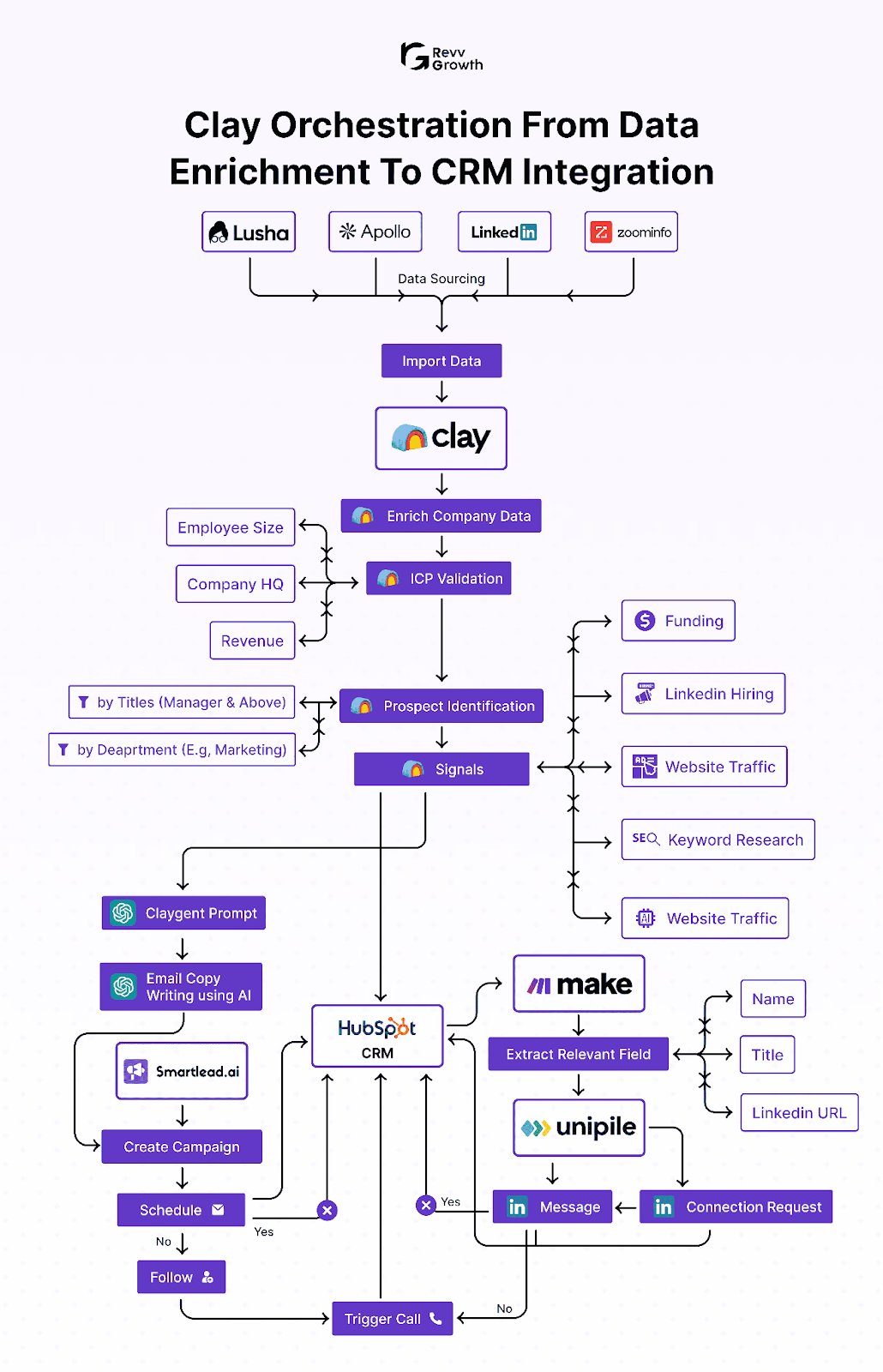
We’ve implemented this solution to streamline processes and optimize outreach for clients in various industries.
What an In-House RevOps Team Structure Looks Like
Building an in-house RevOps team means assembling a dedicated group of internal experts who are fully embedded within your organization. This structure is ideal for companies that require full ownership of their RevOps processes and deep alignment with company culture.
Here’s what a typical internal RevOps team might look like:
The total cost of a fully-staffed in-house RevOps team can easily exceed $300K annually, considering salaries, benefits, tools, and ongoing operational costs. This investment provides full control over strategy and processes but requires substantial resources for hiring, training, and long-term management.
Also read → 7 Steps to Create a Robust Marketing Automation Strategy in 2025
Hybrid Models: Best of Both Worlds
A hybrid model brings the best of both worlds: an in-house RevOps lead combined with agency support. This setup allows companies to retain the strategic control of an in-house team while also benefiting from the speed, expertise, and scalability of an agency.
Hybrid models are especially useful for:
- Scaling SaaS Teams: If your SaaS company is in a high-growth phase, you may need the flexibility to scale quickly without the delay of hiring additional in-house resources. By combining agency support with an in-house RevOps manager, you get the best of both worlds: expert strategy and immediate execution.
- Transitioning: If you're starting with an agency and planning to transition to a full in-house team over time, the hybrid model allows for a smooth handover. You’ll build internal capabilities while maintaining external support, ensuring that growth doesn’t stall.
Benefits of the Hybrid Approach:
- Speed from Agency Support: You can implement strategies quickly and efficiently through agency expertise, while your internal team focuses on long-term alignment and culture.
- Flexibility to Adapt: This model gives you the flexibility to scale up or down based on your evolving needs. Agencies can provide as much or as little support as necessary, depending on your team’s capacity.
- Shared Accountability: The hybrid model creates a shared responsibility for success. Both the in-house and agency teams work together, ensuring alignment and accountability toward the same revenue goals.
By integrating both models, SaaS companies can enjoy the benefits of rapid implementation, strategic alignment, and scalability without sacrificing internal control.
According to Harvard Business Review, 97% of C-suite executives in the tech industry are familiar with RevOps, and many attribute it to tangible gains such as increased revenue, improved net revenue retention (NRR), and reduced go-to-market (GTM) costs.
Cost Comparison: Agency vs In-House for SaaS Companies
When evaluating whether to build an in-house RevOps team or partner with a RevOps agency, cost is one of the most significant factors to consider. Understanding the financial commitment associated with each option is crucial to making an informed decision that aligns with your budget and growth goals.
- Typical Cost Lines: Salaries, Benefits, Tooling, Overhead
Building an in-house RevOps team requires not only recruiting talent but also investing in training, tools, and overhead. The upfront and ongoing costs for a full internal RevOps team can add up quickly, especially when you factor in salaries, benefits, and operational expenses.
Here's a breakdown of the additional cost components beyond salaries:
- Recruitment Costs: Hiring a full-time RevOps team requires significant recruitment expenses, including job postings, recruitment agency fees, and onboarding. Recruiting top talent in specialized roles such as RevOps Manager or Data Specialist can add anywhere from $5K to $20K per hire, depending on the role and recruitment process.
- Training & Development: Continuous training is essential for keeping an in-house team updated with the latest tools, technologies, and methodologies in RevOps. This can cost an additional $5K to $15K per year, factoring in conferences, courses, certifications, and internal development programs.
- Tooling Costs: RevOps tools and software (CRM systems, marketing automation platforms, data analytics tools) can cost $50K+ annually, depending on the scale of your operations and the tools chosen.
Many SaaS companies rely on a combination of paid tools like Salesforce, HubSpot, and Marketo, which require ongoing subscription fees.
- Overhead & Benefits: In addition to salaries, you’ll need to account for employee benefits (healthcare, retirement, etc.), office space, and administrative support, which can easily add 20-30% to salary costs annually.
When combined, these elements can push the total annual cost of a fully-staffed in-house RevOps team to $350K+, making it a significant investment for many businesses, particularly those in the early stages of scaling.
- Agency Pricing Models & Flexibility
RevOps agencies offer flexible pricing models that can be more cost-effective, especially for growing SaaS businesses. Here’s how agencies structure their costs:
- Retainers: Agencies typically charge a monthly retainer for ongoing support. This model allows SaaS companies to access expertise on a consistent basis without the commitment and costs of hiring full-time staff.
Retainers can be tailored to provide the exact level of support your business needs, from high-level strategic guidance to hands-on execution.
- Project-Based Pricing: For specific, one-off initiatives, agencies often offer project-based pricing. Whether you need help with a CRM migration, sales funnel optimization, or data reporting, project-based fees allow you to pay for the exact services required, making it a more budget-friendly option when compared to a full-time hire.
- Fractional RevOps Services: This is a flexible model where an agency provides part-time RevOps expertise to fill gaps in your team or handle specific tasks on an as-needed basis.
For instance, instead of hiring a full-time data analyst, a fractional RevOps service may provide data insights and reporting on a reduced scope, at a fraction of the cost.
The pricing flexibility of agencies allows you to scale services based on the company’s needs, adjusting resources as your operations grow. Agencies often provide immediate impact, with the ability to implement strategies and systems in weeks, not months.
In fact, working with an agency can cost less than maintaining a full in-house RevOps team, making it a highly cost-effective solution for SaaS businesses looking to accelerate growth without the financial commitment of hiring a full-time team.
At RevvGrowth, we specialize in helping SaaS companies scale faster with tailored RevOps solutions that drive revenue growth. Whether you're looking to implement systems quickly, optimize existing processes, or need a flexible, expert-driven approach, we offer the strategic partnership that accelerates results without the burden of in-house hires.
Book a free strategy call with our team to understand how we can help you scale smarter.
ROI & Growth Speed: Which Delivers Faster for RevOps?
When it comes to RevOps, speed and ROI often determine whether your strategy thrives or stalls. While speaking about the impact of cross-functional alignment, a seasoned Revenue Operations executive and thought leader, Rosalyn Santa Elena, noted, “Revenue Operations is the strategic differentiator to drive and optimize the revenue engine.”
In the same interview, Rosalyn further emphasized the importance of a unified approach: “When you have this alignment across all of these different areas, then you have that single view of the business where everyone’s looking at the business the same way.” This underscores the value of a cohesive RevOps strategy in achieving rapid and sustained growth.
Let’s break down the different factors that affect ROI and Growth Speed, and which model is better suited for your needs:
Speed to Value: Time to Impact
When it comes to time-to-impact, RevOps agencies have a significant advantage. Since they already have established frameworks and specialized expertise, agencies can jump right in and begin delivering results within weeks, not months.
For example, an agency can implement a CRM system, automate sales workflows, and align your teams to revenue goals in a matter of weeks, all while ensuring that your data flows seamlessly across platforms.
In contrast, in-house teams take 3-6 months to fully ramp up, with time spent on hiring, onboarding, and aligning the team with company-specific processes. The time-to-impact is significantly shorter with agencies, allowing your business to start seeing tangible benefits quickly.
This speed of execution is one of the primary reasons why fast-growing companies opt for agencies like RevvGrowth; they need immediate results without the lag time.
Scalability & Flexibility in Growth Phases
The stage of your business plays a crucial role in determining which model is the best fit for your needs: agency, in-house, or hybrid.
- For Startups and Scale-ups: In the early or scaling stages, businesses often face rapidly changing needs, shifting market conditions, and the need for agility. Agencies are ideal for this scenario because they offer scalability and flexibility without the burden of hiring and managing full-time employees.
You can quickly scale their involvement up or down based on your requirements, whether it's a product launch, a marketing campaign, or the integration of a new CRM. Agencies bring deep expertise without the need for a lengthy recruitment process, which is invaluable when you need to act fast and maintain flexibility.
- For Mature Enterprises: As businesses mature, they typically have more established systems and processes in place. At this stage, control and alignment become more important.
For enterprises that need a high level of internal ownership and a deep understanding of their unique business culture, a hybrid setup can be a better fit. It allows for more direct oversight and long-term strategy development. Hybrid models can easily manage day-to-day operational adjustments, striking the right balance between agency flexibility and internal control.
Measuring Success: KPIs, Attribution, Revenue Velocity
To accurately track the ROI of your RevOps strategy, it’s essential to focus on key performance indicators (KPIs) that align with your business goals. These KPIs will help you measure the effectiveness of your RevOps processes and gauge the overall performance of your revenue operations.
Here are the most important KPIs to track:
- Revenue Growth Rate: This is the primary measure of success, reflecting how much your revenue increases over time. An agency setup often delivers faster growth due to quicker implementation and alignment across teams.
- Sales Cycle Length: A longer sales cycle often points to inefficiencies in the sales process. Agencies can help shorten this cycle through automation and process streamlining, delivering quicker results than in-house teams, which take longer to optimize these processes.
- Lead-to-Close Ratio: This measures the efficiency of the sales process. A low ratio indicates misalignment between sales and marketing. Agencies are better positioned to resolve this faster through expert alignment and seamless workflows, whereas an in-house team might take longer to harmonize efforts.
- Customer Retention and Expansion: Retaining and expanding existing customers is key to long-term success. Agencies bring a wealth of experience in data-driven strategies that can help optimize retention efforts, while in-house teams, though effective, may lack the flexibility and bandwidth to implement changes quickly.
Overall, an agency setup tends to deliver faster results across these KPIs, due to its ability to implement and scale processes rapidly. An in-house team, while offering control and deep integration, typically takes longer to drive measurable improvements in these key areas.
Beyond metrics, measuring RevOps success means looking at how effectively teams adapt to new processes. Success in RevOps depends on being good at change management, implementing processes, getting buy-in from stakeholders, and rolling out improvements that stick.
Ultimately, the decision between an agency and an in-house team should be based on the speed of implementation, scalability needs, and long-term goals for your RevOps function. Both models can deliver significant ROI, but the right choice will depend on how quickly you need results and the level of control and customization you require.
Also read → 10 Key Marketing Metrics Every SaaS Company Should Track in 2025
Decision Framework: How to Choose What’s Right for Your Company
Choosing between an in-house team and an agency depends on a variety of factors, including your company's stage, growth goals, and internal capabilities. Understanding these elements will help you determine which approach is best suited to your needs.
Below are the key factors to consider when making your decision:
- Company Stage & Growth Goals
Your company’s stage and growth goals are crucial when deciding between an in-house team or agency:
- Startups/Scale-ups: An agency is ideal for fast-paced environments, offering speed and adaptability. They help implement systems quickly, allowing you to focus on scaling without getting bogged down by operational setup.
- Mature Enterprises: In-house or hybrid models are often better suited for organizations with established systems that require long-term control and deeper integration within the company culture.
- Budget, Headcount & Internal Capability
Evaluate your budget and internal resources:
- If your operations manager is already juggling multiple roles or your team lacks specialized skills, an agency can provide the expertise you need without the burden of hiring more full-time staff.
- For companies with enough resources to build and maintain an in-house team, an internal setup might offer better long-term value, though at a higher cost.
- Agency Evaluation Checklist
When selecting an agency, ensure they meet key criteria:
- Proven experience with SaaS companies.
- Familiarity with your tech stack and tools.
- Ability to scale as your business grows.
- Transparent reporting for measurable results and ROI.
By aligning your RevOps decision with these factors, you’ll ensure that your choice complements your company’s unique needs, goals, and capacity for growth.
Whether you’re scaling fast or optimizing existing systems, the right RevOps model can make the difference. Talk to our RevOps experts today and get a custom roadmap designed around your company’s needs.
Key Takeaways
Choosing the right RevOps model is key to scaling your business and driving growth. Here are the essential points to consider:
- RevOps is crucial for aligning sales, marketing, and customer success teams, enabling predictable growth.
- Agencies offer fast results and scalability, making them ideal for growing SaaS teams with limited internal resources.
- In-house teams provide control and cultural alignment but come with higher costs and longer ramp-up times.
- Hybrid models offer the best of both worlds, balancing control with flexibility as your business scales.
- Your choice should be based on your company’s stage, available resources, and long-term goals.
- If you're looking for a scalable, cost-effective solution, a RevOps agency like RevvGrowth can be the key to unlocking faster growth and higher ROI.
Conclusion
Choosing between an in-house RevOps team and a RevOps agency doesn’t have to be overwhelming. The right choice depends on your company’s needs, resources, and growth stage.
If you’re looking for speed, flexibility, and scalability, partnering with a RevOps agency like RevvGrowth can help you achieve rapid results without the long ramp-up times required for an internal team.
At RevvGrowth, we specialize in helping SaaS companies implement scalable RevOps systems that not only drive revenue but also improve ROI visibility and ensure alignment across your go-to-market (GTM) teams for long-term, sustainable growth. Our approach delivers fast, impactful results, allowing you to stay focused on scaling your business.
If you're ready to accelerate your growth with a tailored RevOps strategy, let's talk. Book a free consultation to see how we can help you scale smarter and achieve measurable impact with a strategic RevOps partnership.

.svg)

.webp)