Introduction
Your competitors can reveal some of your biggest growth opportunities if you know what to look for.
It's easy to compare feature lists, pricing pages, and websites. What's harder is understanding why one competitor consistently outranks you, shows up in AI search results, wins deals you expected to close, or gains traction in a market you've been targeting for months.
The difference usually lies in better positioning, stronger messaging, smarter content, or a go-to-market strategy that's easier to miss if you're only looking at the surface.
That's why effective SaaS competitor analysis goes beyond collecting information. It helps you uncover gaps in your competitors' strategy, identify opportunities they haven't capitalized on, and make better decisions across marketing, product, SEO, and sales.
This guide walks you through a practical framework for doing exactly that, along with the tools that make the process faster and more actionable.
Before comparing products, pricing, or marketing strategies, the first step is to identify the right competitors.
Types of SaaS Competitors You Should Analyze
Not every competitor deserves the same level of attention. Some compete with you directly for customers, while others influence buying decisions in different ways. Understanding these categories helps you prioritize your research and avoid concluding that the wrong companies are the right ones.
1. Direct competitors
These companies solve the same problem for the same target audience with a similar product.
For example, if you offer marketing services for SaaS companies, other SaaS marketing agencies are your direct competitors. They should be your primary focus because prospects are most likely comparing you against them during the buying process.
Analyze: Positioning, pricing, features, messaging, SEO, AI visibility, customer reviews, and go-to-market strategy.
2. Indirect competitors
Indirect competitors solve the same problem using a different approach or product category.
For example, a project management platform may compete with spreadsheets or collaboration tools that customers use instead of dedicated project management software.
Analyze: Their messaging, value proposition, and why customers choose them over your solution.
3. Emerging competitors
These are newer companies that may not have a large market share yet but are growing quickly with innovative products, AI capabilities, or a unique positioning strategy.
Keeping an eye on emerging players helps you spot market shifts before they become industry standards.
Analyze: Product launches, funding announcements, feature updates, pricing changes, and marketing strategy.
4. Aspirational competitors
These aren't necessarily your closest competitors today, but they're companies you admire for their brand, content, product marketing, or customer experience.
Studying them can reveal best practices that are worth adapting, even if they serve a different segment or operate at a larger scale.
Analyze: Brand positioning, content strategy, website experience, onboarding, and customer education.
💡 Start small
Focus on 5–8 carefully selected competitors instead of trying to track everyone in your market. A smaller, well-researched list is easier to maintain and often delivers clearer, more actionable insights.
Now that you've identified the right competitors, the next step is knowing what to analyze.
💡 Did you know?
The 4 Ps still hold up as a competitor analysis checklist
- Product. Features, roadmap, integrations, and where the gaps sit
- Price. Packaging tiers, trial terms, and where the cost jumps
- Place. Where they sell, which channels convert, and which markets they have skipped
- Promotion. Content, paid, search visibility, and the claims they repeat
Borrowed from the classic marketing mix, the four Ps work as a quick completeness check. If your analysis has nothing to say about one of them, that is usually where the blind spot is.
How to Perform a SaaS Competitor Analysis (Revv Growth’s Method)
When a new client comes to us, competitor analysis is one of the first things we do. It helps us understand the market, identify opportunities, and build a strategy based on evidence rather than assumptions.
Here's the framework we follow.
Step 1: Start with the Business Objective
Before opening Ahrefs or building spreadsheets, we define what we're trying to learn. Every competitor analysis starts with a business objective, whether that's improving SEO, refining positioning, identifying AI visibility gaps, preparing for a product launch, or entering a new market.
That objective determines what we analyze and what success looks like.
Pick one objective before you start
The objective decides what you skip. Chasing all four at once is how a competitor analysis turns into a research project nobody finishes.
Step 2: Create a Competitor Research Template
Next, we create a research template so every competitor is evaluated consistently. Along with the basics like positioning, pricing, and features, we also track AI visibility, content strategy, and recurring customer complaints from review platforms.
Using the same framework across competitors makes patterns much easier to spot.
One sheet, identical fields for every competitor
| A | B | C | D | E | F | |
| 1 | Competitor | Audience | Core claim | Entry price | AI visibility | Top complaint |
| 2 | Competitor A | Mid-market ops | Easiest to use | $49/user | 4 of 4 | Weak reporting |
| 3 | Competitor B | SMB, self-serve | Lowest price | $19/user | 2 of 4 | Support delays |
| 4 | Competitor C | Enterprise IT | Most secure | Quote only | 3 of 4 | Slow onboarding |
| 5 | Competitor D | Agencies | Fastest setup | $35/user | 1 of 4 | Limited API |
The value is in the columns. Identical fields let you read straight down one and see the pattern, which is impossible across eight separate documents.
Step 3: Evaluate Positioning Before Features
Features rarely explain why one SaaS company wins more deals than another.
We first analyze how competitors position themselves, who they target, the problems they claim to solve, and the proof they use to build credibility. This often reveals messaging gaps long before we compare products.
Three competitors, three headlines, one claim
Competitor A
The easiest project tool your team will ever use
Competitor B
Powerful project management, without the learning curve
Competitor C
Up and running in minutes. No training required.
Paste every competitor headline into one column, then read their reviews for that same promise. Your angle is whatever they all claim and none of them deliver. If everyone sells ease of use and reviewers say the tool breaks at scale, position on staying simple as the work gets harder.
Step 4: Understand the Buying Experience
Next, we evaluate the entire customer journey, not just the product itself. We review pricing, onboarding, documentation, customer support, and public reviews across G2, Capterra, TrustRadius, and Reddit.
We also speak with the client's sales team. Crayon's 2026 report found that internal data is now the most-cited source of competitive intelligence, ahead of competitor websites. Competitor objections, lost deals, and recurring customer questions often reveal insights that no competitor website can.
From the feature list to what buyers actually say
| Competitor | Open API | SSO | Audit log |
|---|---|---|---|
| Competitor A | Yes | Yes | No |
| Competitor B | No | No | No |
| Competitor C | Yes | Yes | Yes |
| Competitor | Trial | Locked behind upgrade | Where cost jumps |
|---|---|---|---|
| Competitor A | 14 days | SSO, audit log | 50 seats |
| Competitor B | Freemium | Integrations, API | 20 seats |
| Competitor C | Demo gate | Pricing itself | Unknown |
| Competitor | Rating | Recurring complaint |
|---|---|---|
| Competitor A | 4.4 | Slows down at scale |
| Competitor B | 4.6 | Slows down at scale |
| Competitor C | 4.2 | Onboarding takes weeks |
Skip the five-star reviews and read the three-star ones. They come from people still using the product who can name exactly what frustrates them. When the same frustration appears under two competitors, you have found something worth building or messaging against.
Step 5: Measure SEO and AI Visibility
Your competitors are competing for visibility wherever buyers discover and evaluate software.
We use Semrush and Ahrefs to analyze keyword rankings, top-performing pages, backlinks, and content gaps. Then we check Google AI Overviews, ChatGPT, Claude, and Perplexity to see which competitors are consistently being cited.
If the same competitors keep appearing across search and AI platforms, we analyze what's driving that visibility. These insights help strengthen our clients' SEO, AEO, and GEO strategy.
By combining SEO, AEO, and GEO into a single strategy and continuously analyzing competitors' search and AI visibility, we have earned rankings in Google AI Overviews and AI assistants like ChatGPT and Claude. The screenshots below show how an integrated approach can improve discoverability across modern search experiences.
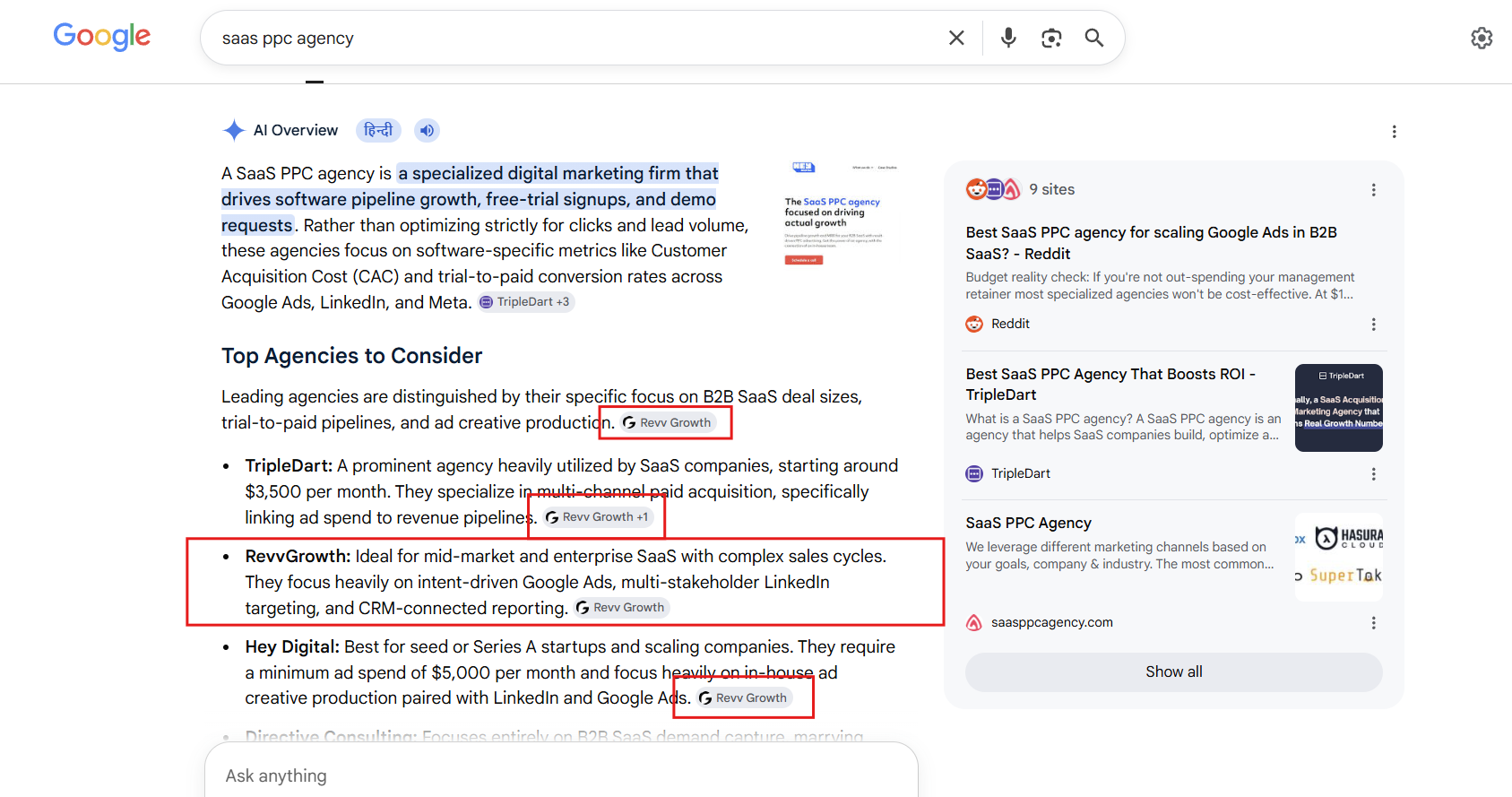
Revv Growth appearing in an AI overview for a query
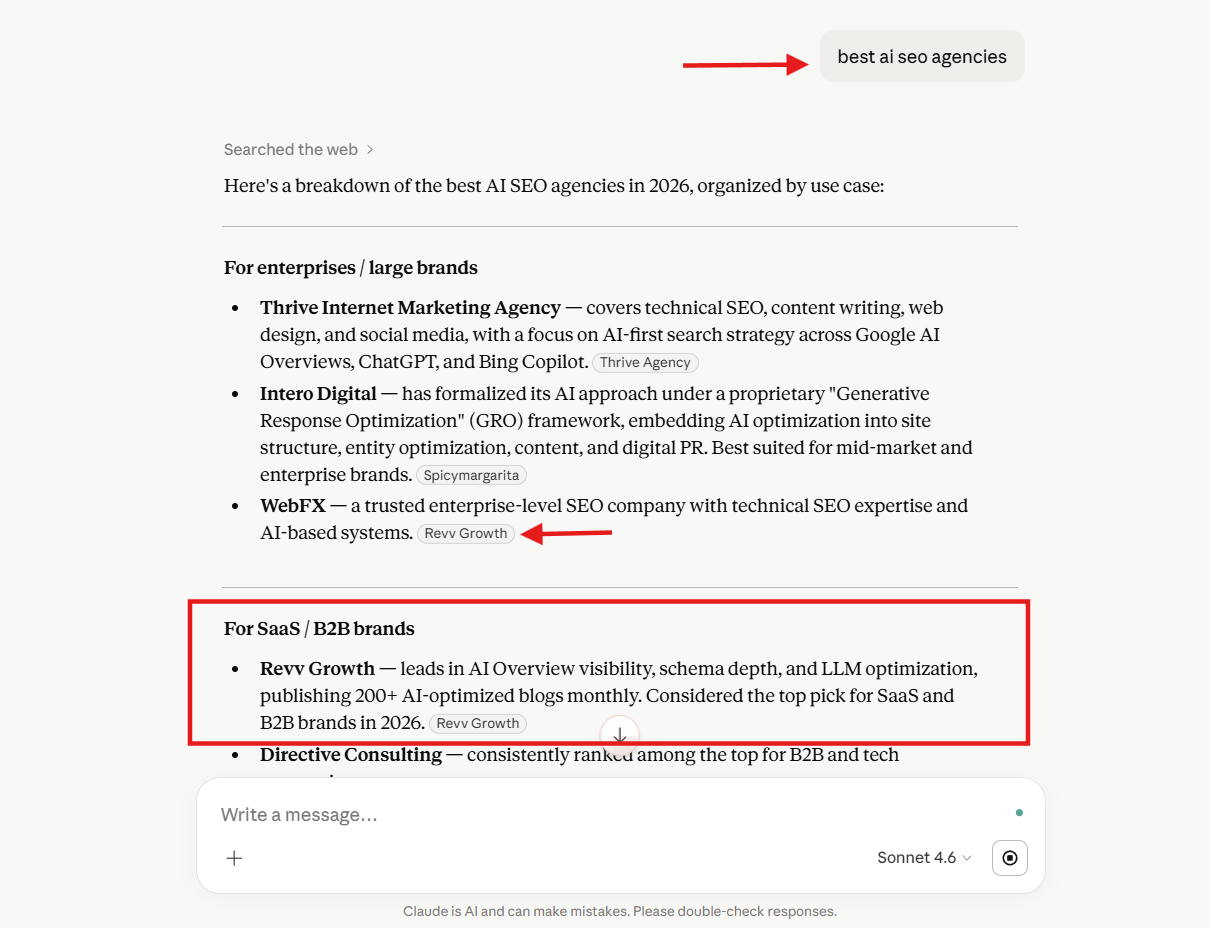
Revv Growth being cited for a query on Claude
Your competitors are showing up in AI answer engines. Are you?
See how we build SEO, AEO, and GEO into one strategy.
Talk to our teamStep 6: Analyze Their Content Strategy
Content tells us how competitors attract and nurture buyers.
Instead of counting blog posts, we look for patterns. Which topics do they consistently invest in? Which formats do they prioritize? Are they educating buyers, building authority, or focusing on product-led content? These insights help shape a stronger content strategy for our clients.
Topic clusters, sized by demand and shaded by competitor coverage
Bigger block means more search demand. Paler block means fewer competitors have covered it.
Plot every cluster by demand and by how many competitors cover it. Large and pale is where you start. Newer subject areas stay pale longest, because competitors keep republishing whatever already ranks for them.
Step 7: Turn Insights into Action
Competitor analysis isn't the deliverable—it's the input.
Once we've identified the biggest opportunities, we translate them into a clear action plan with priorities, owners, and timelines. We also revisit competitor research regularly because markets, products, and buyer expectations don't stand still.
That's one reason ongoing competitive intelligence matters. According to Crayon's State of Competitive Intelligence report, 79% of the teams that share competitive intelligence weekly or faster report revenue impact, compared to 41% of teams reviewing it monthly or less often.
Competitor analysis as a cycle, not a project
Put a name and a deadline against every insight. Then schedule the next analysis before you file this one away.
You don't have to do all this by hand. The right tools handle most of the collecting, which leaves you free to work out what any of it means.
Best SaaS Competitor Analysis Tools
The right tools help you move beyond manual research and uncover insights faster. No single platform does everything, so the best approach is to combine tools based on the type of analysis you're performing.
1. SEO and Keyword Research Tools
Use tools like Semrush and Ahrefs to identify the keywords your competitors rank for, their top-performing pages, backlink profiles, and content gaps. These insights help you uncover opportunities to improve your own organic visibility.
| Tool | What it shows you |
|---|---|
| Semrush | Competitor keyword rankings, paid ad activity, and domain-level comparison |
| Ahrefs | Backlink profiles, top-performing pages, and content gaps |
| Similarweb | Traffic estimates, channel mix, and how their acquisition shifts over time |
2. AI Search Visibility Tools
Traditional rankings are only part of the picture. Use Google AI Overviews, ChatGPT, Perplexity, and Gemini to see which competitors are being cited for your target topics. For ongoing monitoring, platforms like Otterly and Profound can help track AI visibility over time.
| Where to look | What it shows you |
|---|---|
| Google AI Overviews, ChatGPT, Claude, Perplexity | Which competitors get cited for your target topics, checked by hand |
| Otterly, Profound | The same citations tracked over time, with alerts when they shift |
3. Social Media and Audience Monitoring
Monitor competitors across platforms such as LinkedIn, X, and YouTube to understand what they're publishing, how audiences engage with their content, and which topics generate the most discussion. Tools like BuzzSumo, Sprout Social, and SparkToro can help identify trending content, influential voices, and audience interests.
| Tool | What it shows you |
|---|---|
| BuzzSumo | Which competitor content earns the most engagement, and who is amplifying it |
| Sprout Social | Competitor posting activity and audience response across platforms |
| SparkToro | Where your competitors' audience already spends time |
4. Traffic and Referral Analysis
Use Similarweb to estimate where competitor traffic comes from, which channels drive the most visits, and how their acquisition strategy changes over time.
| Tool | What it shows you |
|---|---|
| Similarweb | Traffic estimates, channel mix, and how their acquisition shifts over time |
| Semrush Traffic Analytics | Visit estimates and audience overlap between you and a competitor |
| Cloudflare Radar | Free domain-level traffic trends, useful as a sanity check on paid estimates |
5. Customer and Market Intelligence
Review platforms such as G2, Capterra, and TrustRadius, along with communities like Reddit, help you understand what customers appreciate, what frustrates them, and how competitors are perceived in the market.
| Source | What it shows you |
|---|---|
| G2, Capterra, TrustRadius | What customers praise, what frustrates them, and how competitors rank against each other |
| Unfiltered opinion and the objections buyers raise when no vendor is listening |
6. AI-Powered Competitive Intelligence
For continuous monitoring, platforms like Klue, Crayon, and Kompyte automatically track changes to competitor pricing, messaging, product updates, and website content, making it easier to stay informed without constant manual research.
| Tool | What it shows you |
|---|---|
| Klue | Competitor updates packaged into battlecards for sales |
| Crayon | Automated tracking across pricing, messaging, and website changes |
| Kompyte | Change alerts and ongoing competitor content monitoring |
The best SaaS competitor analysis combines SEO data, AI visibility, customer feedback, social insights, and competitive intelligence. Use these tools to build a living competitive intelligence dashboard that evolves as your market changes.
Key Takeaways
- SaaS competitor analysis uncovers why buyers choose someone else, which feature comparisons alone will never explain.
- Sorting competitors into direct, indirect, emerging, and aspirational groups keeps research focused on the ones actually costing you deals.
- Buyers now shortlist through AI assistants and answer engines, so visibility there matters as much as traditional search rankings.
- Run the analysis quarterly, and uncovered openings become decisions your team acts on, instead of observations that sit in a folder.
Competitive visibility
Not sure where competitors are beating you?
We map competitor visibility across search and AI answers, then show you which gaps are worth chasing.
Book a callConclusion
When the SaaS competitor analysis is done properly, it helps you understand your market and build a better product. You find the gaps buyers keep running into, you learn what actually drives purchasing decisions, and you stop guessing why deals are being won or lost.
Run it every quarter. That's what turns a one-off document into something you can actually act on.
Just don't hand the whole thing over to the framework. You know things a spreadsheet doesn't. The objection your last three sales calls had in common. The feature a customer mentioned in passing. The competitor who suddenly went quiet on LinkedIn. Use the process to gather the evidence, then trust your own read of it.
The best decisions usually come from both.
Frequently Asked Questions (FAQs)
Is comparing features enough for SaaS competitor analysis?
No. Feature comparisons are just one part of the process. You should also evaluate positioning, pricing, customer reviews, SEO performance, AI search visibility, and go-to-market strategy to understand why customers choose one product over another.
How often should SaaS companies perform competitor analysis?
Conduct competitive analysis at least quarterly, and monitor major competitor updates such as pricing changes, feature launches, and positioning shifts on an ongoing basis.
What's the best way to find gaps in competitor products?
Analyze customer reviews, support forums, Reddit discussions, and feature requests. Recurring complaints often reveal unmet needs that your product can address.
What's the biggest mistake SaaS companies make during competitor analysis?
Many teams focus on copying competitor features instead of understanding customer problems, positioning, and messaging. The goal is to identify opportunities to stand out, not build an identical product.
Can competitor analysis help improve SEO?
Yes. It helps you identify keyword gaps, content opportunities, backlink prospects, comparison pages, and topics your competitors rank for, allowing you to build a stronger organic search strategy.
Can customer reviews improve competitor analysis?
Absolutely. Reviews reveal recurring pain points, feature requests, and buying motivations that marketing pages rarely mention, helping you identify opportunities to differentiate.