TL;DR:
- AI campaign generators help marketers automate content creation, ad creatives, personalization, campaign execution, and performance optimization.
- This guide compares 7 AI campaign generator tools based on their capabilities, use cases, pricing, and limitations.
- Some tools focus on generating campaign assets, while others support audience segmentation, automated workflows, campaign launches, and optimization.
- Choose a tool based on your campaign bottlenecks, existing marketing stack, integration needs, and the level of automation required.
Introduction
“AI campaign generator” has become a broad label. One platform might turn a campaign brief into copy and creative, while another can handle personalization, audience segmentation, workflows, launch, and optimization.
For marketers, that makes the buying decision less about who has the longest feature list and more about what you actually need to automate. Are you trying to produce campaign assets faster? Reduce manual work between creation and launch? Or manage more of the campaign lifecycle from one place?
In this guide, we compare seven AI campaign generator tools by use case, campaign capabilities, pricing, and limitations. The goal is to help you see where each type of tool fits in your workflow and how much work remains after generation.
What can AI campaign generators actually automate?
AI campaign generators can automate five core areas: content, creative production, personalization, campaign execution, and optimization. The catch is that few tools cover all five. Most are built to solve a specific part of the campaign workflow.
That distinction matters when choosing a tool. According to McKinsey, while 90% of CMOs are experimenting with AI, fewer than 10% have scaled it across marketing workflows. The real value comes from automating the parts of the campaign process where your team is losing time.
Here’s where that automation shows up across the campaign workflow:
1. Campaign content and messaging
Most AI campaign generators can create email copy, ads, landing page messaging, social posts, and variations for different audiences or channels.
HubSpot's 2026 State of Marketing found that 80% of marketers already use AI for content creation. So the more useful buying question is what happens after the content is generated.
2. Creative production
Some tools go further into static ads, images, creative variations, and video. This can help paid teams produce more assets for different audiences, placements, and tests.
Here, look beyond output volume. Brand controls, editing flexibility, and approval workflows determine how quickly generated creative becomes usable creative.
3. Personalization and lifecycle automation
Platforms connected to CRM and marketing automation data can personalize campaigns based on audience segments, behaviors, interactions, or lifecycle stages.
This can also extend into triggered emails, nurture sequences, and follow-ups. The key question is what customer data the tool can access and how that data influences the campaign.
Getting this right requires a clear marketing automation strategy that defines which customer journeys to automate, what triggers each interaction, and when leads should move to sales.
4. Campaign launching and execution
This is where AI marketing campaign tools differ significantly. Some stop at asset generation, while others can send emails, manage audiences, trigger workflows, or launch ads.
For paid media teams, AI in PPC management extends beyond asset creation to bidding, budget pacing, performance monitoring, and reporting. Marketers still control campaign objectives and decisions that require strategic judgment.
5. Testing and optimization
Depending on the platform, AI can support A/B testing, creative scoring, predictive scoring, performance recommendations, and ongoing optimization.
So before comparing tools, identify the stage slowing your team down. Then evaluate how much of that workflow the AI campaign generator actually automates and what still requires another platform or manual work.
AI campaign generator tools compared
The right tool depends on where you need support in your campaign workflow and whether it works with the systems your team already uses.
Here’s a side-by-side look at the seven AI campaign generator tools, including their ideal use case, standout capability, and pricing.
| Tool | Ideal Use Case | Standout Capability | Pricing |
|---|---|---|---|
| HubSpot Campaign Assistant | Creating campaign copy across multiple channels | Generates landing page, email, and ad copy from campaign inputs | Free |
| ActiveCampaign | Email and lifecycle campaign automation | Combines AI campaign creation with segmentation and automated workflows | From $15/month |
| Campaign Monitor Marketing Studio | Creating branded email campaigns quickly | Generates on-brand emails, images, translations, and social content | From $31/month |
| Omneky | Creating and managing paid ad campaigns | Combines AI ad creation with campaign launching, scoring, and optimization | From $29/month |
| Anyword | Performance-focused campaign messaging | Predicts and evaluates copy performance before publishing | From $39/month annually |
| Jasper | Producing brand-consistent campaign content | Applies Brand Voice, company knowledge, and audience context across assets | From $59/month/seat annually |
| AdCreative.ai | Producing paid-ad creatives at scale | Generates creative variations and provides creative scoring and performance insights | From $39/month |
The comparison makes one thing clear: the best fit depends on the part of campaign execution you want to improve. With that context, let’s look more closely at what each tool does, where it fits, and its limitations.
7 Best AI campaign generator tools for 2026
We evaluated these tools based on their campaign capabilities, practical use cases, integrations, pricing, and how much of the workflow they can actually support.
1. HubSpot Campaign Assistant: Built for HubSpot-centered campaigns
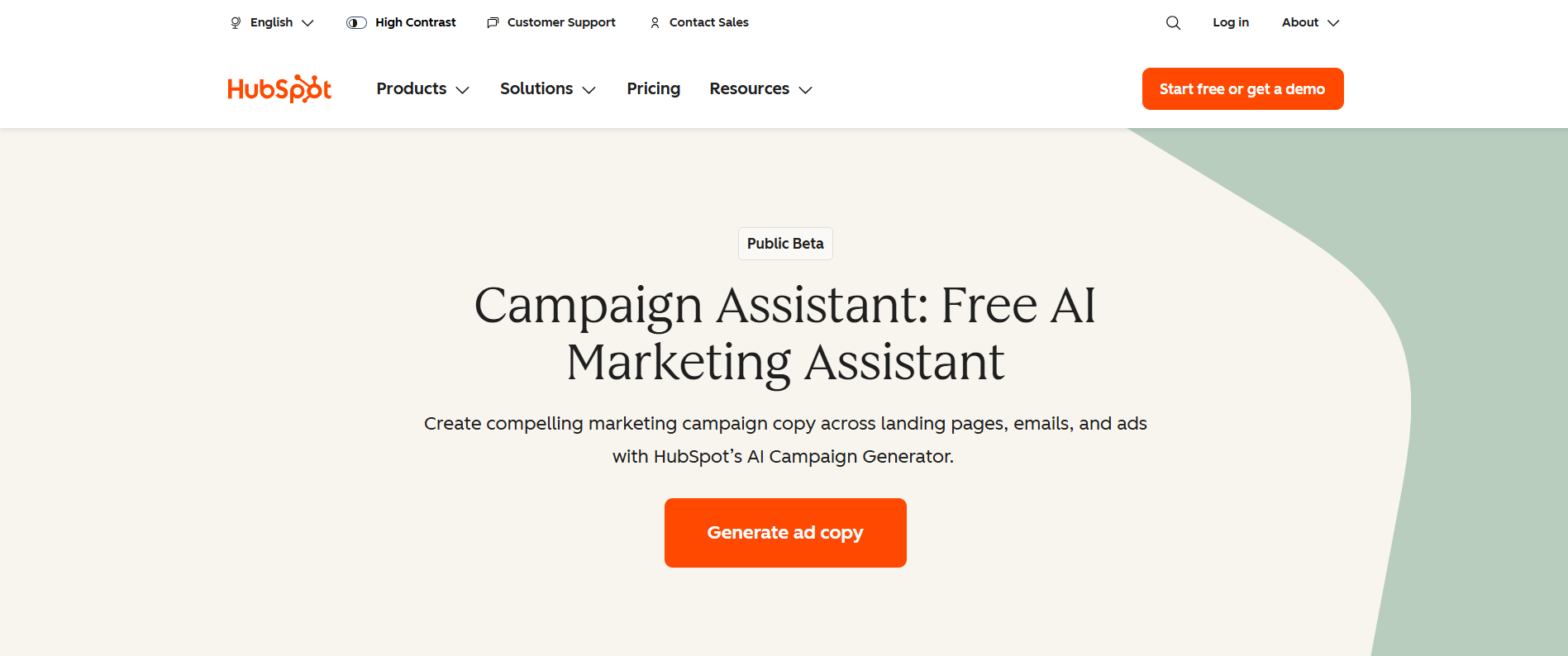
HubSpot Campaign Assistant is a good starting point if you already work in HubSpot and want to generate campaign copy faster. Its appeal is less about having a long feature list and more about fitting naturally into a HubSpot-based marketing workflow.
What can HubSpot Campaign Assistant generate for marketing campaigns?
It can generate copy for marketing emails, landing pages, Google Search ads, Facebook ads, and LinkedIn ads based on your campaign goals, key messages, and preferred tone.
This makes it useful for preparing first drafts and channel-specific variations faster, although the generated content still requires editing for audience relevance and brand positioning.
Can HubSpot Campaign Assistant automate and optimize campaigns?
Campaign Assistant focuses on content creation. Campaign execution, automation, ad management, and reporting are handled through HubSpot's broader marketing platform.
So, if you need AI to manage more of the campaign after the assets are created, you'll need capabilities beyond Campaign Assistant itself.
Who should use HubSpot Campaign Assistant?
It's best suited for existing HubSpot teams that regularly create email, landing page, and ad copy and want to reduce repetitive writing tasks.
That ecosystem is also part of the buying decision. HubSpot has established ratings across software marketplaces, while marketers working with HubSpot's newer AI capabilities have raised practical concerns about more complex AI-driven workflows. If you only need campaign copy, Campaign Assistant keeps things simpler.
Also: If HubSpot is becoming a bigger part of your marketing stack, our guide to HubSpot agencies to watch and work with can help you evaluate partners for implementation and ongoing support.
2. ActiveCampaign: Strong choice for email and lifecycle automation
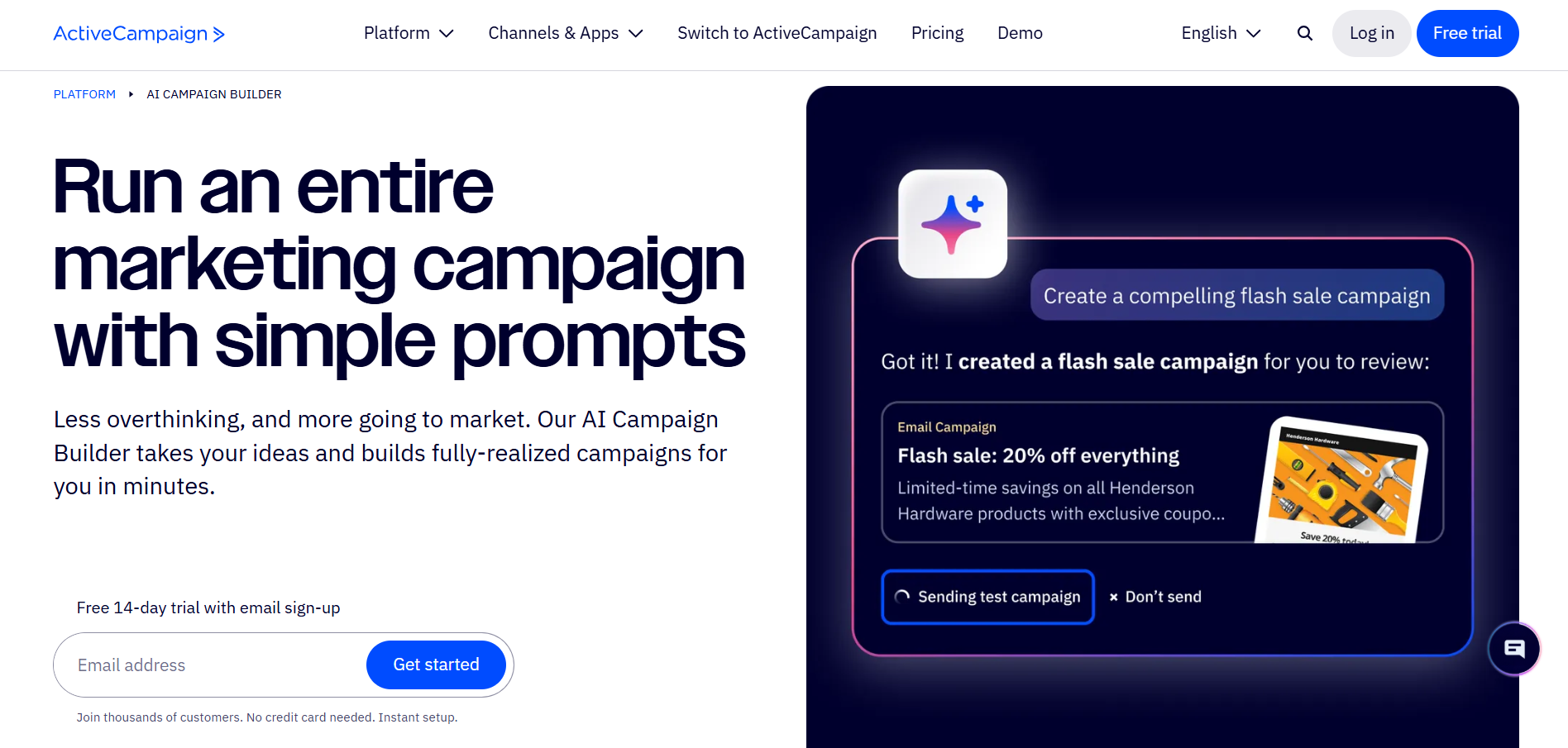
ActiveCampaign goes further than generating campaign copy. Its AI Campaign Builder sits inside a mature automation platform, making it more interesting for teams that want AI involved in both creating campaigns and moving contacts through them.
What can ActiveCampaign generate for marketing campaigns?
ActiveCampaign's AI Campaign Builder can generate email subject lines, preheaders, layouts, images, copy, and CTAs based on your campaign goals. You can then edit the generated assets before publishing.
Its stronger use case is combining AI-generated content with audience segmentation and personalization, allowing teams to tailor campaigns to different customer groups.
Can ActiveCampaign automate and optimize campaigns?
Yes. ActiveCampaign supports multi-step automation, behavioral triggers, audience segmentation, A/B testing, and automated follow-up sequences.
This makes it useful for managing nurture campaigns that respond to customer actions. For instance, a SaaS company could trigger different email sequences based on whether a prospect downloads a resource, attends a webinar, or requests a demo.
However, setting up complex workflows still requires planning. Teams managing multi-step email automations need to define triggers, conditions, and exit points carefully to avoid overlapping or irrelevant messages.
Who should use ActiveCampaign?
ActiveCampaign is a good fit for teams where email marketing, lead nurturing, and lifecycle campaigns are central to customer acquisition and retention.
It's particularly useful when the bottleneck involves segmentation, campaign timing, or repetitive follow-ups. However, teams primarily looking for quick creative generation may find its broader automation capabilities more than they need.
3. Campaign Monitor Marketing Studio: Built for faster branded campaign creation
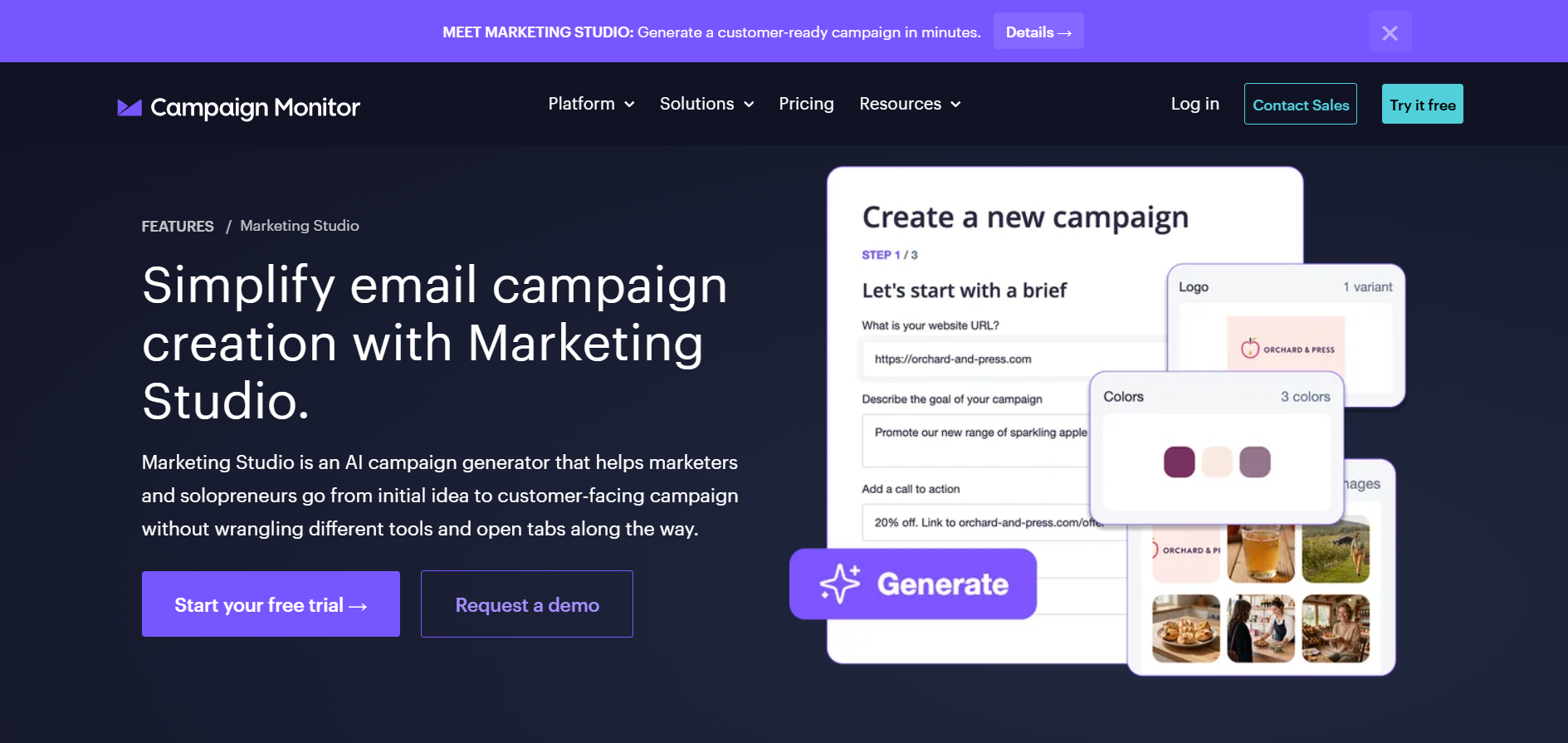
Campaign Monitor Marketing Studio is designed for marketers managing both email copy and creative production. Its main advantage is applying your brand's visual identity and tone to campaign assets, reducing the time spent creating everything from scratch.
What can Campaign Monitor Marketing Studio generate for marketing campaigns?
It can generate branded emails, custom images, banners, translated versions, and social content based on your campaign requirements. You can also edit the generated assets before publishing.
Its Brand Hub pulls logos, colors, imagery, and tone of voice from your website, helping teams maintain consistency without manually applying brand guidelines to every asset.
Can Campaign Monitor Marketing Studio automate and optimize campaigns?
Marketing Studio focuses on AI-assisted campaign creation, while email sending, automation, and performance tracking depend on Campaign Monitor's broader capabilities.
Its Brand Hub helps streamline creative production, although the imported brand kit is view-only. If your branding changes, you'll need to resync it from your website.
As a result, it is better suited to simplifying branded campaign production than managing highly complex lifecycle automation.
Who should use Campaign Monitor Marketing Studio?
Campaign Monitor Marketing Studio is a practical fit for small marketing teams and solo marketers who handle email content, design, and campaign production themselves.
Its straightforward email creation experience is particularly useful for teams without dedicated design or technical resources. However, businesses requiring advanced automation and detailed reporting may find its capabilities limiting.
4. Omneky: Focused on AI-powered ad campaigns
Omneky is built around paid advertising rather than email or lifecycle marketing. What makes it interesting is the range of work it brings together, from developing creative variations to getting approved ads live across multiple channels.
What can Omneky generate for marketing campaigns?
Omneky can turn a campaign brief into image, video, and copy variations tailored to different platforms and audiences. You can also apply brand guidelines for logos, colors, typography, and tone.
This helps paid media teams produce creative variations faster, although assets may still need manual adjustments when the campaign requires a specific visual direction.
Can Omneky automate and optimize campaigns?
Yes. Omneky's Campaign Launcher lets you configure audiences and budgets, then publish approved ads across platforms including Meta, Google, TikTok, LinkedIn, and Reddit.
The platform also scores creatives before launch and uses campaign performance data to inform further iterations. This makes it useful for teams that want AI involved in campaign execution and optimization, beyond generating advertising assets.
This reflects a broader shift toward using AI in PPC management for creative iteration, campaign monitoring, and optimization.
Who should use Omneky?
Omneky is a strong fit for paid media teams and growth marketers running frequent creative tests across multiple advertising platforms.
It's particularly useful when producing ad variations is slowing campaign launches. Teams using Omneky for creative testing may benefit from faster experimentation, although highly specific creative concepts can still require hands-on refinement.
For businesses primarily focused on email nurturing or lifecycle automation, a dedicated marketing automation platform may be more suitable.
5. Anyword: Designed for performance-driven campaign copy
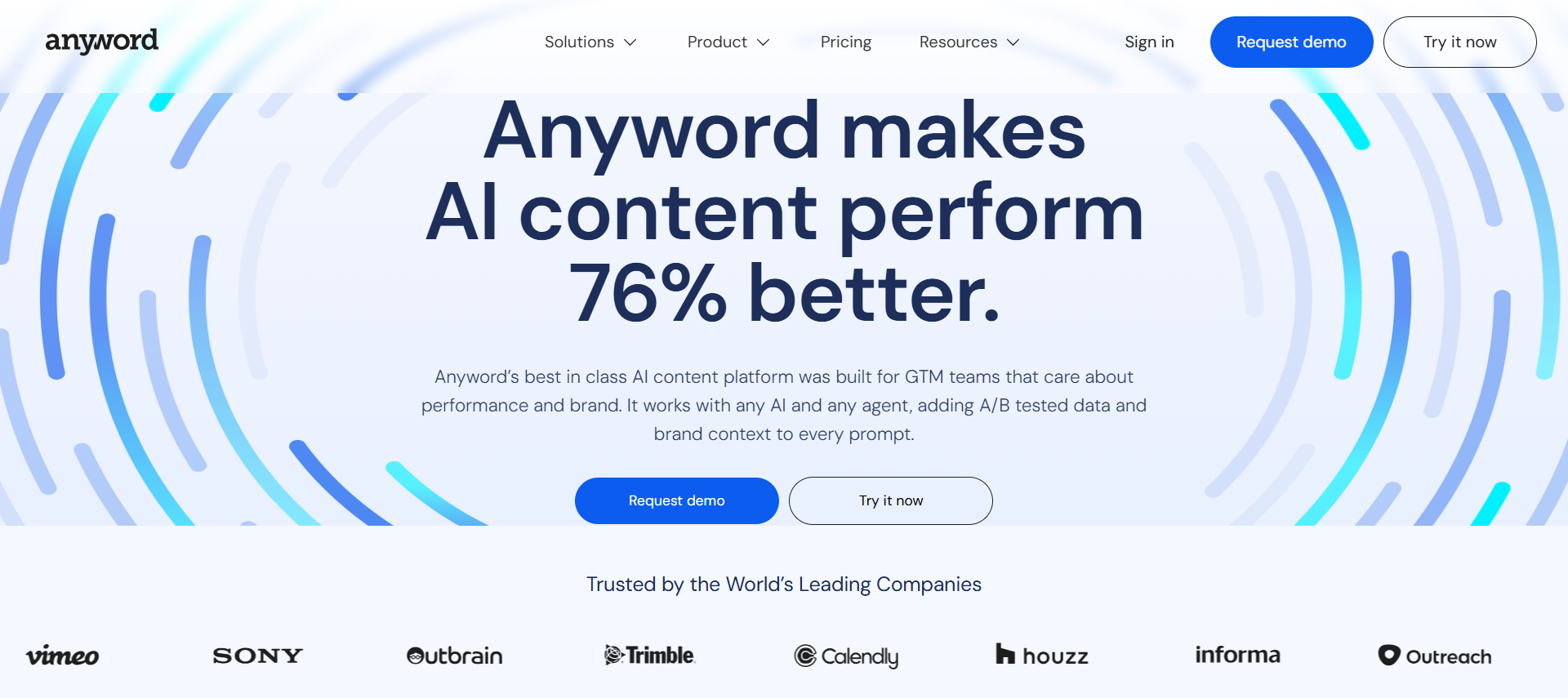
Anyword is built for marketers who want more than AI-generated copy. Its main advantage is predictive performance scoring, which helps teams compare messaging variations before investing campaign budget.
What can Anyword generate for marketing campaigns?
Anyword can generate ad copy, marketing emails, landing page messaging, social posts, and other campaign assets. Its Brand Voice capabilities help align generated content with your messaging guidelines, target audiences, and existing positioning.
The platform also creates multiple copy variations, making it useful for teams that regularly test different headlines, offers, and calls to action.
Can Anyword automate and optimize campaigns?
Anyword uses predictive performance scoring to evaluate generated and existing copy, helping marketers estimate how different messages may perform with specific audiences.
This makes it easier to prioritize variations for testing. However, predictive scores should complement live campaign data, since actual performance also depends on targeting, placement, and offers.
Unlike platforms built for campaign execution, Anyword primarily supports content generation and messaging optimization.
Who should use Anyword?
Anyword is a good fit for performance marketers and growth teams that frequently create and test campaign messaging.
Its predictive scoring capabilities can help teams compare copy variations before launching experiments, although the scores shouldn't replace actual A/B testing.
Teams that need visual creative production, automated customer journeys, or multichannel campaign launching may require additional tools.
6. Jasper: Strong fit for brand-consistent campaign content
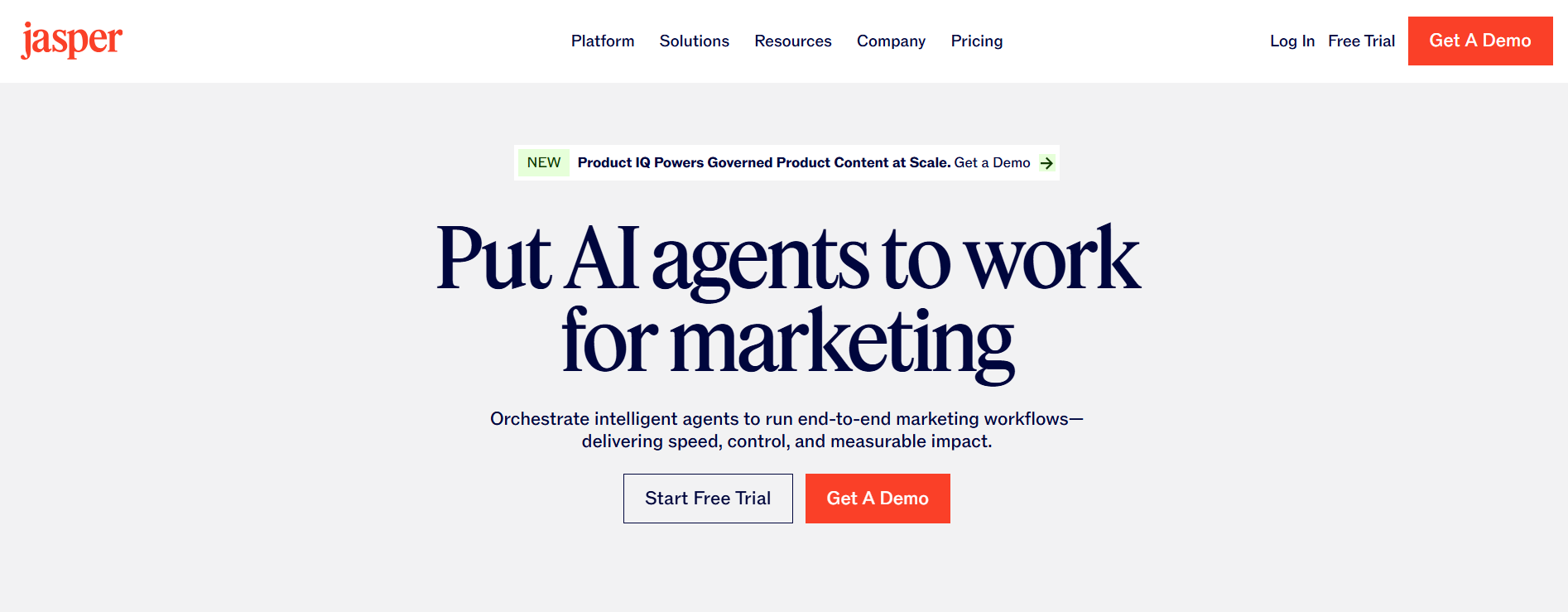
Jasper is built for teams producing content across multiple campaigns, channels, and contributors. Its strength is giving AI enough brand and company context to produce drafts that require less correction before they’re usable.
What can Jasper generate for marketing campaigns?
Jasper can generate ad copy, emails, landing pages, social posts, campaign briefs, and other marketing content. Its Brand Voice capabilities let you define style rules, company knowledge, and audience context that carry across generated assets.
This makes it useful for teams producing campaign content at scale, especially when multiple contributors need to work from the same messaging and positioning.
Can Jasper automate and optimize campaigns?
Jasper supports AI-assisted content workflows, helping teams turn campaign briefs into assets for different marketing channels.
However, its primary focus is content creation and workflow automation. Campaign distribution, paid advertising management, and advanced lifecycle automation generally require additional platforms.
Therefore, Jasper works well for coordinating campaign content production but does not independently manage the complete campaign lifecycle.
Who should use Jasper?
Jasper is a good fit for content marketers and campaign teams producing large volumes of assets while maintaining a consistent brand voice.
Its structured approach to brand consistency can be valuable when several contributors work on the same campaigns. However, AI-generated content still requires human editing, particularly when communicating complex product benefits or audience-specific messaging.
Teams primarily looking for automated campaign launches or advanced performance optimization may need a more execution-focused platform.
7. AdCreative.ai: Built to scale ad creative production
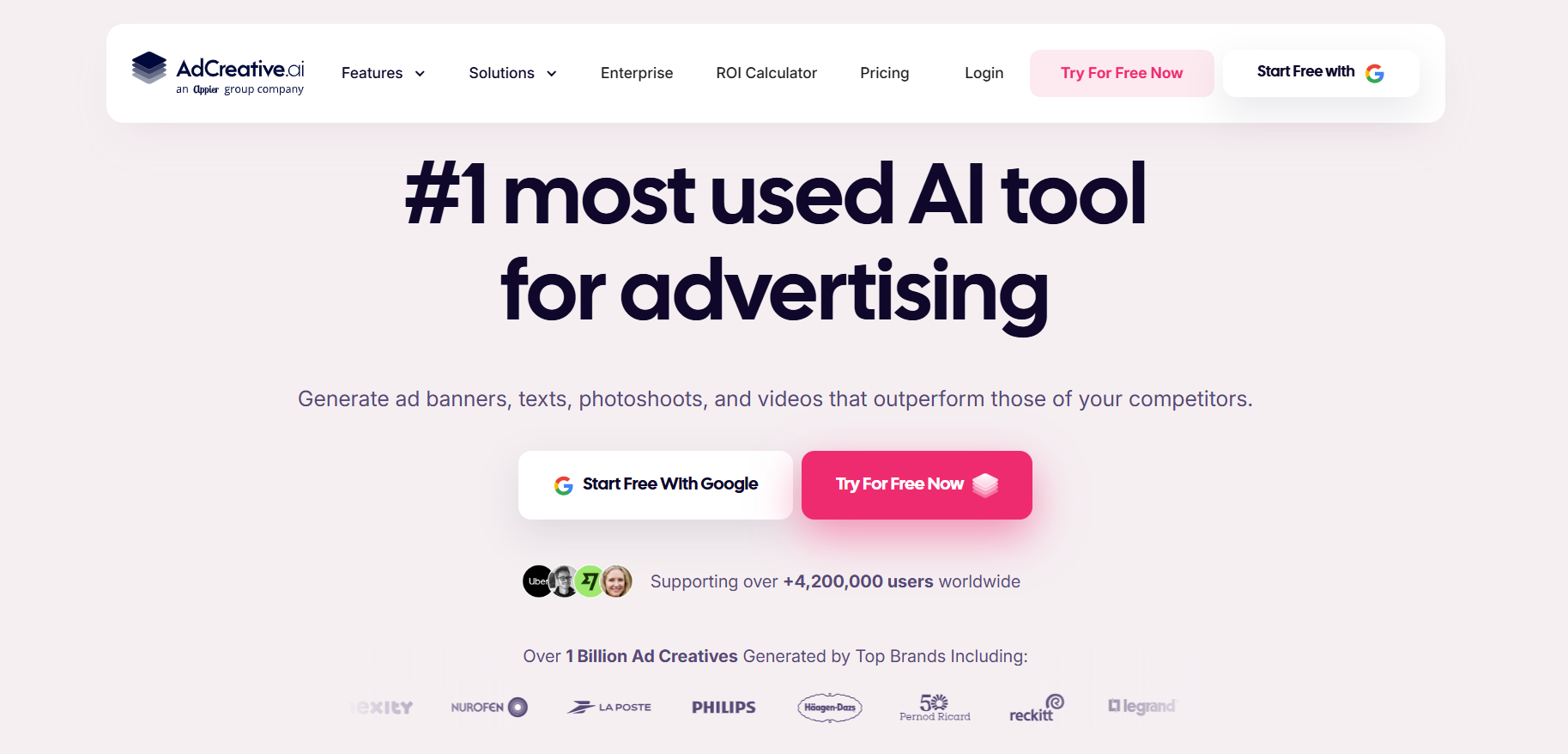
AdCreative.ai is aimed at teams that need a steady flow of paid ad creatives without designing every variation from scratch. Its strongest use case is taking brand assets and turning them into multiple creative options for testing across ad platforms.
What can AdCreative.ai generate for marketing campaigns?
AdCreative.ai can generate ad creatives, banners, product images, videos, and ad copy in different sizes and formats. You can apply brand colors, fonts, logos, and other visual guidelines to maintain consistency.
This makes it useful for teams producing high volumes of advertising assets, although more distinctive creative concepts may still require manual design adjustments.
Can AdCreative.ai automate and optimize campaigns?
AdCreative.ai uses predictive creative scoring to help marketers evaluate and prioritize ad variations before testing.
You can also connect advertising accounts to analyze existing creatives and identify elements associated with stronger performance.
However, these scores should support actual campaign testing, since audience targeting, offers, and placements also influence how ads perform.
Who should use AdCreative.ai?
AdCreative.ai is a good fit for paid media specialists and growth teams that regularly need fresh creative variations for testing.
Its ability to produce ad creatives at scale can help reduce repetitive design work, although teams may still need hands-on creative direction for more specific campaigns.
If your primary challenge involves lifecycle automation, campaign orchestration, or advanced copy development, other tools on this list may be more suitable.
How to choose the right AI campaign generator
Start with the campaign bottleneck you actually need to solve, whether that’s copy, creative production, lifecycle automation, or paid campaign execution. Then decide how far you want the tool to go. Some AI campaign generators stop at asset creation, while others can manage audiences, workflows, launches, and optimization.
Check how well each option fits your existing CRM, automation platform, ad accounts, and analytics setup. Brand controls, approval workflows, and human oversight also matter if AI-generated assets are going live at scale.
AI campaign generators can reduce production time, but campaign performance also depends on audience targeting, execution, and measurement. RevvGrowth connects these activities through B2B SaaS demand generation, helping teams translate campaign activity into qualified pipeline opportunities.
Need help turning campaign activity into qualified pipeline opportunities?
Talk to RevvGrowthFrequently Asked Questions (FAQs)
An AI campaign generator uses your goals, audience, offer, and brand context to create marketing campaign assets. Depending on the tool, it can also support personalization, automation, launching, and optimization.
Some tools can support most of the campaign workflow, but few handle everything. Human input is still important for strategy, positioning, approvals, and final decisions.
They can create emails, ad copy, landing page messaging, social content, images, videos, and campaign variations. More advanced platforms can also build segments, workflows, and personalized experiences.
Some can. Platforms with execution capabilities can send emails, trigger workflows, manage audiences, or launch ads, while others stop at content and creative generation.
ActiveCampaign is suited to email and lifecycle automation, while Campaign Monitor Marketing Studio focuses on branded email creation. HubSpot Campaign Assistant is useful for generating email copy within a HubSpot-centered workflow.
Yes. Many tools let you define brand voice, messaging, visual guidelines, and company context. Human review is still important before generated assets go live.
Yes, when they solve a clear campaign bottleneck. They can reduce time spent on content production, personalization, creative variations, and repetitive campaign work.